What does 'Euclidean' actually mean on a drum machine?
The term comes from a 2005 paper by computer scientist Godfried Toussaint, "The Euclidean Algorithm Generates Traditional Musical Rhythms," which showed that spacing a number of hits as evenly as possible across a number of steps produces patterns that already exist across musical traditions: the Cuban tresillo, West African bell patterns, Balkan additive meters. Modular manufacturers turned that math into a knob years ago, Euclidean sequencer modules generate a pattern from just two numbers (hits and steps) instead of programming every step by hand, and it's why Elektron boxes like the Digitakt and Analog Rytm carry a Euclidean mode of their own. AudioThing's new plugin, Orbita, takes that same logic and puts it in front of anyone with a DAW or an iPad, no patch cables required.
What's actually inside Orbita?
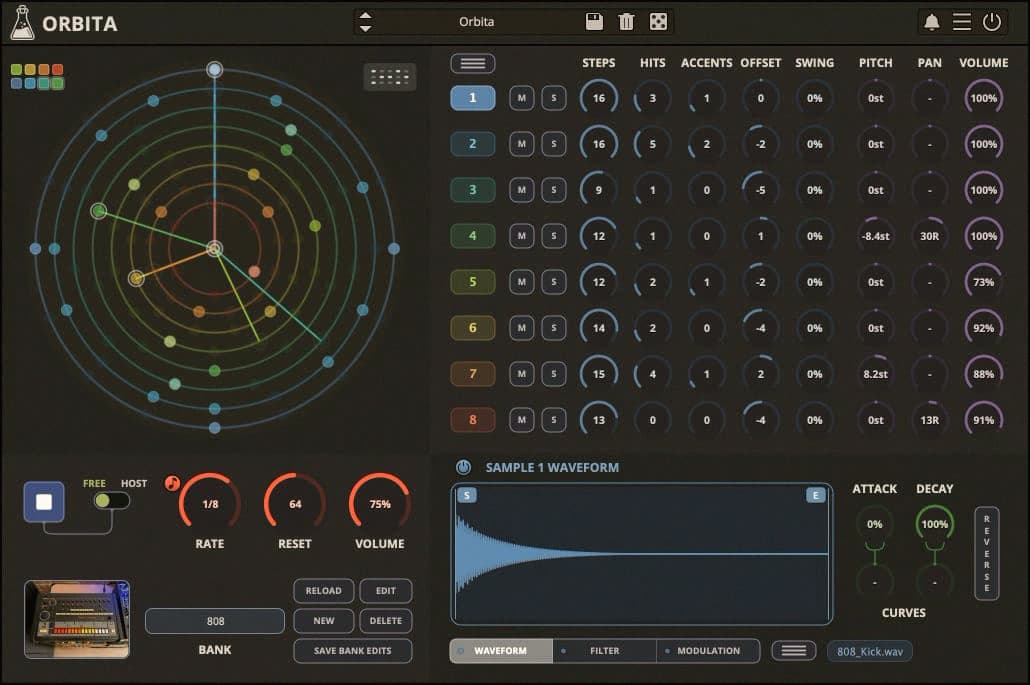
Orbita is built around eight sample tracks arranged on a circular sequencer, each one gets its own hits and steps count, so patterns interlock into polyrhythms rather than lining up on the same grid. Every track carries a 2-pole or 4-pole filter and an attack/decay envelope with a reverse option, plus a multi-wave LFO that can be routed to pitch, pan, volume, cutoff or resonance. Offset rotation, accent control and swing sit on top, and mute/solo buttons make it workable live. The plugin ships with 36 factory drum kits pulling from machines like the 808, CR-78, DR-220A and Ult-Sound DS-2, and a drag-and-drop editor lets producers load their own one-shots instead. It runs as VST2/VST3/AU/AAX/CLAP on macOS, Windows and Linux, and as a separate iOS/iPadOS app (AUv3 and standalone) for $9.99 on the App Store.
The pitch is polyrhythm and swing generated automatically, then shaped per track, not programmed step by step.
Why does the price actually matter here?
Because Euclidean sequencing has mostly lived behind a modular tax. A single hardware Euclidean sequencer module with a handful of channels routinely runs past €200, before you own anything to trigger with it. Orbita covers eight tracks, filters, an LFO per track and 36 drum kits for an introductory €39 (rising to €69 once the launch window closes), and the same idea runs on an iPhone for $9.99. That's not a new algorithm, Toussaint's paper is two decades old and modular racks have sold this exact trick for years, but bundling it with real drum samples and desktop-to-phone parity turns a modular party piece into something a house or techno producer can just open in Ableton or Logic on a Tuesday.