What's actually different from an LFO or step sequencer?
A standard LFO repeats the same shape forever. A step sequencer locks modulation to a discrete grid you punch in by hand. Sinusoidal Run Rhythm throws out both premises. It's built on Steffen Krebber's theory of the same name, which treats rhythm as a continuous wave generated by adding multiple in-phase cosine functions in integer frequency ratios, rather than a series of fixed on/off steps. In Krebber's own words, the approach "does not conceive of time as discrete subdivisions, but makes it continuously quantifiable."
"It does not conceive of time as discrete subdivisions, but makes it continuously quantifiable."
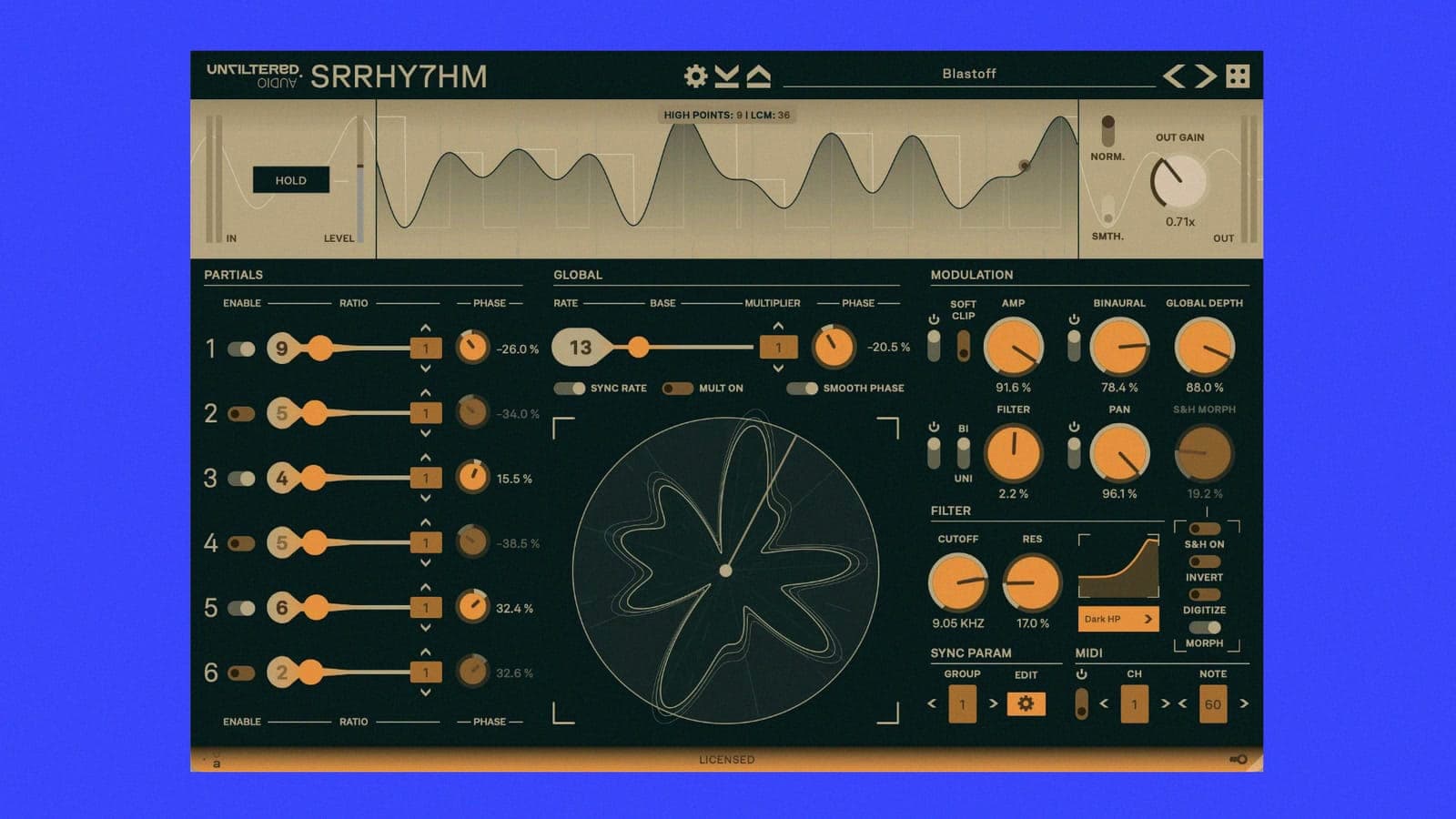
Practically, that means the peaks of the resulting pattern shift and interact instead of repeating identically bar after bar, even though the whole thing is fully deterministic and can be locked to MIDI. Unfiltered Audio built the plugin, called SRRhythm for short, around six sine-based partials that can each be switched on or off, tuned to an integer ratio as high as 64, multiplied up to five times, and phase-shifted independently. Stack a few of those against each other and you get an interference pattern that keeps evolving rather than looping.
Why should a house or techno producer care?
Most modulation on a dance floor track still comes from the same handful of sources: a synced LFO, a step sequencer, or a handful of envelope followers. That's fine for a kick and a hat, but it's also why so much modulated percussion across deep house, minimal and techno ends up sounding like the same three plug-ins wearing different presets. Sinusoidal Run Rhythm gives producers a mathematically distinct source of groove instead, one built for exactly the kind of microtimed, slightly-off-grid feel that experimental deep house and IDM-adjacent house producers chase by hand-automating parameters for hours. Because the wave interference produces what Unfiltered Audio calls microtemporal rhythmic grids, a percussion loop, a filtered pad or a vocal chop run through it can pick up a pulse that never quite repeats without ever losing sync to the track.
What's actually inside the plugin, and what does it cost?
The modulation engine routes into a set of built-in effects: an amplifier with soft clipping, a binaural offset, a multimode filter, and a panner, so the wave interference isn't just a modulation source, it's a full rhythmic FX chain. A sample and hold processor morphs the underlying waveform between sine, square and hybrid shapes, and everything can be automated over MIDI. Unfiltered Audio ships it two ways: the full plugin at 39.95 euros, or a MIDI-only version at 12.95 euros for producers who just want the wave-interference engine driving outboard gear or other plugins. Both are VST2, VST3, AU and AAX for macOS and Windows, and a free demo is available directly from Unfiltered Audio.