What does splitting a sound into eight rhythmic bands actually do?
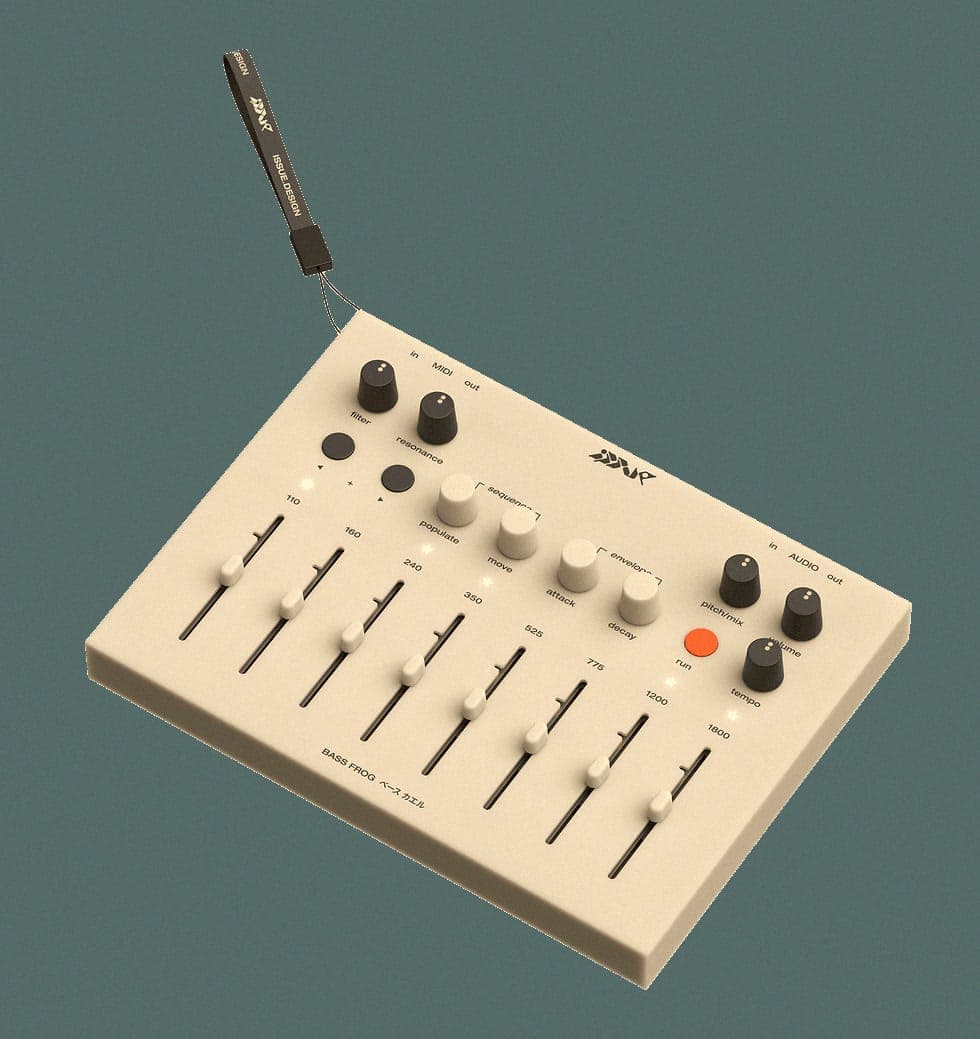
Feed a sound into BASS FROG, either its own internal oscillator or an external line such as a vocal, a break or a bassline from another machine, and it gets carved into eight fixed frequency bands running from 110 Hz up to 1800 Hz. That much is standard filterbank behaviour, the same trick vocoders and rack filterbanks have used for decades to split a signal into its frequency components. What's different here is that each of the eight bands doesn't just sit there loud or quiet: it runs its own independent Euclidean rhythm pattern plus its own attack/decay envelope. Push one sustained pad through BASS FROG and the low band can pulse four even hits a bar while the top band ticks out a completely different Euclidean division, all from a single static input.
That's the practical pitch for a live set: instead of racking up a case of Euclidean sequencer modules or opening a laptop to automate a filter sweep, one compact box turns a static sound source into a moving, polyrhythmic texture, hands-on and in real time.
Why does a filterbank matter to acid and techno producers specifically?
Filterbank processing is one of the oldest tools in dance music. The resonant sweep on a 303 is functionally a one-band version of the same idea, and rack filterbanks have been turning static pads into pulsing basslines since long before house and techno had names. issue.design, the Berlin studio that also designed the Nonlinear Labs C25, is betting that giving every band its own Euclidean clock instead of one shared LFO or envelope is the piece nobody had packaged into a compact box yet. The filters are morphable per band too, from a classic ladder-style character to a resonant twin-peak shape, so the eight bands can differ in tone as much as in rhythm.
Why no screen?
BASS FROG ships with no display at all. An animated LED strip runs above each of the eight bands instead, doubling as a level meter and a rhythm indicator. Sliders, knobs and a "fader strike" performance mode make up the whole interface, and the unit takes MIDI notes, CC, clock and transport, with automatic local takeover the moment you touch a physical control mid-performance. It's the same tactile-first logic that defines the C25: no menu diving mid-set, every parameter mapped to something you can grab without looking down.
issue.design hasn't confirmed pricing or a release date yet; the company is running an early-bird waitlist for the launch price ahead of the actual drop.