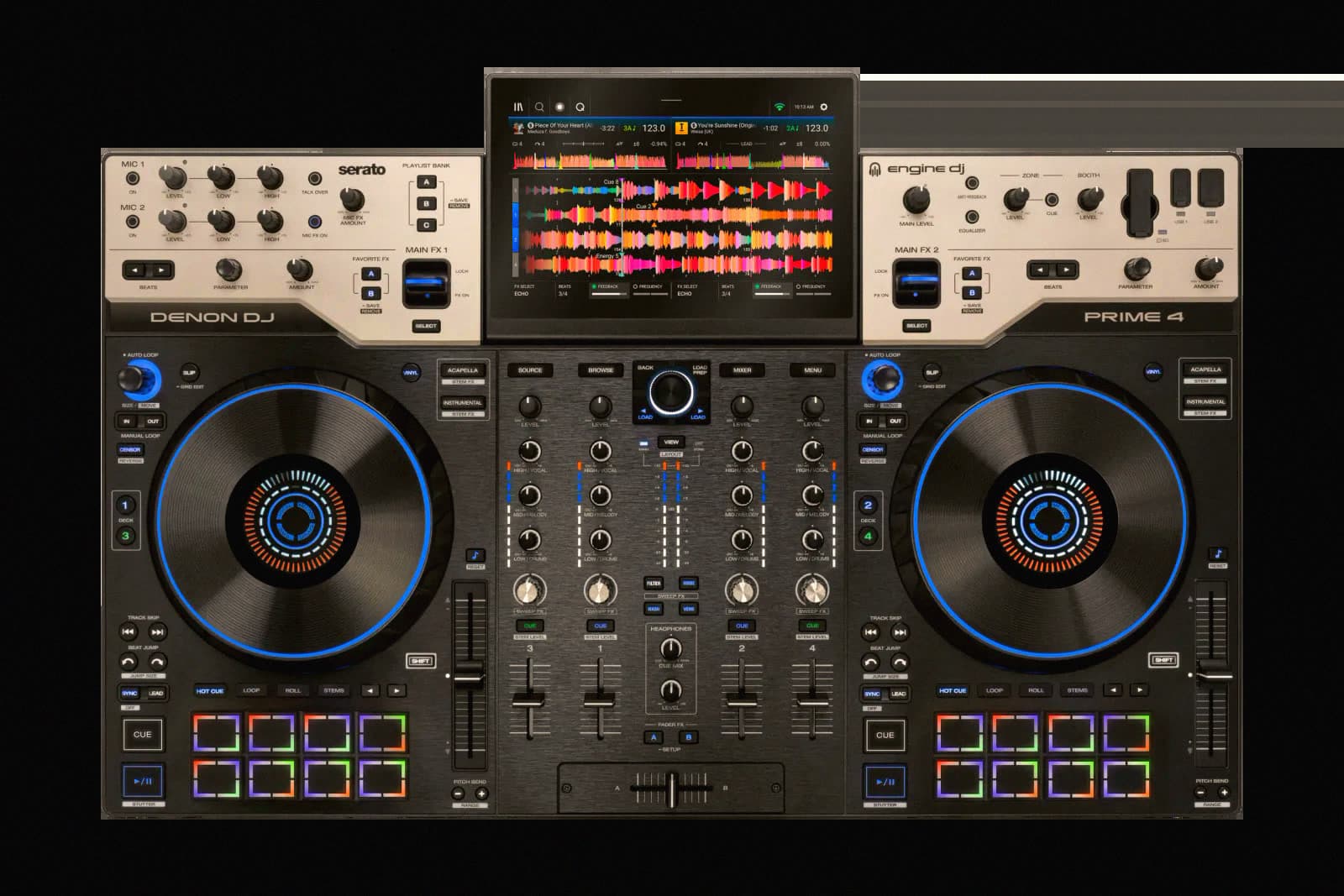
Behringer didn't send out a press release. It just dropped prototype photos on its own Facebook page, the way it has for synths and mixers for years, and let the DJ internet do the rest. Within hours the ANIMA photos were all over r/DJs, and the reason is obvious: a standalone system with real I/O for roughly a third of what a flagship AlphaTheta or Denon rig costs, with a promise that nobody owns your workflow.
What is Behringer actually showing?
The units in the photos are bare prototypes, not finished units; they carry an ANIMA badge on top and a Klark Teknik logo on the rear panel, Klark Teknik being the Music Tribe-owned brand Behringer has used before for pro-audio gear. Each deck gets eight pads and a long-throw pitch fader, and a touchscreen sits in the center that reportedly folds flat when not in use. Round the back there's a bay marked HARD DISK, a USB port, an Ethernet jack, a row of line outputs, XLR outs and two mic inputs, the kind of connectivity you'd want for an actual booth, not a bedroom toy.
The jog wheel wells, notably, are empty in every photo. Nobody, including DJ TechTools, is confirming motorized platters are even feasible at this price; a static or belt-driven wheel is the more likely bet. There's also no firmware shown running anywhere. This is a chassis and a pitch, not a product.
Why open hardware, and why now?
Music Tribe's framing leans hard on "no proprietary lock-in": the company says it intends to publish ANIMA's schematics and bootloader to GitHub under an AGPL-3.0 license, and that the box is meant to run alongside existing platforms like Serato and Traktor rather than force users into a closed app. Behringer has also been steering hardware requests, like swappable crossfaders or motorized platters, into Music Tribe's open source Discord rather than a product roadmap document.
"We build the hardware. You create the magic."
That's the line Behringer itself is using, and it's the same undercut-the-incumbent playbook that turned the company into a synth-market disruptor: copy the workflow everyone already knows, strip the margin, and let the community build what the first-party software won't. AlphaTheta and Denon have built entire standalone ecosystems, Rekordbox and Engine DJ, around keeping DJs inside their own software and hardware. A $300 to $400 box that explicitly refuses to do that is a direct shot at that model, if it ever ships.
What's still unknown?
Everything that actually makes a standalone system usable on a real night out. There's no confirmed release date, no final retail price (DJ TechTools reports Behringer itself walked the figure down from $400 to $500 to $300 to $400 within an hour of the first post), and no firmware anyone has seen running. Gearnews' corroborating report adds that the system is pitched as Serato and Traktor compatible, but neither outlet has seen that integration demonstrated. Until Behringer shows a working unit, ANIMA is a tease, not a launch.
Why it matters
If Behringer ships anything close to what the photos show at anywhere near $300 to $400, it resets the price floor for standalone DJ hardware the way the company's synth clones reset the floor for Eurorack. Even if it doesn't ship at all, the reaction proves working and bedroom DJs alike are hungry for cheap gear that doesn't lock them into one software ecosystem, and that's a pressure AlphaTheta and Denon will feel regardless.
What we think
Behringer has teased plenty of prototypes that quietly vanished, so treat the price and the spec sheet as aspirational until a unit actually boots. But the instinct behind ANIMA, an open, non-proprietary standalone, is overdue; the big standalone players have gotten comfortable charging a premium for walled gardens, and a credible threat to that, even an unfinished one, is good for every DJ who isn't buying the flagship.