Behringer built its name on recreating other companies' synths for a fraction of the price, which has made "clone" the word that follows the brand everywhere. The AQ64L, unveiled November 11, doesn't try to dodge that reputation. It leans into a different one: give the hardware away to the people who'll actually hack on it.
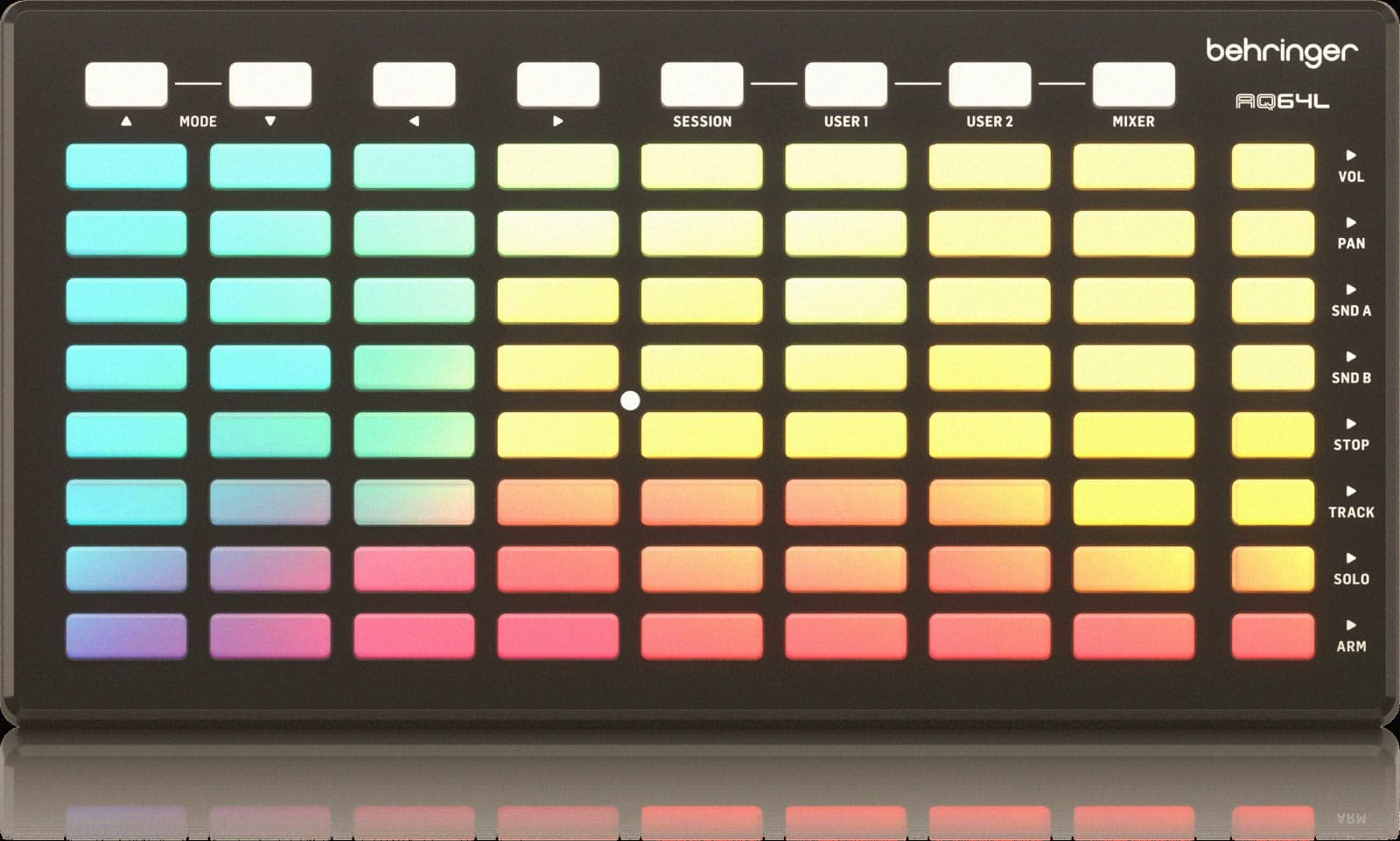
The device itself is a familiar shape. An 8x8 grid of RGB pads for launching clips and MIDI events, eight buttons dedicated to volume, pan and sends, plus navigation and session/mixer-view controls, is the exact layout Akai popularized with the APC line and the APC mini in particular. Behringer isn't hiding the target: it's positioning the AQ64L as the cheaper way into that same workflow, minus the nine faders Akai keeps on its own box. USB-C bus power and full class compliance mean it talks MIDI to a laptop, a phone or an iPad (with an adapter) with zero drivers.
What's actually open here?
The part worth paying attention to isn't the grid, it's what Behringer put on GitHub alongside it. The repository, published under Music Tribe's open-source account, hands over the main-board schematic for the digital section, a working example firmware for the onboard GD32F350 chip (a 128KB-flash Cortex-M4), and the signing and upload tools needed to flash a custom build without a hardware debug probe. The code is AGPLv3, the hardware docs are CC BY-NC-SA 4.0.
The nuance that matters: the AQ64L's factory firmware isn't itself open source. Behringer still ships and signs that from the box. What's public is a developer kit, meaning you get everything required to write your own firmware from scratch and run it on real hardware, not the company's actual production code. That's a meaningfully smaller gift than "fully open firmware," but it's also a bigger one than the zero gearheads usually get from a MIDI controller maker: a schematic and a toolchain, not a locked bootloader and a support ticket.
Gearnews put it bluntly: the firmware "is already on GitHub if you want to start coding it with vibes."
Does this actually move the clone debate?
For a brand whose entire catalog is built on recreating other people's circuits, publishing your OWN schematic is a genuinely different posture, even a small one. It costs Behringer nothing it can't recoup on volume, and it buys goodwill with exactly the DIY crowd that has spent two decades calling the brand a parasite on better engineers. Whether that's enough to flip the reputation is a separate question. One open-firmware grid controller doesn't erase a back catalog of 303s and 808s built from other people's reverse-engineered designs. But it's a real data point in a debate that usually runs entirely one direction.
Who should actually want one?
Anyone building a live-looping or clip-triggering rig who doesn't need faders is the obvious buyer, assuming the price lands where everyone expects. The more interesting buyer might be the firmware tinkerer who never had a reason to open a MIDI controller's case before: an 8x8 RGB grid with documented hardware and a buildable toolchain is a cheap platform for building something that isn't a clip launcher at all.