Behringer's entire business model, for two decades, has been reverse-engineering other companies' hardware and selling it cheaper. The Behringer KICK breaks that pattern in a way nobody saw coming: the company isn't just copying an MPC-style groovebox, it's giving away the code that runs it.
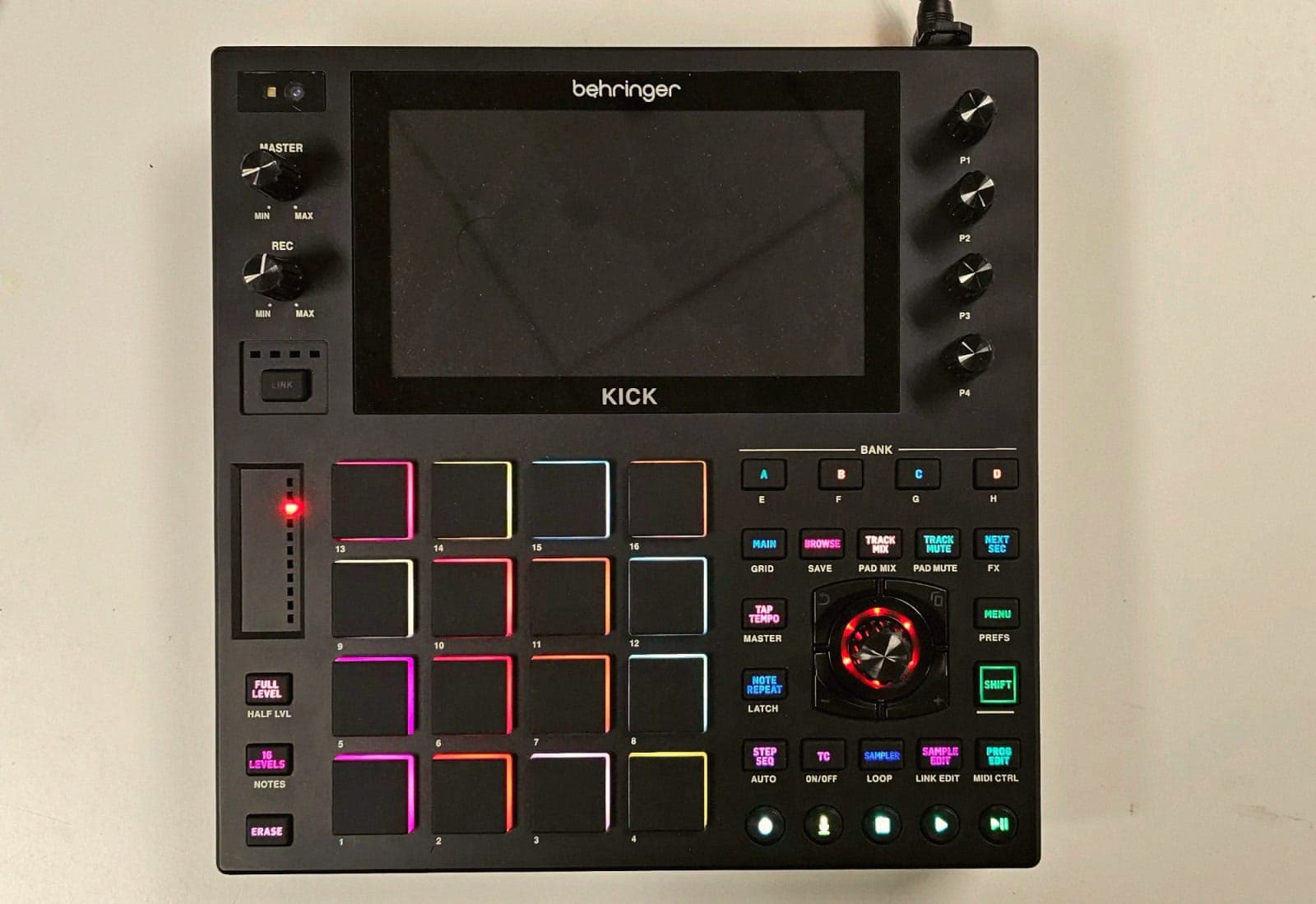
The KICK itself reads like a budget MPC One with extras: a 7-inch touchscreen, 16 RGB pads spread across eight banks, an integrated sampler with full sample editing, a step sequencer, a looper and more than 300 built-in effects. Four assignable knobs and a jog wheel handle the hands-on work, there's a touch strip for expressive control, and an AI camera reads gestures. Round the back: MIDI In/Out, USB-A, USB-C, stereo audio I/O, an SD card slot and four CV/Gate jacks for talking to modular gear. On paper, that's a serious list of specs at a price point Behringer has built its name on undercutting.
Why does the license matter more than the hardware?
Any company can stuff pads and a touchscreen into a box. What's different here is that Behringer published the full firmware, the application layer, the audio engine and the communication protocol, as open source on GitHub, at MusicTribeOpenSource/0700-AAM, licensed under AGPL-3.0-or-later. The system boots Linux through Buildroot, which means the KICK is a real embedded Linux machine, not a walled-garden chip running code nobody outside the factory ever sees.
AGPL specifically forces anyone who modifies the code and runs it as a service to publish those changes too, it's one of the strongest copyleft licenses available. Choosing it signals Behringer isn't doing a token gesture: it's inviting the community to actually fork, rebuild and redistribute what runs on this hardware. Compare that to Akai's MPC line, where the OS is closed and firmware updates arrive on Akai's schedule only. This isn't Behringer cloning the MPC's industrial design, it's Behringer opening a door Akai has kept shut.
"Making the firmware open-source is interesting, it could set a precedent for how hardware development should work."
What changes for producers if the brain is hackable?
Once firmware is open, the ceiling on a device stops being whatever the manufacturer shipped on day one. Independent developers can patch bugs Behringer never gets to, build entirely new sequencing modes, write custom effects chains, or strip the AI camera gimmick out entirely if it's not useful to them. The CV/Gate jacks suddenly matter more too, because a hackable brain means custom modulation routings and integrations with modular rigs that the stock firmware was never designed for.
Uli Behringer framed the bigger picture around AI and abundance rather than firmware specifically: "The biggest threat to business isn't AI. It's abundance," he said, adding, "I believe the greatest AI revolution won't be replacing humans. It will be unlocking the creator in every human being." Whatever the motive, the practical effect for anyone making beats on a budget is the same: a cheap groovebox whose software evolves at the pace of its community, not at the pace of a corporate roadmap.
Why it matters
If open firmware on a budget groovebox works and other manufacturers feel pressure to match it, the entire hardware-sampler category could shift from closed black boxes to platforms the community actively extends, the same shift that happened to routers and smart-home gear a decade ago.
What we think
This is the most interesting thing Behringer has done that isn't a clone. The company's reputation is built on taking someone else's R&D and racing it to the bottom on price, so watching it choose AGPL, the license that most aggressively protects community contributions, feels almost out of character, and that's exactly why it's worth paying attention to.