Why did producers never let the BCR2000 die?
Behringer discontinued the BCR2000 years ago, but the used market never got the memo. The 2004 controller built its reputation on sheer density: 32 rotary encoders wrapped in LED rings, wired for deep, low-latency MIDI CC and NRPN control at a price that undercut anything else offering that much hands-on surface. Modular and semi-modular users adopted it as a universal patch-and-tweak panel, the kind of box you leave permanently mapped to a rack of Eurorack modules or a software synth's every parameter. That density is exactly what a mouse and a plugin GUI can't replicate: eight, sixteen, thirty-two knobs your hands can find without looking.
The cult status went further in 2014, when Christian Stocklmeier of ZAQ Audio wrote the Zaquencer, alternative firmware that reflashed the BCR2000 into a standalone 32-step sequencer, no computer required. It spread through modular forums as one of the best-kept tricks for getting real hands-on sequencing out of cheap, discontinued hardware.
What does the Zaquencer actually add?
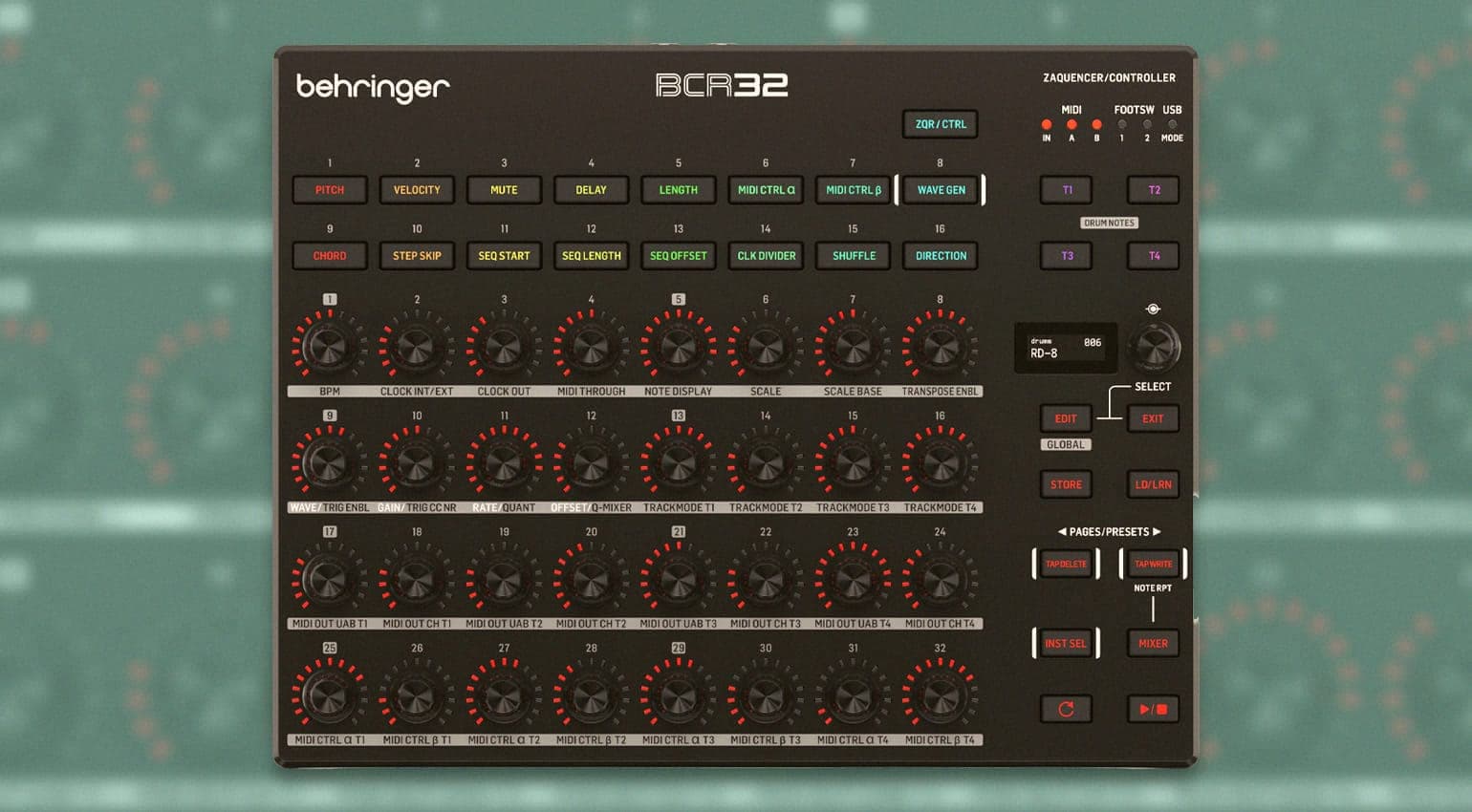
Behringer's answer to over a decade of that grassroots hack: partner with Stocklmeier and build his firmware in from the factory. The BCR32 switches between two personalities with a single button. As a controller, it is the BCR2000's descendant, 32 encoders across four rows feeding MIDI CC and NRPN over two USB-C ports or full 5-pin MIDI (in, out A, out B/thru). Press the button and it becomes a 4-track, 32-step hardware sequencer with a small OLED display, 16 rubberized buttons handling functions like mute and shuffle, four dedicated T1 to T4 track buttons, and storage for up to 192 patterns onboard.
The genuinely new part is on the back panel: four CV/Gate outputs, something the original BCR2000 never had. That turns the sequencer half from a MIDI-only tool into something that can drive analog synths and modular gear directly, alongside two footswitch inputs and sync in/out for locking to other hardware.
A control surface that quietly became a cult sequencer through a decade of community firmware hacks now ships that sequencer built in, on purpose.
What does this signal about Behringer's strategy?
The BCR32 fits a pattern Behringer keeps repeating: take a piece of hardware with a devoted but shrinking user base, rebuild it cheaply, and ship it at a price that makes the original's collector-market value look absurd. It did it with Minimoog and TR-808 style clones; it is now doing it with a MIDI controller whose real afterlife was a third-party firmware mod. At 169 euros for a unit that is simultaneously a dense encoder controller and a standalone CV/Gate sequencer, Behringer is not just reviving a discontinued product, it is formalizing a hack the community built for it for free and crediting the person who built it.
For studios built around modular and semi-modular gear, that combination, hands-on control plus a sequencer that doesn't need a laptop open, is the actual pitch. Whether Behringer can ship it on the timeline it promises is a separate question, one this product's own history makes worth asking.