Why did it take nine months to actually ship?
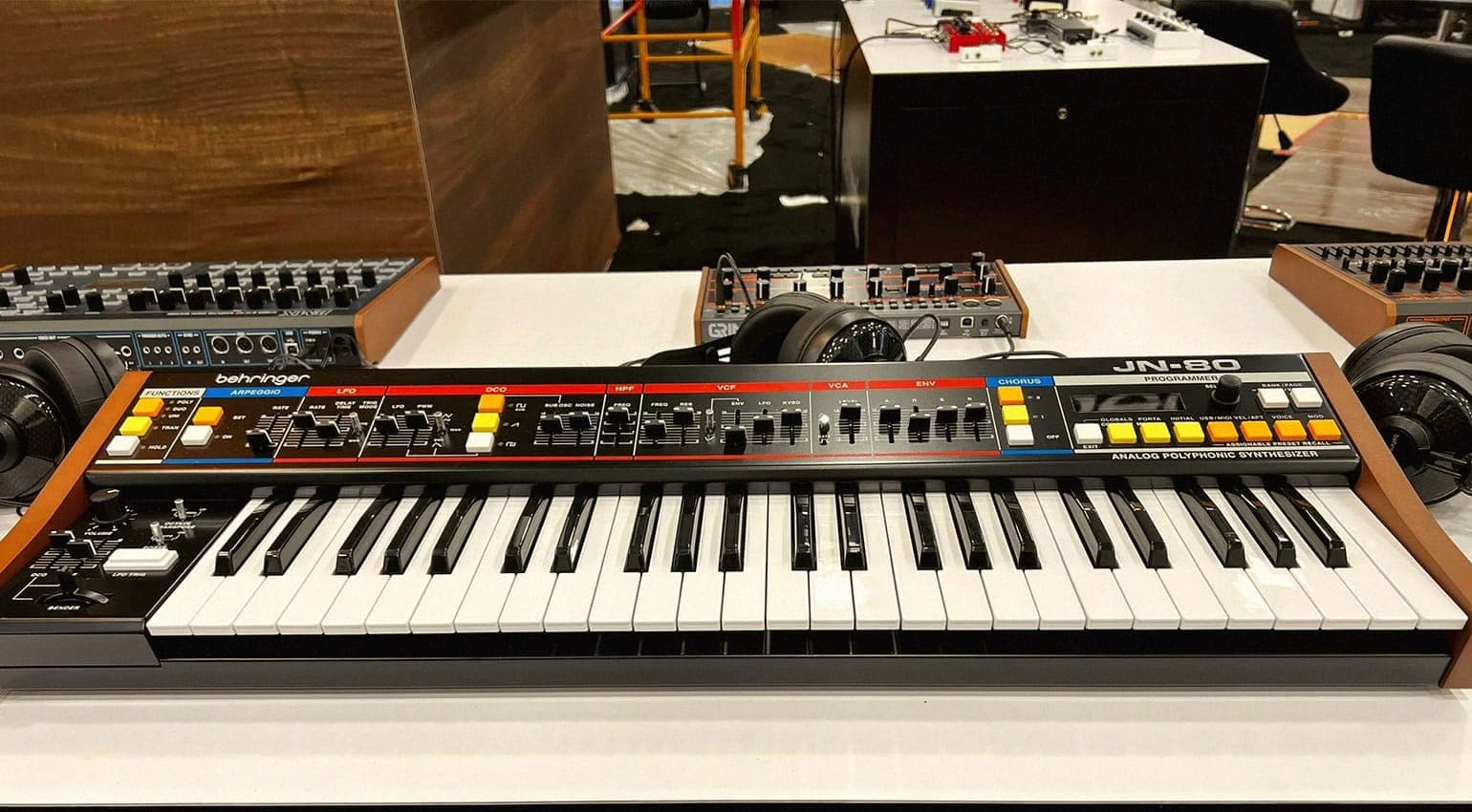
Behringer teased the JN-80 back in late January 2026, the latest in its long run of affordable clones of synths most producers will never own an original of. Behringer builds a reputation on cloning gear cheap, but it also builds a reputation on long waits between the press release and the actual box landing on a doorstep. The JN-80 clones the Roland Juno-60, the chorus-soaked analog polysynth that shaped early house and new wave alike, and it spent most of 2026 as a rumor with a price tag attached. As of October 15, 2026, that's over: EU buyers can now actually get one, listed in Germany at 559 euros, down from the 569 euros (or 569 dollars outside the eurozone) quoted at pre-order.
What do two extra voices actually buy a producer?
The original Juno-60 shipped with six voices, enough for a tight chord before you ran out of notes. The JN-80 bumps that to eight, which sounds like a spec-sheet footnote until you actually play a pad patch: two more voices means two more notes held at once, which is the difference between a thin triad and a full extended chord ringing through that same Juno chorus. For deep house, where a huge, slowly moving pad often carries the whole arrangement, that headroom matters more than almost any other spec on the sheet.
What's actually under the hood?
Behringer kept the architecture that made the Juno-60 a workhorse: saw and square waveforms with pulse-width modulation, a sub-oscillator, a dedicated noise generator, and a 24dB-per-octave ladder-style filter voiced after the original. A 49-note keyboard adds velocity and aftertouch the Juno-60 never had, and the front panel trades the original's sliders for an LCD display and encoder, with 400 preset slots and a Compare/Match function for dialing a patch back against a saved version. The chorus circuit, the one effect that made the Juno-60 instantly recognizable, is reproduced faithfully, and Behringer threw in a built-in arpeggiator the original never had either.