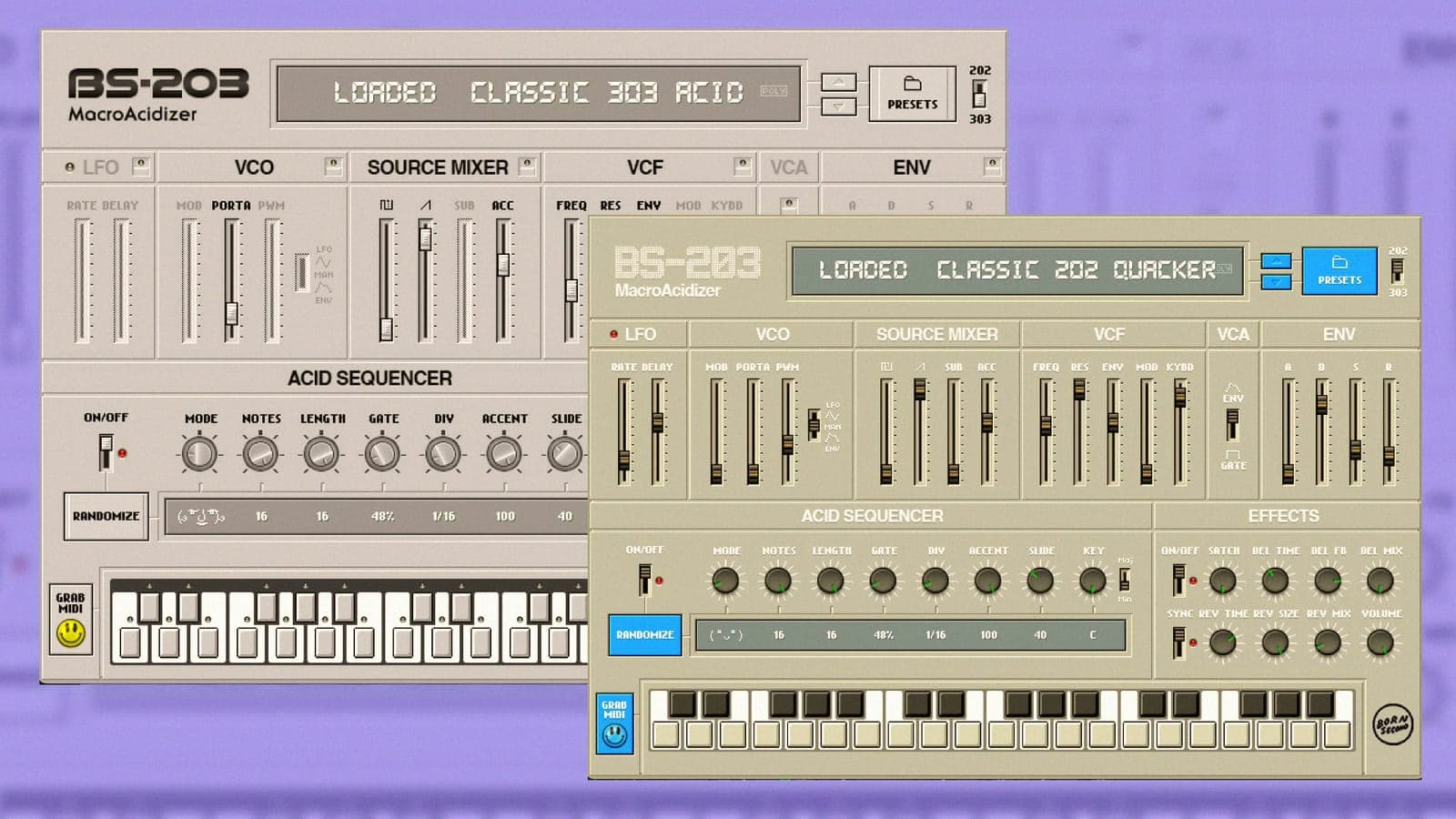
Acid house exists because of one accident: Roland built the TB-303 as a bass practice tool for guitarists in 1982, nobody bought it, and a handful of Chicago producers started twisting its resonant filter into the squelch that became a genre. Forty-plus years later, Born Second Records has put that filter, plus two of its lesser-known cousins, inside a single $25 plugin.
BS-203 MacroAcidizer, released August 30, ships three switchable synthesis modes: a 303 mode modeling the original TB-303's square and saw oscillators, accent and decay envelope; a 202 mode modeling the Roland MC-202's LFO, VCO, source mixer, VCF and VCA; and a BB mode modeling the Juteon BassBoy+, a two-pole filter box with pre and post-filter saturation and cutoff step quantization that never got anywhere near the 303's fame. Each mode is switchable inside the same instrument rather than sold as separate plugins, and unlike any of the three hardware originals, MacroAcidizer runs 6-voice polyphonic on top of the expected mono mode.
What does the generative sequencer actually do?
The feature Born Second is leading with isn't the filter emulation, it's the sequencer. Called the Acid Brain, it composes acid lines on its own, locked to a chosen major or minor scale, with control over note range, pattern length, gate, clock division, accent and slide. Feed it a scale and length and it writes a bassline; you shape it rather than step-program it note by note the way a real 303 forces you to. Patterns export as MIDI, so a line the plugin generates can be dragged straight into a DAW's piano roll and edited by hand from there.
The plugin composes acid lines locked to a scale and exports them as MIDI, a workflow no hardware 303 or 202 ever offered.
That's the real tension for anyone who has spent years hand-programming a hardware 303's tiny buttons: does a pattern the software wrote for you still count as an acid line you made? Born Second isn't pitching MacroAcidizer as a replacement for that ritual. It's pitching speed, three circuits for the price of a round of drinks, and a sequencer built for people who want the sound without the decade of secondhand-gear hunting a real TB-303 or MC-202 now demands.
Why bundle three boxes instead of one clone?
A faithful 303 clone alone is a crowded market; Born Second is betting the MC-202 and BassBoy+ modes are the differentiator, since neither has anywhere near the plugin coverage the 303 already has. The MC-202 was Roland's own 1983 follow-up, a mono synth with a built-in step sequencer that shares circuitry with the 303 but adds an LFO and a different mixer stage; it's had a cult acid-techno following for decades without ever getting the 303's cultural mythology. The Juteon BassBoy+ is more obscure still, a boutique bass module built around a two-pole filter with its own saturation stage. Putting all three in one $25 instrument, alongside built-in delay, reverb and saturation, is squarely aimed at producers who want acid's range of textures without buying, shipping and maintaining three separate pieces of aging hardware.