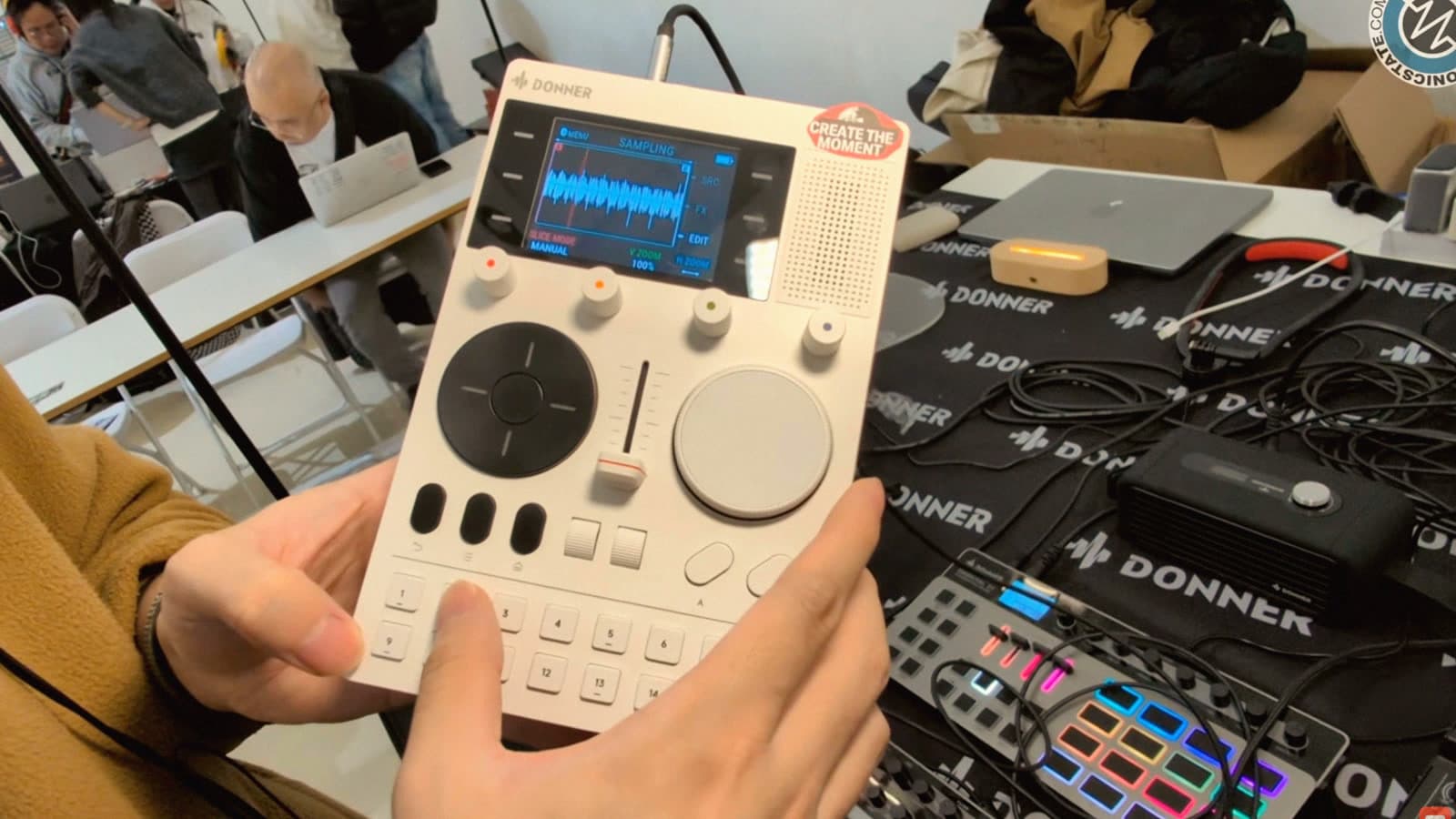
Donner used Beijing Modular 26 to confirm what an unlabeled Amazon listing hinted at back in August: a handheld sampler workstation called Sample Boy, built in the same chunky, brightly-colored mold as Teenage Engineering's OP-1. The company's Logan walked through a working prototype on site, hardware close to final, software still being finished, no price and no firm ship date beyond "2027."
What makes it a sampler, not just another groovebox?
The headline feature is where the audio comes from. Sample Boy pulls from line input, its internal mic, USB audio, or an internal tape-style resampling mode that grabs whatever is already running through the unit, the same workflow that made the OP-1's tape mode a cult favorite for capturing happy accidents rather than pristine takes. Once captured, samples run through input effects (filter, EQ, compressor, distortion) before landing in memory at 48kHz/24-bit, with 480 seconds of stereo capacity or 960 seconds in mono. From there, players can set start and end points by hand or let the unit auto-slice the material, then zoom and adjust each slice.
Is the hardware actually usable, or just a tech demo?
The control surface suggests Donner is building for real performance, not a spec-sheet gimmick: 16 backlit buttons double as slice pads, four color-coded encoders and six touch points handle sound-shaping, and a jog wheel plus crossfader sit alongside D-pad and function-key navigation. A 7-track sequencer, built-in speaker and mic, MIDI and sync in/out, USB audio I/O and a microSD slot round out a feature set that reads like a direct answer to anyone priced out of an OP-1 or OP-Z. Polyphony tops out at 32 voices, enough for layered sample-based arrangements without the unit choking.
Donner has spent the last few years chasing Teenage Engineering's design language at a fraction of the price, and Sample Boy is the clearest version of that bet yet.
Why the long wait to 2027?
Donner's own framing, hardware close to done, software still in progress, is the tell. A sampler lives and dies by its firmware: slicing logic, sequencer feel, and how forgiving the tape mode is to play with. Rushing that part out the door is how budget hardware earns a reputation for feeling unfinished at launch.