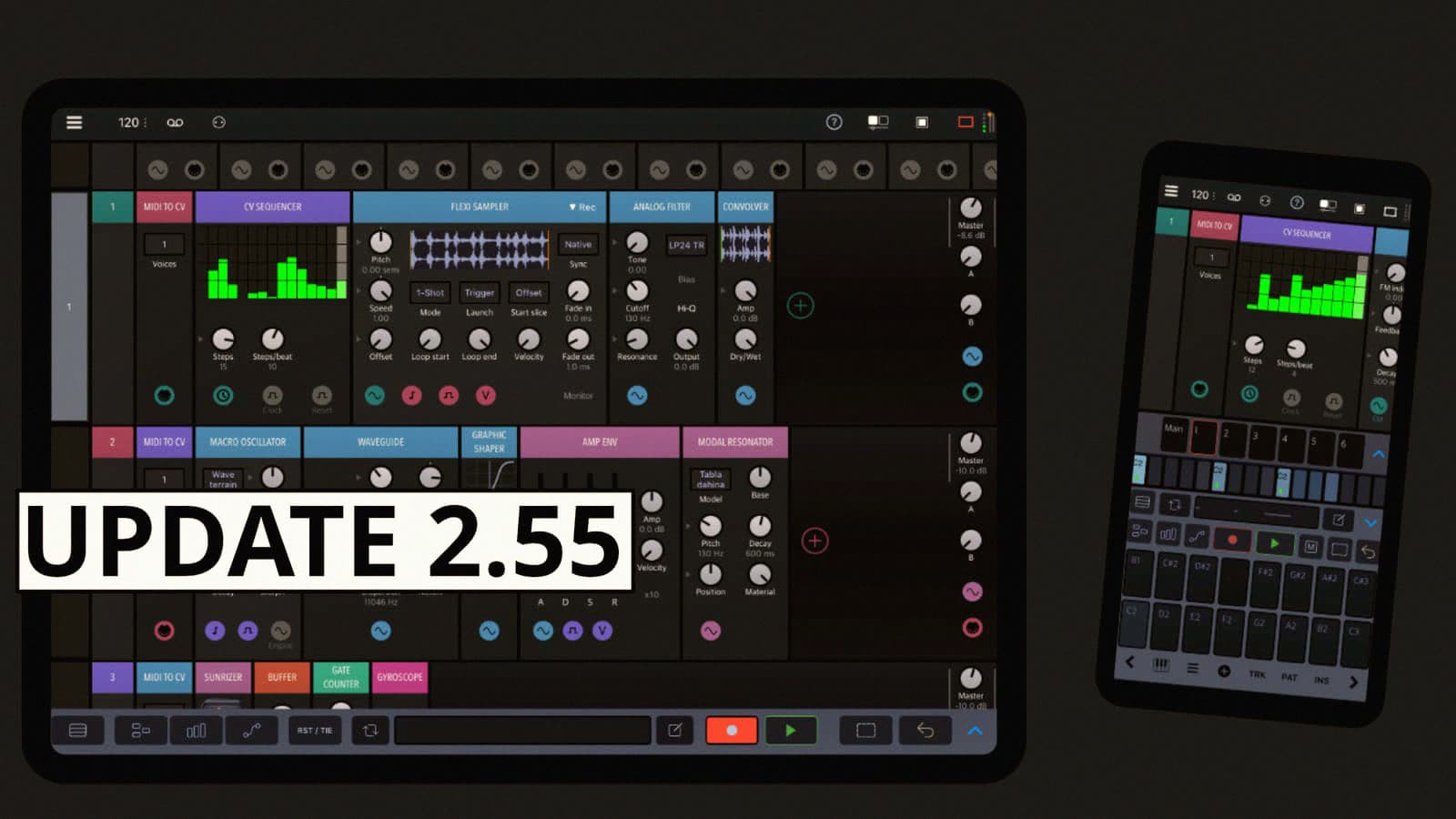
Most modular groove apps add a filter or two and call it an update. BeepStreet just gave Drambo a way to sample a camera feed.
Version 2.55, out August 17, 2026, is really two upgrades stitched into one release. The first is straightforward: a Granular Sampler and Granular Processor, sold as a separate in-app purchase, that chops audio into grains you can stretch, freeze, and reshape with Drambo's usual patch-cable-free modular routing. Forum users on Loopy Pro who grabbed it early called the grain shaping "really accurate with minimal artefacts" and praised how tightly it integrates with the rest of the engine, since every grain parameter can be modulated by anything else in the patch.
The second half is the one worth stopping for. Three modules in a new Signal category, the Texture Wave Scanner, Texture Wave Oscillator and Texture Spectral Oscillator, read the texture of a live video input and turn it into an audio or modulation signal. Point Drambo at a phone camera, a screen recording or any connected video source and the pixels themselves become raw material for a patch: brightness, contrast and motion in the frame can drive an oscillator's waveform or modulate a filter cutoff in real time.
Why does a groovebox need a camera?
Because the underground has spent a decade pulling texture from anywhere it can get it, field recordings, contact mics, granulated vocals, and a live video feed is just another noisy, unpredictable source to grain up. For a deep-tech or organic-house producer building evolving pads and rhythmic modulation from found sound, a video-reactive oscillator is a genuinely new tool, not a reskinned filter. It also plays to Drambo's real audience: mobile modular heads who already treat an iPad as a rack, not a toy.
The video tools live behind the separate Drambo Visual upgrade rather than the granular purchase, so producers who only want the grain engine do not have to pay for the camera-processing side, and vice versa. The update itself, including a new looper module with custom length and quantization, is free for every existing owner; only the granular and visual extensions are paid add-ons.
Who actually gets to use this?
Anyone who already owns Drambo on iOS or macOS gets the free 2.55 base update immediately. The granular sampler and processor cost 4.99 euros as an in-app purchase, and the texture modules require the Drambo Visual add-on, a step BeepStreet has taken before with the app's Code and physical-modeling extensions. Drambo runs as a standalone app, an AUv3 instrument, effect and MIDI effect, so both sets of new modules slot into whatever DAW or live rig a producer is already running.
"Fully controllable grain sync, minimal artefacts, native to Drambo" is how one early adopter on the Loopy Pro forum summed up the granular processor days after launch.
BeepStreet, the Polish developer better known for the Sunrizer synth, has built Drambo's reputation on exactly this kind of steady, unglamorous expansion since the app launched in 2020. Version 2.55 is the update that pushes it from sampling sound into sampling light.
What we think
Video-to-audio synthesis has floated around modular hardware and Max/MSP patches for years without ever reaching a mainstream mobile groovebox. Shipping it inside an app that already lives on thousands of producers' iPads, rather than as a niche standalone tool, is the kind of move that actually gets a weird technique used on records instead of just demoed on YouTube.