What makes DW-303 different from another soft-303?
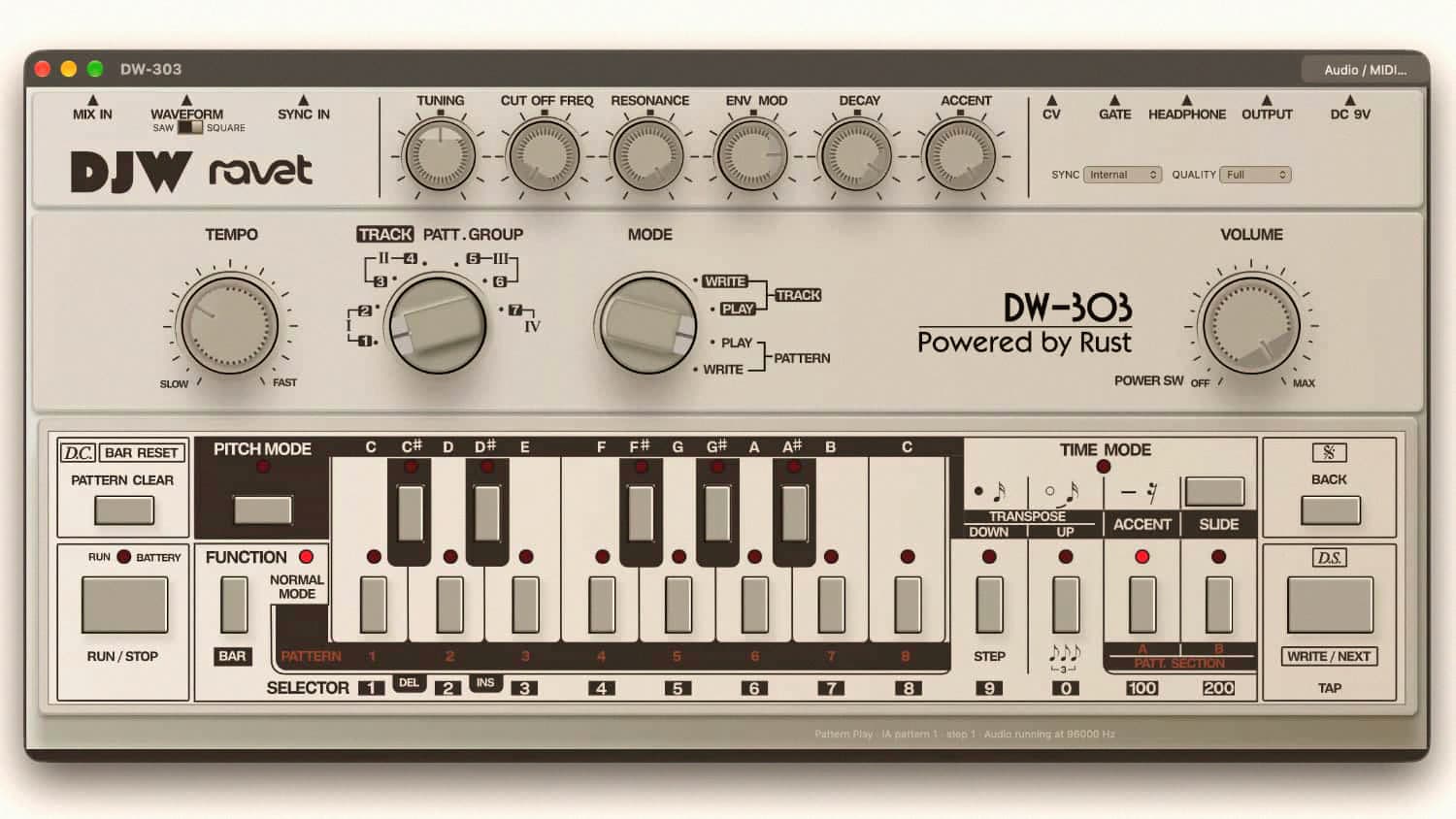
Most software 303 clones fake the sound with virtual-analog math: a filter curve tuned by ear until it sounds close enough. DJW Audio built DW-303 stage by stage instead. The oscillator, the resonant ladder filter, the envelopes and the amplifier are each modeled against the TB-303's original circuit schematics and fitted against real hardware measurements, not approximated after the fact. The plugin runs that model in two modes, Full and Economy, so producers can trade CPU load for fidelity depending on the session.
The sequencer follows the same logic. Sixteen steps with separate pitch and time entry, notes, ties, rests, accent and slide, spread across 64 patterns in four groups and seven tracks for chaining into a full arrangement. That is the part most browser-based or stripped-down 303 clones skip, and it is the part that actually writes acid lines.
Why give away a plugin this technical for free?
DW-303 ships under the GPL-3.0-or-later license, meaning anyone can read, modify, redistribute or fork the entire codebase, hosted in the open at github.com/mo0kid/DW-303. The repository carves out one exception: the DW-303 name, the DJW Audio name and logo, and the panel artwork stay outside the code license, so a fork cannot reuse the branding. No license key, no activation server, no subscription: install it on macOS 11 or later, Windows 10 or 11, or Linux x86_64, and it runs as VST3, AU, AAX, CLAP, LV2 or standalone depending on the OS.
No license key or activation required, across every major plugin format on Mac, Windows and Linux.
Where does this land in the 303 clone market?
The original TB-303 flopped commercially in 1982 and then became the backbone of acid house a few years later, which is exactly why everyone still wants a piece of it. Roland eventually made peace with that and now sells its own official TB-303 plugin through a Roland Cloud subscription, $19.95 a month for the full catalogue. Behringer went the hardware route with the TD-3, a direct clone that street-priced around $149 when it launched. DW-303 undercuts both: free to download, free to keep, and the circuit models behind it are public code instead of a trade secret.
That does not automatically make DW-303 the best-sounding 303 clone on the market; hardware loyalists will keep arguing that case forever. But it does remove the last financial excuse not to try one.