Why is a Balkan festival brand building at the pyramids?
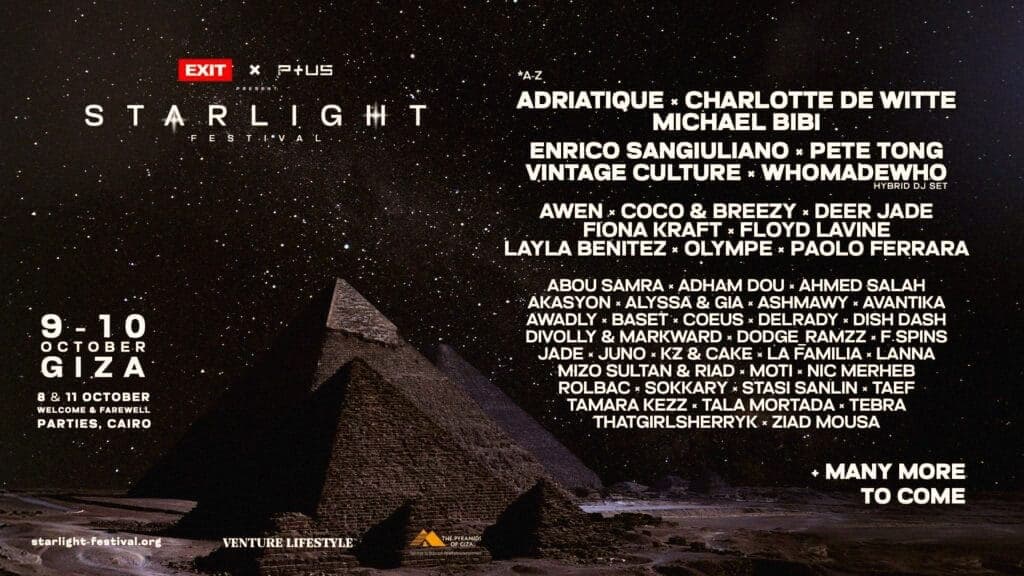
EXIT Festival built its name at Petrovaradin Fortress in Novi Sad into a three-time winner of European Best Major Festival and the reigning Promoter of the Year at the European Festival Awards. Now it's putting that machine to work in a country it has never operated in. Starlight, its first Egyptian production, is a co-venture with P+US, part of the Cairo-based Venture Lifestyle group, and it debuts October 9-10, 2026, on the Giza Plateau with the Great Pyramids of Giza as the backdrop, bookended by Cairo satellite events on October 8 and 11.
"It is a great honour to be invited to bring the premium festival concept near one of the grandest monuments in human history," EXIT founder Dušan Kovačević said announcing the deal. P+US founder Rabih Mokbel framed it in tourism terms: "Bringing this legacy to Egypt together represents a major milestone for the region... we expect Starlight to attract a significant number of international visitors." That framing matters: organizers cite a global music-tourism market worth more than $100 billion, and Starlight is built to pull a slice of that into Egypt.
Why split house and techno into two separate nights?
Starlight isn't blending its 50-plus artists into one generic bill across at least three main stages. October 9 is curated as a house night: Adriatique, Pete Tong, Vintage Culture, Indira Paganotto and WhoMadeWho. October 10 flips the identity entirely for a harder techno night: Charlotte de Witte, Michael Bibi and Enrico Sangiuliano, with regional and Egyptian DJs filling out both nights.
That's a real curatorial call, not a lineup dump. A blended bill would let the festival brand itself as generic "electronic music" and sell one undifferentiated ticket. Splitting the nights bets that audiences will buy into two distinct scenes back to back, house one night and club techno the next, instead of one diluted middle ground. It's the same logic EXIT already runs at its home festival in Novi Sad, where different stages carry different genre identities across one weekend; here it's compressed into two nights instead of multiple simultaneous stages.
"We expect Starlight to attract a significant number of international visitors." - Rabih Mokbel, P+US
What does this actually mean for Egypt's own scene?
This is the real test. Egypt's house and techno scene has been building for years around independent promoters and small venues in Cairo and along the coast, largely without a festival of this scale or budget. A brand with EXIT's resources and reputation landing at the country's single most recognizable monument either validates Egypt and the wider MENA region as a serious touring destination, or it's a two-week import that books foreign headliners, banks the tourism-revenue story, and leaves the local scene's own infrastructure no stronger than it found it.
The location itself comes with real constraints that underline how unusual this booking is: concerts at heritage sites like the Giza Plateau are negotiated with the site authority on a case-by-case basis, not under a standing arrangement, and the plateau closes to ordinary tourism around large productions like this one. Pulling that off twice in one weekend, for two different genre crowds, is the actual thing being tested here, not just whether the lineup sells tickets.