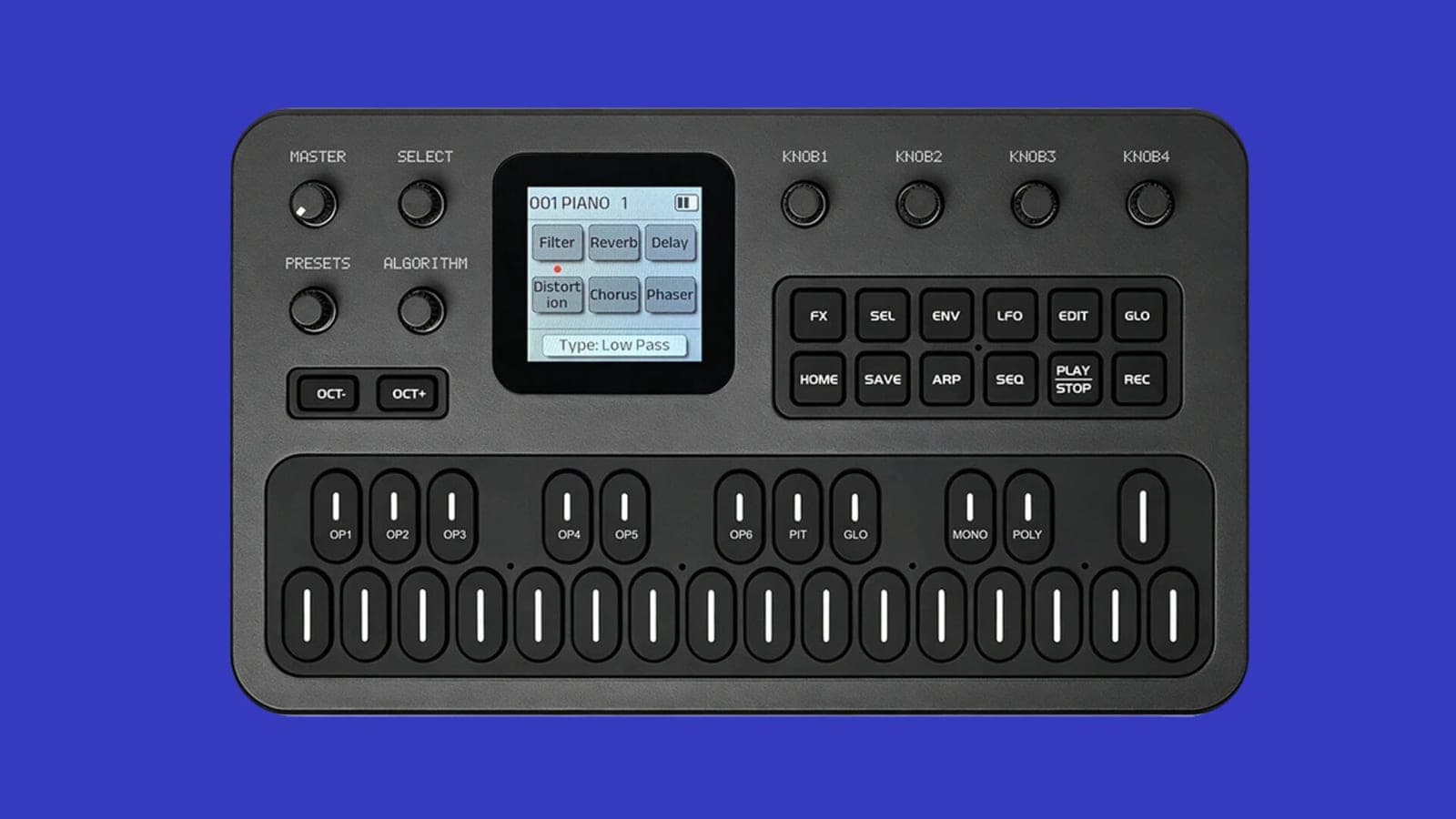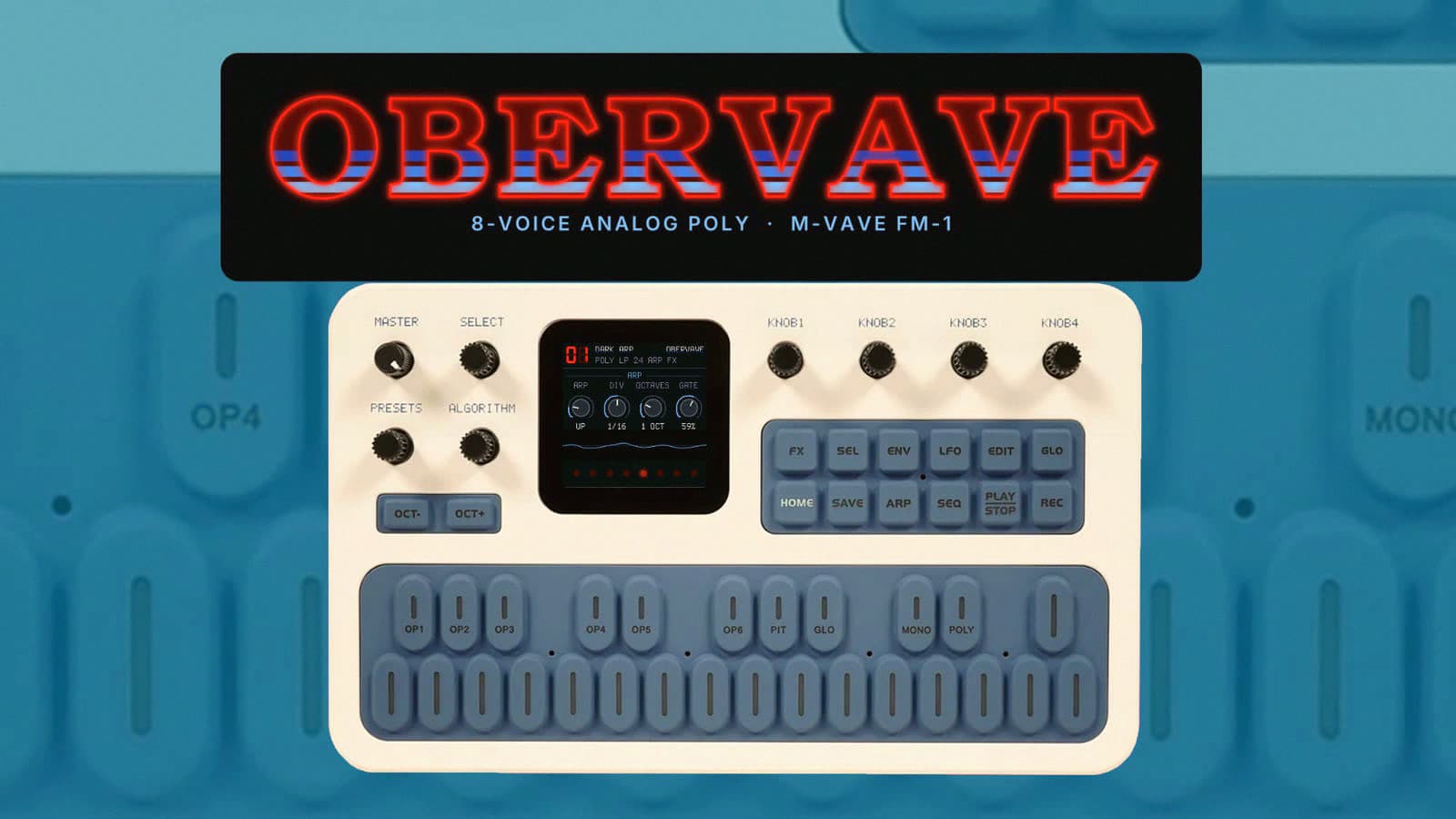
What does Obervave actually do to the hardware?
Obervave is a complete firmware swap. Flash it onto an M-VAVE FM-1 and the box stops being an FM synth and becomes an 8-voice polysynth built around the sound of American polysynths from 1979 to 1984, the Oberheim lineage in everything but the badge. Each voice runs two oscillators with hard sync and cross-modulation, feeding a SEM-style filter: a 12/24dB design that morphs continuously between low-pass and high-pass rather than flipping between fixed modes, the exact trick that gave Tom Oberheim's OB-X era machines their liquid tone. Two envelopes, a multi-wave LFO and multimode step arpeggiators sit on top, and every one of the 8 voice cards carries its own tune, cutoff and envelope offsets plus pitch randomization, the kind of per-voice drift that made the originals feel alive rather than eight stacked copies of one patch. Developer zvenson lays out the goal plainly on the project's GitHub page:
"a single, deep instrument in the spirit of the classic American 8-voice poly synths of 1979-84"
The FM-1 build is finished and flashable today. The SMK-37 Pro/Elite port is still in beta.
Why clone Oberheim architecture on a budget FM box?
Because the originals are priced for collectors, not working producers. An OB-X, OB-Xa or OB-8 in playable condition runs well into five figures when one even turns up for sale, and the plugin substitutes put you back behind a mouse and a screen. The M-VAVE FM-1 ships as a roughly $100-class FM module, and Obervave doesn't touch its circuit board, it rewrites what the chip does. That's the whole appeal of firmware hacking as a format: zvenson didn't need Oberheim's schematics or M-VAVE's blessing, just a published toolchain and enough hours to model the architecture in code, then give it away under a GPL-3.0 licence.
Does firmware really capture a vintage polysynth's character?
This is where the modular and DIY crowd actually argues, and both sides have a point. A digital SEM-style morph is a model of the filter, not the filter: the component drift and voice-to-voice variance that made a real OB-8 feel unpredictable in exactly the right way can be approximated in code but not lifted straight off a vintage unit. But Obervave's source is public, so anyone can read exactly what's being modeled, tune it, or fork it, something no closed plugin or boutique clone module offers. Whether that counts as capturing Oberheim or just borrowing its vocabulary is a genuinely open question, and it's one worth having in daylight instead of behind a marketing sheet.