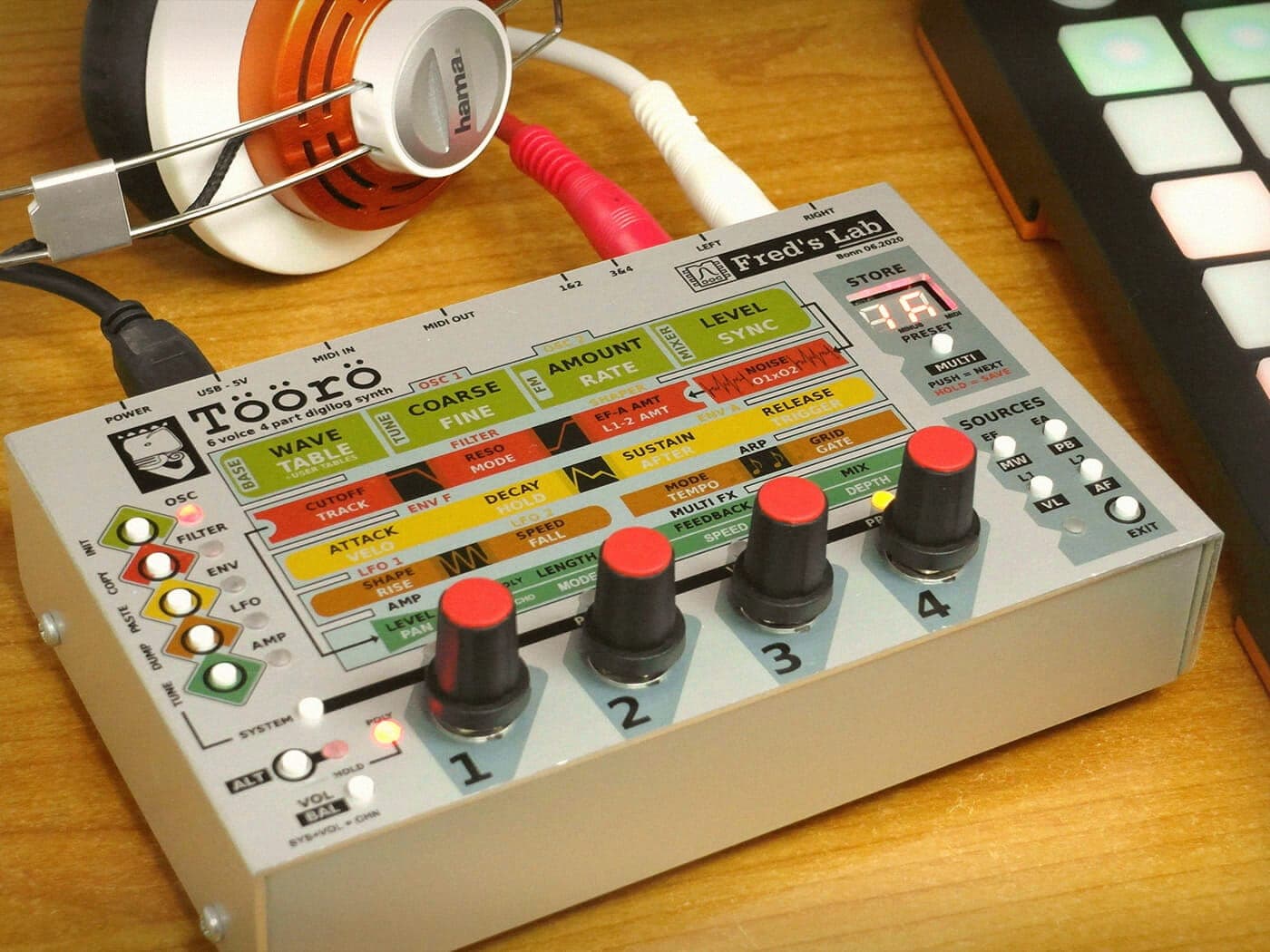
French boutique maker Fred's Lab built a name on the Töörö, a small hybrid synth that paired an analog filter with digital oscillators and genuinely useful MPE support for a fraction of what bigger brands charge. Then the supply chain caught up with it: the chips that powered the original 2020 board stopped being made. Most manufacturers at that point quietly discontinue the product and move on. Fred's Lab instead spent the downtime engineering a second generation.
What actually changed inside the box?
The headline fix is the oscillator path. The original Töörö ran its digital oscillators at 12-bit, which was audibly limiting in two specific ways: a higher noise floor and 'zipper noise,' the stepped, slightly crunchy artifact you hear when a parameter changes in discrete steps rather than smoothly. The MKII moves that engine to 16-bit, which is the standard jump synth designers make when they want cleaner sweeps and quieter sustained tones without touching the character of the sound itself.
Crucially, Fred's Lab didn't touch the part of the Töörö that gave it its identity. The FL A847 analog 12dB/octave low-pass filter, the component responsible for the synth's warmth and its reputation among hybrid-synth owners, carries over unchanged. That is the harder engineering call: rebuilding the digital half from scratch while leaving the analog half exactly as it was means the MKII has to sound like an improved Töörö, not a different synth wearing the same name.
The digital path got rebuilt from the chips up. The analog filter that gives the Töörö its voice didn't move.
Does it still do what made the original worth owning?
Yes. The MKII keeps the 6 hybrid voices and 4-part multi-timbrality that let a single unit cover a surprising amount of a live or studio rig, plus the stereo digital effects: modulated delays, chorus and flanger. MPE support across two zones also survives the rebuild, which matters for anyone using expressive controllers like a Linnstrument or a Roli-style surface into the Töörö's engine rather than just a standard keyboard.
Fred's Lab is taking preorders at €499 including VAT, with the first units shipping in October 2026.
Why it matters
Small synth makers live and die by component availability in a way the big manufacturers mostly don't. When a chip goes end-of-life, the easy move is to discontinue the product and let the brand recognition fade. Fred's Lab choosing to re-engineer around the shortage, rather than drop the Töörö, is the kind of decision that keeps a boutique maker's catalog alive for the long haul and keeps secondhand owners from being stuck with an orphaned instrument.
What we think
This is the unglamorous version of hardware longevity: no flashy redesign, no marketing reset, just a maker quietly swapping out the parts that died and leaving the parts that worked alone. That restraint, upgrading only what broke, is rarer than it should be in a gear market that usually treats 'MKII' as an excuse to raise the price and change everything.