Eurorack has always made you pay for chords. Want more than one note at a time, you stack VCOs, multiply your filters, eat up HP you don't have. Hampshire Electronics is betting producers are done with that math: its new Apollo and Janus modules each squeeze 8-voice polyphony, running across two engines at once, into 19HP and 10HP respectively.
What do you actually get for the money?
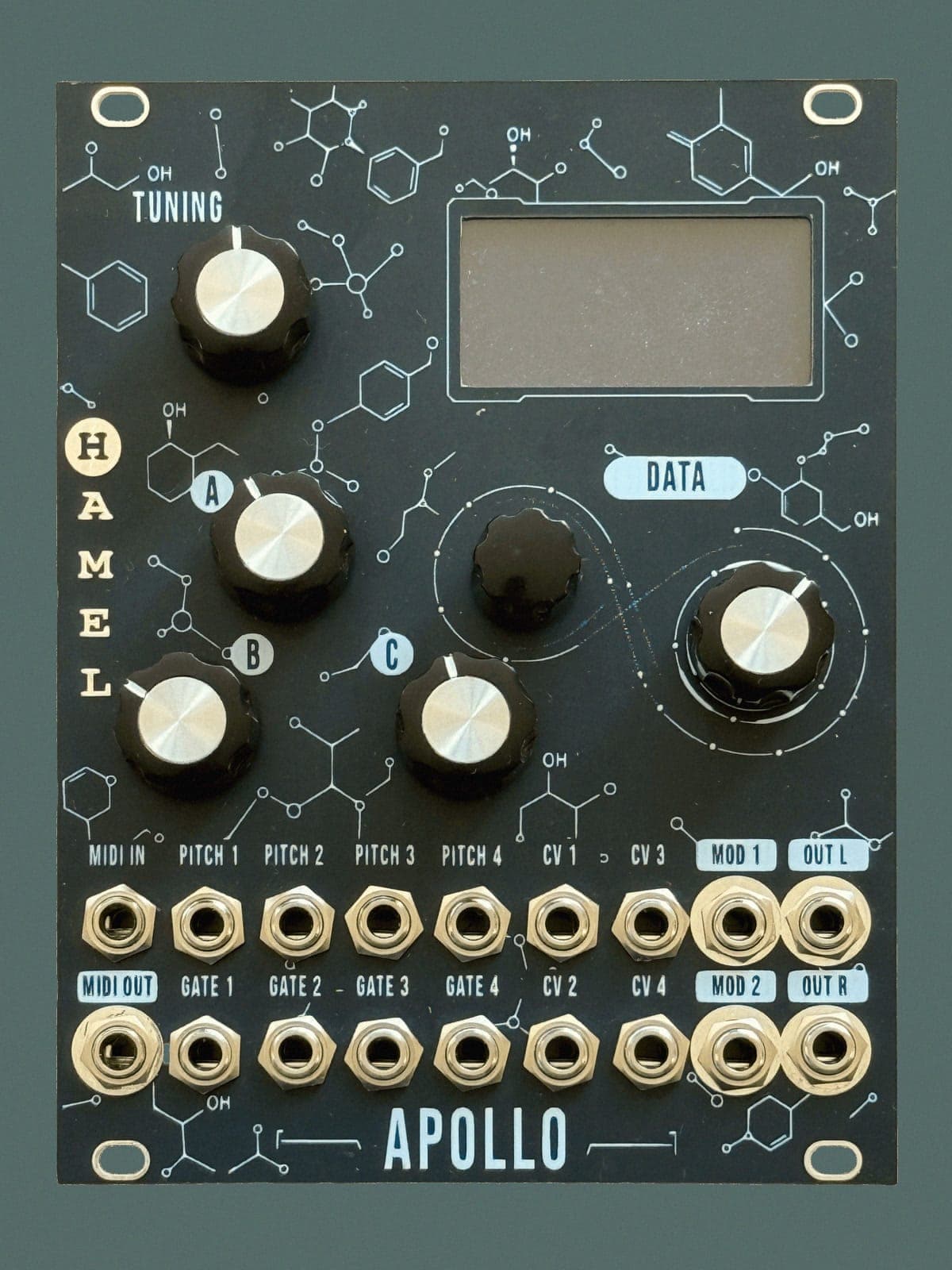
Apollo, the flagship at 19HP and £329, keeps a full I/O set: MIDI in and out over mini-jack, four 1V/octave and gate inputs, four CV inputs, two mod outs and stereo out, run from a main encoder and five knobs with a large display. Janus strips that down hard. No MIDI, a single 1V/octave and gate input, two CV ins, same stereo out, in a case half the width. Launch price is £219 for the first 25 units, then £239, and per Hampshire Electronics' own listing both are already shipping.
Under the hood they're close siblings. Each module runs two synthesis engines in parallel, each engine carrying its own 8 voices, picked from twelve types: V-Analogue, FM, Modal, String, Drums, Tonewheel, Wavetable, Phase Distortion, Additive, Formant, Waves and Noise. Layer a chord engine with just-intonation tuning and a polyphonic arpeggiator on top, then run the whole thing through a stereo chain of bitcrusher, filter/drive, phaser, granular, delay, reverb and chorus, with Janus adding a glitch effect into the mix.
Why does 8-voice polyphony matter in a modular case?
Most Eurorack voice modules are monophonic, or stretch to two or four voices at best if you're willing to commit half your rack to oscillators and filters.
That's the real story here, not the engine list. A producer building a live hardware rig for house or techno sets has historically needed multiple modules just to hold down a chord, let alone play one polyphonically and modulate it. Fitting 8 voices, two engines, a chord generator and an arpeggiator into 10HP means a producer can carve out space for a polyphonic voice without giving up the rest of the case to get there. That's a genuine shift in what's practical to patch live.
What's the trade-off?
Janus's missing MIDI is the obvious catch for anyone who wants to trigger it from a DAW or a keyboard controller rather than purely from CV and gate. Hampshire Electronics isn't new to this ground either: its earlier Vulcan module already put 8-voice analog polyphony into Eurorack, so Apollo and Janus read less like a one-off experiment and more like the company doubling down on a polyphony focus it's held for several years.