Why does an Andromeda A6 emulation matter?
The Alesis Andromeda A6 landed in 2000 as one of the last mass-produced true-analog polysynths: 16 voices, switchable between an Oberheim-style SEM state-variable filter and a Moog ladder filter, wrapped in custom analog ASICs that gave it a grain deep and minimal producers have chased for years. Alesis stopped building it long ago, and the used market has stayed thin and expensive ever since. Nobody had put a faithful hardware model of its actual circuit into a new instrument, until now. Per Synth Anatomy's July 24 report, Isla Electronics' Caladan changes that: its Andromeda voice card, still in final development, is built around the Andromeda's ASICs, its Moog 921B-style VCO, and both of its switchable filters, the first hardware emulation of that engine to exist.
How does the voice-card system change what a producer can build?
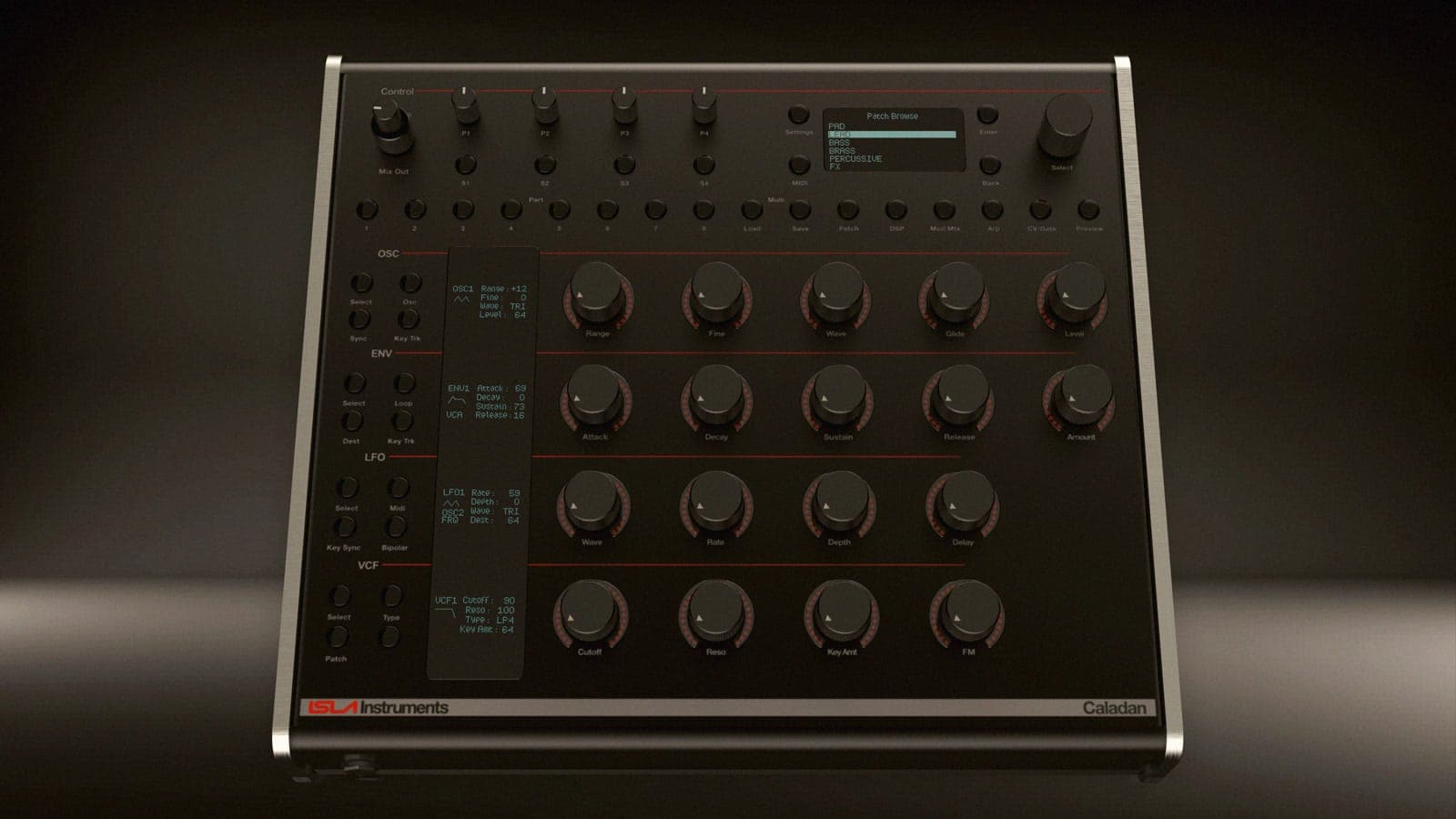
The Caladan runs 8 parts, and each part pulls its sound from either a native engine or a swappable voice card, a small circuit board that slots into the chassis and can be added, removed or traded over time. Three cards are already finished, per Synth Anatomy: DCO3, a straightforward 3-oscillator analog voice with analog filters and a VCA; OPL3, a 6-voice, 4-operator FM/subtractive hybrid modeled on the Elka Synthex rather than the FM chip its name recalls; and Quadrowave, a 4-voice digital wavetable engine running 256 morphable waveforms through analog SSI2144 filters. Callisto, a 16-voice-per-instance emulation of the Roland JP-8000's supersaw engine, and the Andromeda card are both nearing completion. Load 8 of the same card and the Caladan becomes a single-engine polysynth; mix and match and it becomes eight different synthesizers sharing one chassis, one power supply and one mixer. That is the practical pitch: instead of buying a JP-8000 clone, an FM box, a wavetable synth and a five-figure vintage Andromeda separately, each with its own footprint and price tag, a producer builds the same rig one card at a time inside a single unit.
Nobody had built hardware that faithfully modeled the Andromeda A6's actual circuit, until Isla Electronics put one on a voice card.
What else is in the box, and when does it actually ship?
Each part gets its own channel strip with up to four insert effects and two aux sends, plus per-part performance tools like an arpeggiator, step sequencer and trance gate, and every card and plugin has an on-unit editor whose interface is piped out over the Caladan's HDMI port rather than tied to a phone or laptop app. Beyond the cards, the Caladan hosts a 32-note multi-sample engine reading SoundFont files and can run Linux VST3 and LV2 plugins directly on the hardware. Brad Holland has been developing the Caladan for more than three years; his original US company, Isla Instruments, closed its LLC in March 2026 when he relocated to the UK, and development continued under the new Isla Electronics name. The unit is in late pre-production now, targeting a summer 2026 release, though Synth Anatomy notes the timeline could still move, and the pre-order list reopens once the production-ready revision is fully tested.