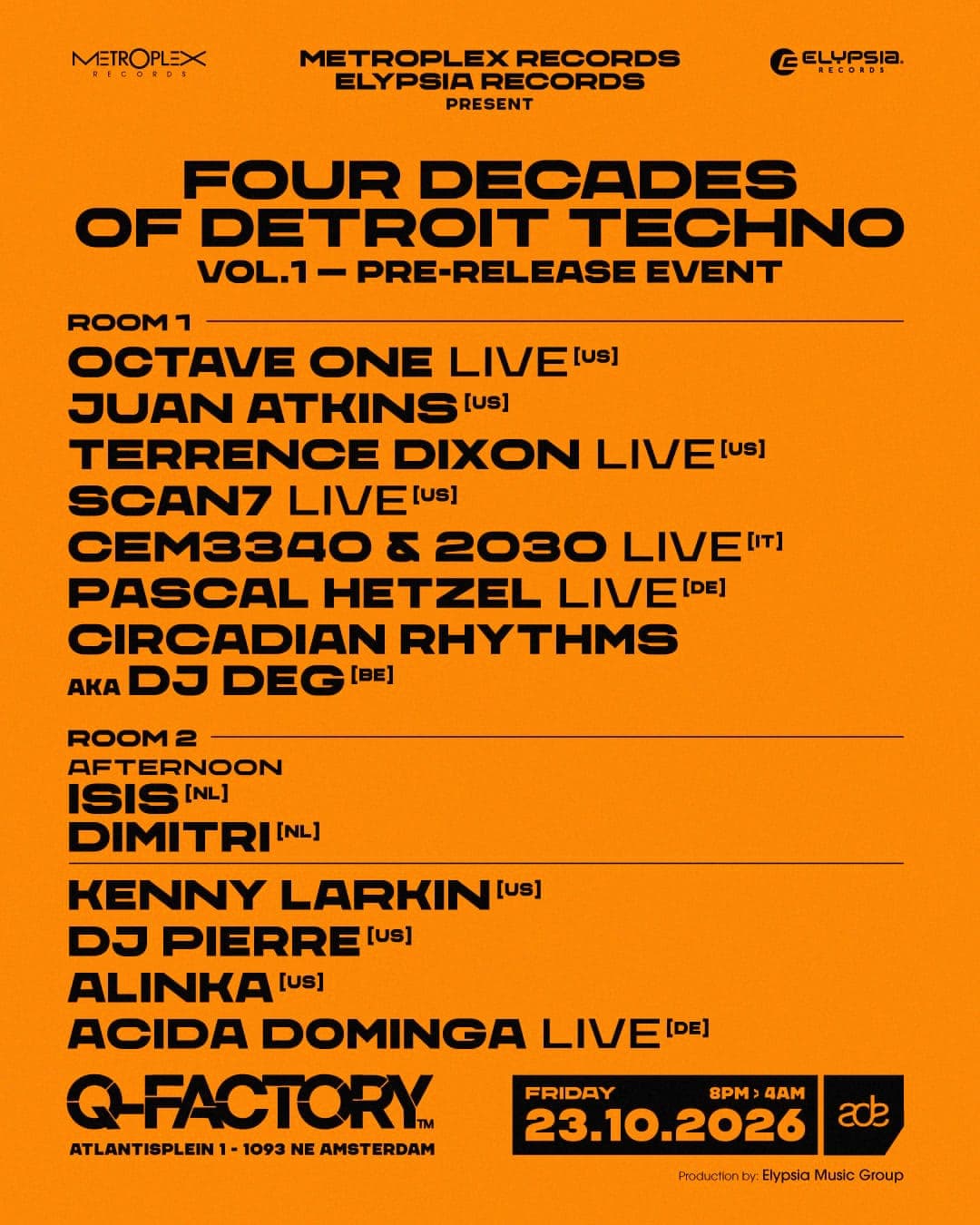
Line-ups built around a genre's history usually work the same way: the old guard gets a closing headline slot, separate from everyone else, a nod more than a conversation. "Four Decades of Detroit Techno" at Q-Factory Amsterdam does something different. On Friday, October 23, Juan Atkins, the man who started Metroplex Records out of Detroit in 1985 and is as close as this genre gets to a single point of origin, plays a 14-hour bill alongside Octave One, Scan 7, Terrence Dixon and Kenny Larkin, the artists who built the second and third waves of the sound, and younger names like Alinka, Acida Dominga and DJ Pierre carrying it now.
Why put four decades on one stage instead of four separate ones?
Elypsia Music Group and Metroplex are billing this as a single, continuous night rather than a string of generational showcases, running from 2pm straight through to 4am. The event's own framing is explicit: it wants to show, in one room, the connective tissue between Detroit, Chicago and the European scenes that spent thirty years importing, distorting and sending techno back across the Atlantic. That's a different claim than "legend plus support act." It's lineage treated as a shared timeline rather than a trophy case.
What else is riding on this one night?
The show also previews "Four Decades of Detroit Techno: Vol.1," a compilation project documenting the music and artists shaping the city's electronic legacy, before it's formally released. Pairing a listening preview with a live, cross-generational bill is a statement about where the city wants the story told first, on a dancefloor, not in a press release.
The framing line from the event itself: it aims to highlight the intersection between Detroit, Chicago and the European electronic music community.
Why does the timing matter?
This lands inside Amsterdam Dance Event's 30th-anniversary edition, itself a milestone year for the conference that became Europe's biggest clearinghouse for electronic music. Putting Atkins on the same stage as the generation he influenced, rather than above it, is a pointed way to mark two anniversaries at once: ADE's thirty years, and the four decades since Detroit techno had a name.