How do you actually play a Haloplane?
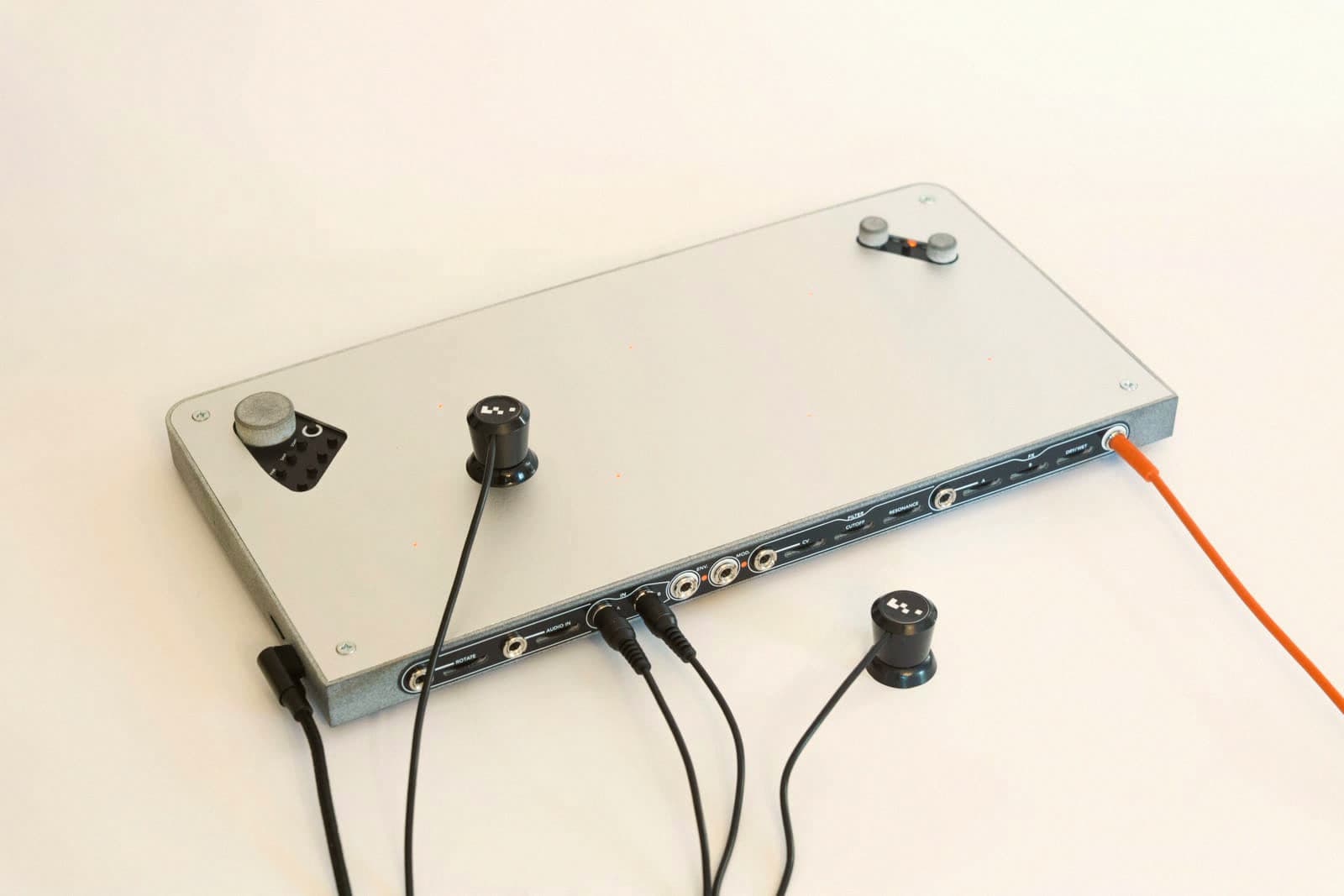
Forget keys, pads, or touch strips. The Haloplane's interface is a ring of seven electromagnetic fields arranged around a tabletop unit, and you play it by moving a pair of stereo electromagnetic pickups over them by hand. Rest a pickup in one spot and it holds a stable tone. Swipe it across a field and the sound shifts with the movement. Swing it in a loop and you get something closer to a physical gesture translated straight into rhythm. Each of the seven fields can carry either a micro-loop sample, up to four seconds, auto-sliced into segments that smoothly morph into each other as you move, or a wavetable built from six waveforms blended together.
The feature that separates Haloplane from its older sibling, the KOMA Elektronik Chromaplane, is field rotation: the seven fields themselves rotate around the instrument, manually or via CV, reassigning sounds to new physical positions as they spin. A fixed layout becomes a moving one, generating melodic riffs on the fly or timed sequences locked to a rotation speed. Add ring modulation, saturation and downsampling into the signal path, plus a state-variable filter and a delay, reverb, flanger, chorus and bitcrusher effects block, and the pickups stop looking like a gimmick and start behaving like a genuine performance instrument.
What's Passepartout Duo's history with this idea?
Passepartout Duo, the duo of Nicoletta Favari and Christopher Salvito, didn't design this as a product first. They built the Chromaplane as a custom instrument for their own live sets, years into a touring career that has taken them across more than 60 countries, and the magnetic-pickup idea grew out of needing something rugged and expressive enough to carry around the world. That original build won first prize at the 2025 Guthman Musical Instrument Competition, the kind of recognition that gets instrument makers' attention. KOMA Elektronik, the Berlin maker known for leaning into unusual interfaces rather than conventional synth architecture, partnered with the duo to turn the idea into the production Chromaplane, and the Haloplane is the stereo, more developed next step: a second electromagnetic instrument built on the same DNA but aimed squarely at sampling and wavetable work rather than pure improvisation.
What do you actually get, and when?
Pre-orders are open in priced batches, a model KOMA uses to reward early buyers: the first 30 units go for EUR486, the next 50 for EUR505, then EUR532 for 100 units and EUR550 for 200, before the price settles at the EUR584 standard rate. The order window runs from November 12 at 16:00 CET to November 27 at 13:00 CET, with a two-unit limit per customer and a 15-minute price lock once something is added to the cart. Under the hood, the Haloplane runs on USB-C power with no internal battery (it'll take a power bank on the road), talks to a WiFi companion app that works offline, holds up to 100 presets and custom scales, and doubles as a seven-track USB audio interface for recording each field straight into a DAW, or patching into VCV Rack. There's no MIDI. First units are scheduled to ship from Berlin in early 2027.
"Haloplane is an electromagnetic instrument for exploring digital sound design."