Since May, anyone running Native Instruments gear has been quietly asking the same question: is Maschine next on inMusic's shelf of half-supported acquisitions? inMusic already owns Akai, Alesis, Rane and a stack of other overlapping hardware brands, and its track record with absorbed product lines has not always been reassuring. Maschine, the company's flagship groovebox and sequencing software, went quiet enough after the deal closed that the silence itself became the story.
On September 23, that silence ended. Native Instruments pushed Maschine 3.7, a free update for anyone already on Maschine 3.0, with a version for the standalone Maschine+ hardware confirmed to follow shortly. Per MusicRadar, the company is explicitly framing this as evidence that Maschine is alive and evolving, its clearest public statement yet that the line survives the acquisition intact.
What actually changed in 3.7?
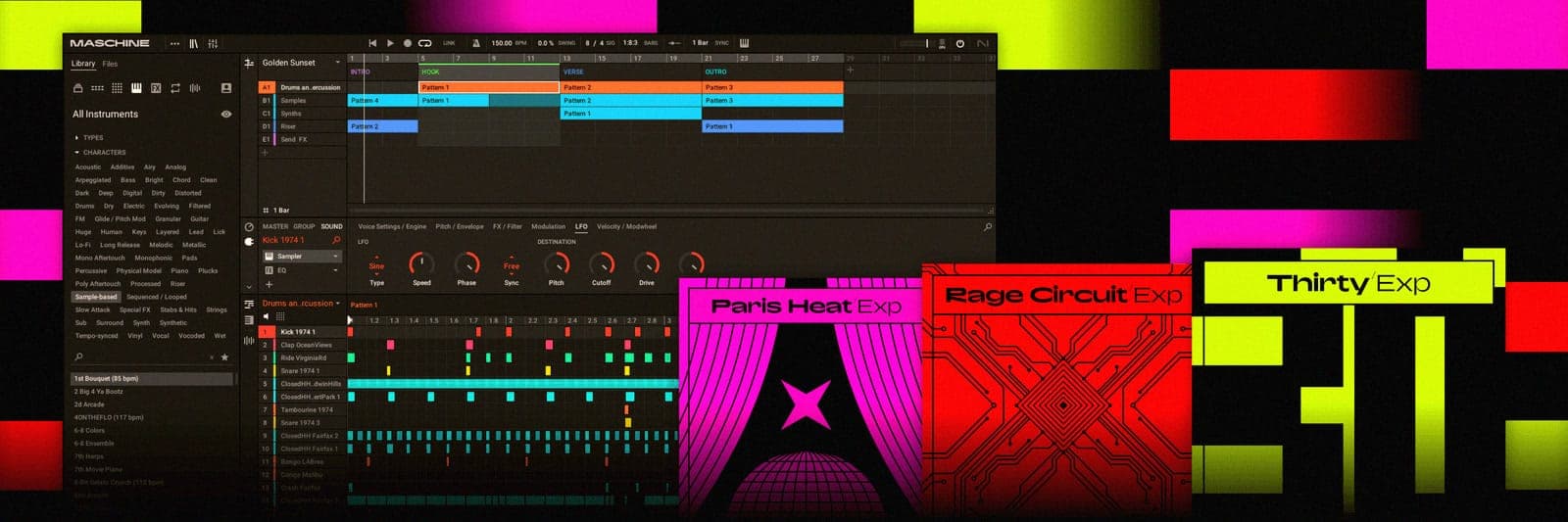
The headline addition is a Euclidean Sequencer: dial in step count, fills and rotation and the grid distributes hits algorithmically, updating live while the loop plays rather than forcing you to draw every hit by hand. Alongside it sits a Random Note Generator that can populate an empty pattern from scratch based on odds you set, tuned separately for percussive, melodic or chord material with its own velocity randomization. The third piece, Note Event or per-note Chance, assigns each individual note a probability value that gets re-rolled every loop, so a pattern keeps mutating instead of repeating identically.
None of this is conceptually new to hardware sequencing. Elektron's Digitakt and Digitone lineup and Polyend's Tracker and Play have shipped Euclidean and probability-based sequencing for years, and producers who've used either have been asking why Maschine, a platform built around the same pad-and-grid workflow, didn't have it. NI closing that gap is less an invention than catching up to where a chunk of its own user base already expected it to be.
Maschine is alive and evolving.
That's how MusicRadar summarizes Native Instruments' own framing of the release, and it's a deliberate answer to a specific worry, not neutral marketing copy.
Why launch Expansions at the same time?
Three new sound packs shipped alongside the software update: Paris Heat ($49), a French house-leaning pack aimed at club-facing production; Rage Circuit ($49), a rage and hypertrap collection built with Grammy-winning producer Snipe Young; and Thirty ($30), a 30th-anniversary set that resamples highlights from Native Instruments' own back catalogue. Landing paid content the same day as a free feature update is a commercial signal as much as a creative one: it tells a nervous install base that new revenue-generating content is still being greenlit and shipped, which matters more right now than the Expansions themselves.
2026 also marks Native Instruments' 30th year as a company, which is presumably why Thirty exists at all. The anniversary framing doubles as convenient cover for a release that is, underneath the branding, primarily a reassurance exercise.
Why it matters
A free sequencer update alone wouldn't be industry news. What makes 3.7 worth writing about is the timing: it's the first concrete signal, four months into inMusic ownership, that Maschine has an active roadmap rather than a maintenance mode. For a user base that has watched inMusic's other acquisitions go quiet, that's the whole story.
What we think
The features themselves are solid but not groundbreaking, Elektron and Polyend users will shrug at probability sequencing that's been standard on those platforms for a while. The real news is corporate, not creative: inMusic choosing to invest engineering time in Maschine rather than let it coast is the signal producers were actually watching for, and this update reads exactly like a company trying to say that out loud without saying it outright.