Ask most people to name the inventors of electronic music and the answers arrive fast: Kraftwerk, Robert Moog, maybe Karlheinz Stockhausen. What gets left out is that women were in the room from the instrument's very first decade, doing the technical work of turning electricity into sound, and in more than one landmark case, they were the ones written out of the credit.
Who was playing electronic instruments before the word "synthesizer" existed?
Clara Rockmore was a violin prodigy sidelined by tendinitis when she met the Russian inventor Léon Theremin in New York in the late 1920s. She didn't just perform on his instrument, she helped engineer it: working with Theremin to widen its range and sharpen its sensitivity, and developing a precise fingering technique that let her play fast, controlled passages on an instrument with no strings, keys or frets to touch. By the 1930s she was the theremin's defining performer, touring concert halls and, later, the country with Paul Robeson, decades before anyone called this genre electronic music at all.
That same instinct, an artist becoming the engineer because the instrument didn't exist yet without her, runs through the whole story. In 1956, Bebe Barron and her husband Louis built their own custom circuits from scratch to score Forbidden Planet, the first film with an entirely electronic soundtrack. The circuits were so unstable they would overload and burn out mid-recording, so every cue was also a small act of physical risk. Critics loved the result. The industry did not know what to call it: the American Federation of Musicians balked at the word "music" appearing on an electronic score's credit, so MGM billed the Barrons for "electronic tonalities" instead, a technicality that quietly disqualified Forbidden Planet from any Best Score nomination that year.
Why did the credits leave women's names off their own inventions?
The same pattern repeated in Britain. Delia Derbyshire joined the BBC Radiophonic Workshop in 1960, and in 1963 she was handed composer Ron Grainer's sketch for a new science-fiction show, little more than a melody line and a few scribbled sound descriptions. What she built from it, splicing and speeding tape loops of a plucked string, white noise and test-tone oscillators note by physical note, became the Doctor Who theme, arguably the most recognisable piece of electronic music of the 20th century. Grainer was reportedly so struck by the result he tried to give her a co-composer credit and half the royalties. The BBC's blanket policy of anonymising Radiophonic Workshop staff overruled him, and for years only Grainer's name appeared on screen.
By the end of the 1950s, Daphne Oram had co-founded that same Radiophonic Workshop and then left it to build something stranger on her own: Oramics, a machine that generated sound by reading hand-drawn shapes on 35mm film through photo-electric cells, turning musical notation into an act of drawing. It's a direct ancestor of the sequencer grids and modulation curves that shape a DAW project today.
"I sat and soldered joints and drilled holes for three dollars an hour."
Who built the machines that producers still patch into today?
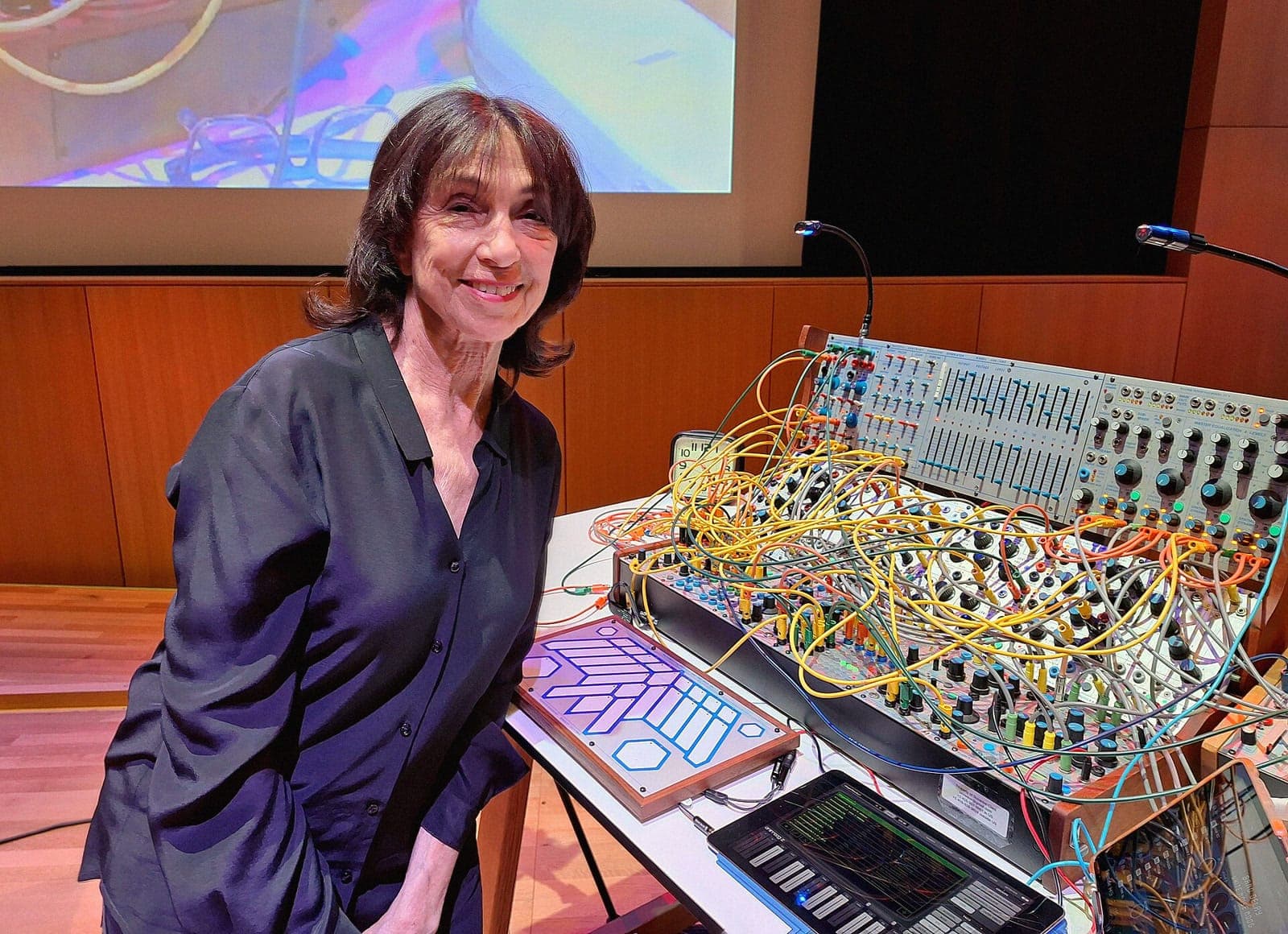
That line belongs to Suzanne Ciani, describing her early job at Don Buchla's synthesizer workshop after meeting him at Berkeley in 1968. She turned that hands-on knowledge of modular patching into a career soundtracking American consumer culture, most famously the pop-and-pour fizz of Coca-Cola's television ads, before scoring The Incredible Shrinking Woman in 1981 and becoming the first woman to solo-compose a major Hollywood film. In France, Éliane Radigue took the opposite route: after learning tape-splicing musique concrète from Pierre Schaeffer and Pierre Henry, she spent five decades composing almost exclusively on a single ARP 2500 she nicknamed Jules, pioneering the slow-built drone music that ambient and modular-scene producers still study. She died this February, aged 94, still composing until the end. In New York, Wendy Carlos pushed Robert Moog to add a filter bank and touch-sensitive keys to his synthesizer, then used it to record 1968's Switched-On Bach, a record so popular (three Grammys, the first platinum classical album) that it single-handedly convinced a skeptical music industry the Moog was an instrument, not a novelty. And at Bell Labs, Laurie Spiegel wrote algorithmic composition software before most musicians had touched a computer; her 1970s piece based on Kepler's Harmonices Mundi was chosen for the Voyager Golden Record, meaning a Bell Labs coder's music is now further from Earth than anything else humans have made.
None of this is a footnote to the men's version of the story. It is the story: the theremin's technique, the first electronic film score, the most famous TV theme in the world, the record that legitimised the synthesizer, the modular patch that scored a Hollywood film, the software behind algorithmic composition, all of it built or co-built by women who mostly weren't billed for it at the time.