What does OMNI actually turn the FM-1 into?
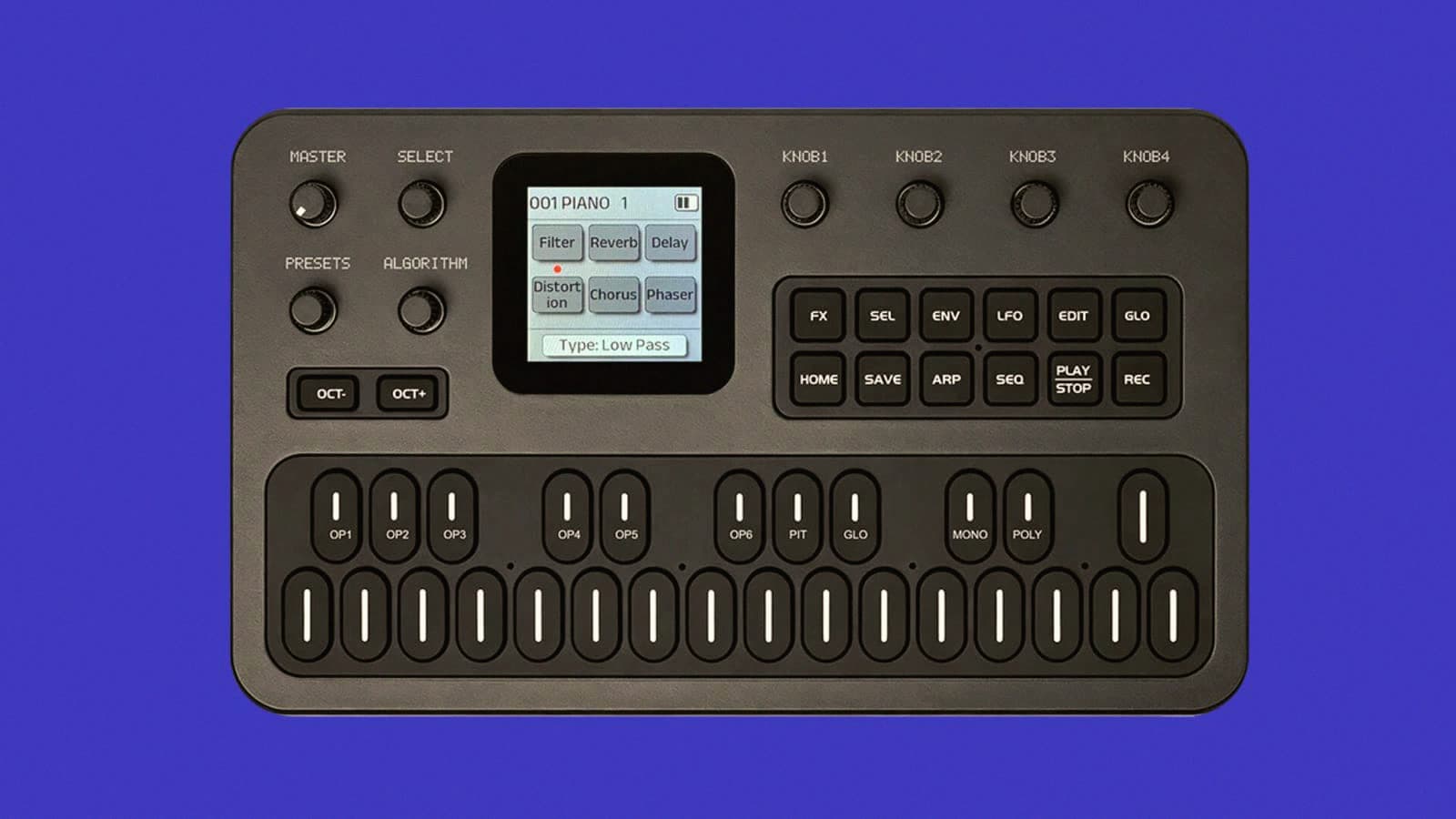
Open up the M-Vave FM-1 with Charles Vestal's OMNI firmware flashed on and the $60 FM box stops being an FM box. The 16 white keys become a strum plate, exactly like the Suzuki Omnichord's: run a finger across them and the current chord rings out as plucked strings. The 11 black keys sit above them as chord-select buttons, and two modifiers (ENV, LFO) turn a plain major chord into a minor, a seventh, or a minor-seventh with a second press. Underneath it all sits a small organ-style bass voice and ten rhythms modeled on the original OM-84's drum patterns, auto-synced so the bass and chord both lock to the beat the moment you strum.
The whole thing runs off one screen split into three pages, four knobs each. HOME covers voices and sustain, SEQ handles tempo, drum level and the auto-bass switch, FX gives you reverb, a spatial "room" control, stereo width and a lo-fi mode. No pattern programming, no menu-diving: you pick a rhythm, pick a chord, strum.
Why free, when someone else is charging $29 for a firmware mod?
The FM-1's custom-firmware scene has exploded in the back half of 2026, and OMNI is not even Vestal's first entry: he already shipped X0X, a standalone groovebox firmware that turns the same hardware into a TR-909/TR-808 pair with dual TB-303 acid generators. Alongside his work, developers like hugelton (Felucca, a nine-engine multi-sequencer) and isod89 (SLOOP, a free four-track groovebox) have been giving away full rewrites of the box's firmware under open licenses.
That's the backdrop that makes OMNI's price tag a statement rather than a footnote. A separate custom firmware for the same FM-1, Peter Gombos's Groove OS, turns it into an 8-track groovebox and sells for $29, built by a third party with no M-Vave warranty attached and no source code released. Flashing any custom firmware already carries a real risk, a bad flash can brick a $60 synth, and critics in the FM-1 community have pointed out that asking for money on top of that risk, with nothing open to inspect, is a harder sell than a free GPL project anyone can audit, fork or roll back themselves.
Strum the white keys, pick chords on the black ones.
That's the whole pitch, straight from the project's own description, and it works precisely because it costs nothing to try.
How do you actually try it?
No hardware required to start. Vestal built a browser-based emulator so you can play with the chord layout, the rhythms and the FX pages from a laptop before deciding whether to flash anything. If you've got an FM-1, there's also a web-based installer that works from Chrome or Edge with the synth plugged in over USB, and the firmware is built to roll back cleanly to the stock M-Vave firmware if you change your mind. The sound engine itself leans on Chordian, an existing open-source chord-instrument project, rather than reinventing that part from scratch, which is part of why a solo developer could ship something this polished this fast.
What's the Omnichord got to do with a $60 FM synth?
The Suzuki Omnichord, the instrument OMNI is explicitly modeled on down to its OM-84 rhythm bank, has been a cult object in ambient, lo-fi and house production circles for decades: an autoharp crossed with a cheap synth, built for anyone to strum a chord and get something musical out instantly. Putting that same idea, free, on top of a $60 FM synth that was never designed to do it is exactly the kind of move that keeps a budget box relevant six months after launch.