What does the AGE control actually do?
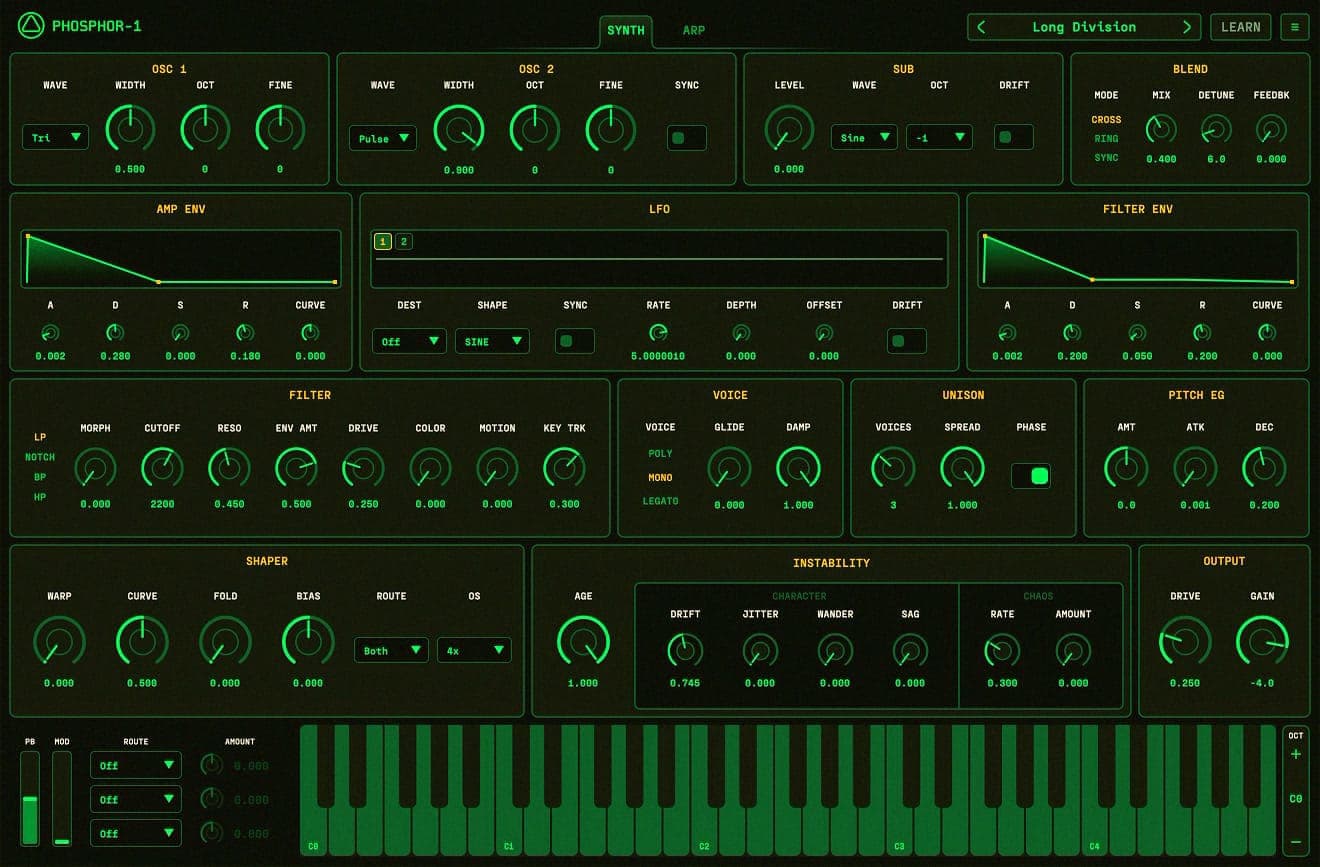
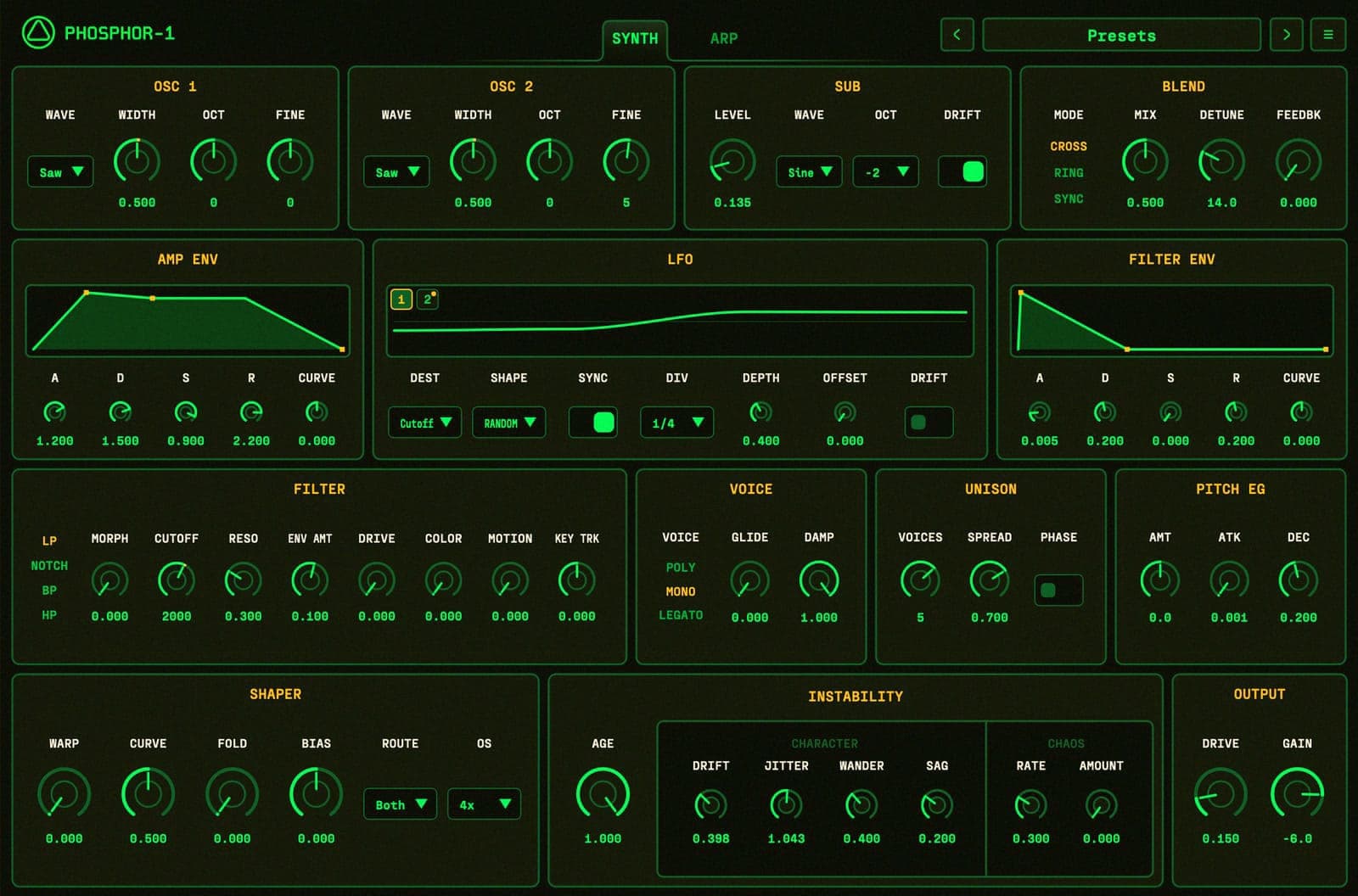
Phosphor-1 ships with a single master knob called AGE, and it doesn't behave like anything else on a synth's front panel. Turn it up and a built-in chaos engine starts pulling at pitch, filter, level and shape all at once, the same way an old analog machine drifts as its capacitors warm up or its power supply sags with age. It's not modulation in the usual LFO sense, it's the whole instrument slowly losing its composure the way real hardware does over a set, a session, or a decade in a rack.
Underneath that engine sit two multi-wave oscillators and a dedicated sub-oscillator that gets its own separate drift path, so the low end can wander independently of the lead voice. Cross-modulation, ring modulation and sync are there for shaping the raw tone before instability ever touches it, and OA-Labs built in 8-voice unison plus poly, mono and legato modes so the same drift can sit under a chord or a single wandering bassline.
Why would a producer want an unstable synth?
Most virtual analog plugins spend their engineering budget fighting drift: keeping oscillators locked, filters predictable, voices identical every time a key gets hit. Phosphor-1 does the opposite on purpose. That's the whole appeal for house and techno producers who chase the loose, slightly-off character of vintage hardware, the kind where a pad never sounds quite the same twice and a bassline has a faint wobble that reads as alive rather than broken. Deep house, organic house and anything built around a hardware-adjacent groove has always leaned on that imperfection; Phosphor-1 turns it into a single controllable parameter instead of something you can only get by tracking down an actual aging synth or spending hours hand-programming modulation to fake it.
An instrument that behaves exactly the same way twice can sound clean. It rarely sounds alive.
How was Phosphor-1 built?
According to Bedroom Producers Blog, the plugin came together in roughly two months, built by a designer and musician who leaned on AI-assisted coding to get the engine running while putting the actual design effort into the interface and how the synth ultimately sounds. That's a fast turnaround for a plugin with its own chaos algorithm at the core, and it fits a broader pattern of small, independent developers using AI as a coding tool to move quicker without outsourcing the part that actually matters: how the thing feels to play and tune by ear.
For now Phosphor-1 is macOS only, running as AU and VST3, with a Windows build in testing and a waitlist open on OA-Labs' site for producers who want in first.