Physical modeling synthesis has always been the expensive cousin in the plugin world: the kind of DSP that lives in research papers before it lives in a DAW. Different Instruments just skipped the markup entirely. PartialString, released this week, is a free plugin that generates plucked-string tones by numerically solving a wave equation in real time, and it runs on macOS, Windows and Linux with no license fee attached.
What makes FDTD synthesis different from a normal plugin?
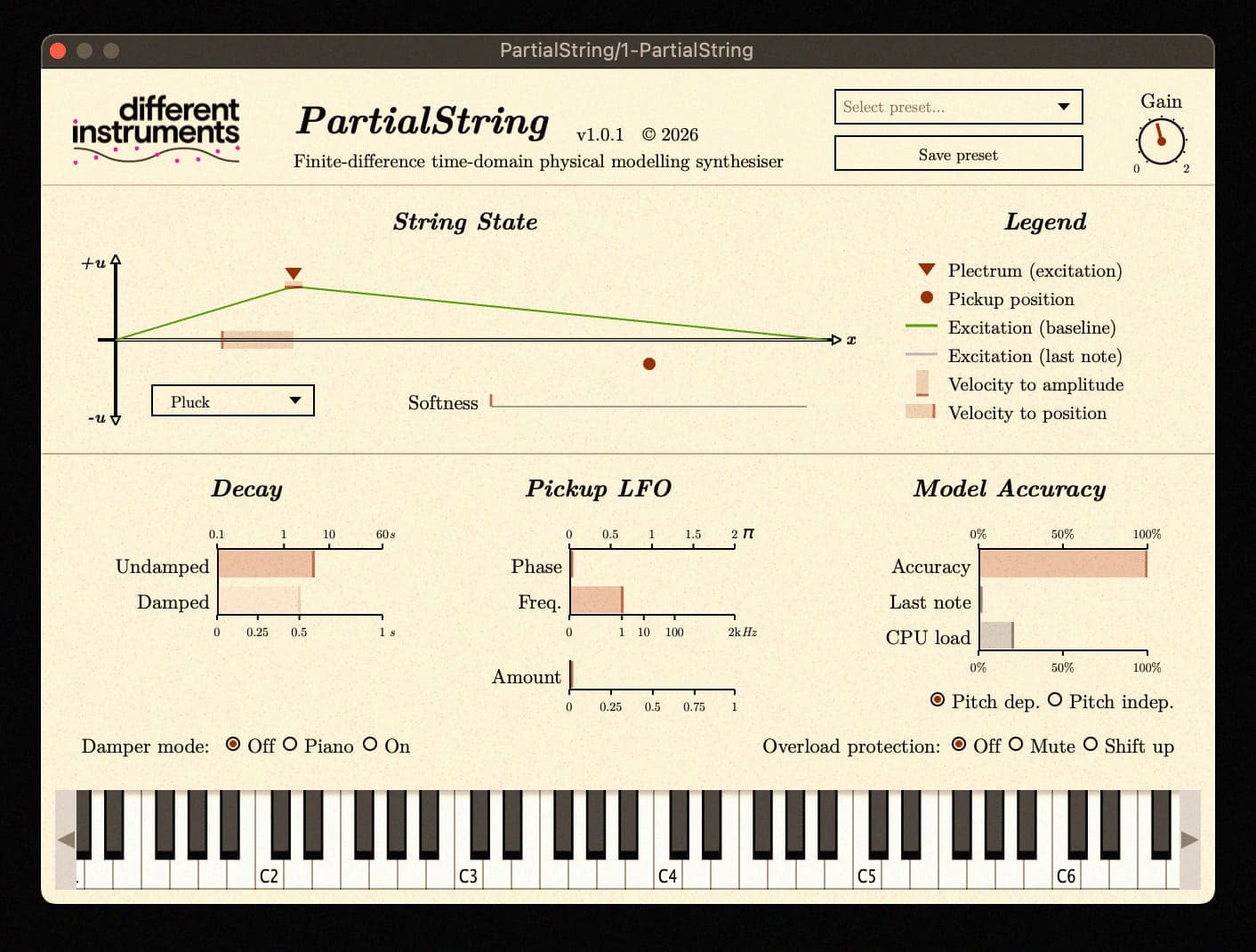
Most virtual instruments either play back recorded samples or shape a waveform with filters and envelopes. PartialString does neither. It uses finite-difference time-domain (FDTD) simulation, representing a vibrating string as a series of displacement points in memory and calculating how energy propagates across those points, sample by sample, the way a real string actually moves. A virtual pickup then reads the displacement at a chosen point on the string to generate the audio, mirroring how a pickup on a guitar or a hammer strike on a piano string works in the physical world. It is the same category of method acoustics researchers use to model real instruments, not a synthesis shortcut dressed up to sound organic.
That approach is why the timbres move the way they do: pluck position, decay and pickup placement all interact the way they would on an actual string, producing evolving, slightly unstable textures that subtractive synthesis has to fake with layered LFOs and noise. PartialString supports up to 10 voices, with the plugin dynamically trimming polyphony depending on CPU headroom and how long the simulated string is, since longer strings cost more to compute per sample.
Who built it, and why does that matter?
PartialString is a one-person project. Its developer, Christian Baker, works professionally as a biomedical engineer in ultrasonics, optics and photoacoustics, and did his MSc at the University of Edinburgh in 2009 under Stefan Bilbao, a researcher known for finite-difference modeling of musical instruments. That is not a marketing bio: FDTD synthesis is exactly the kind of technique that circulates in acoustics papers and rarely makes it into a consumer plugin, because getting a stable, real-time simulation running without artifacts is hard. Baker's first release under the Different Instruments name, gostringsynth, came out in 2022, and PartialString is the more developed follow-up.
"I'm amazed that this is a freebie. Quite an impressive synth, and it's not long ago that a synth like this would have been $200.", a commenter reacting to the release, quoted by Synthtopia
What can producers actually do with it?
For deep and deep-tech producers chasing textures that do not sound like every other plugin preset, PartialString is a plucked-string engine that behaves less like a sample library and more like an actual instrument responding to how it is excited and picked up. The interface groups controls into String State (Plectrum exciter and Pickup placement), Decay, Pickup LFO and Model Accuracy sections, giving fine control over exactly where on the modeled string the sound originates and how the simulation trades accuracy for CPU load. It is free to download, with an optional pay-what-you-want contribution to the developer.
Why it matters
FDTD synthesis has mostly stayed inside university acoustics departments and pricey specialist plugins. Giving it away free, with an optional tip jar, hands producers a genuinely different sound-generation method rather than another preset bank dressed up as innovation.
What we think
Most "physical modeling" marketing copy means a filter designed to sound organic. PartialString is the real thing, built by someone with the acoustics background to make the math stable in real time, and he is giving it away. That is worth more attention in production circles than another synth with a flashier GUI and a $99 price tag.