What does a phase-locked loop actually do to a sound?
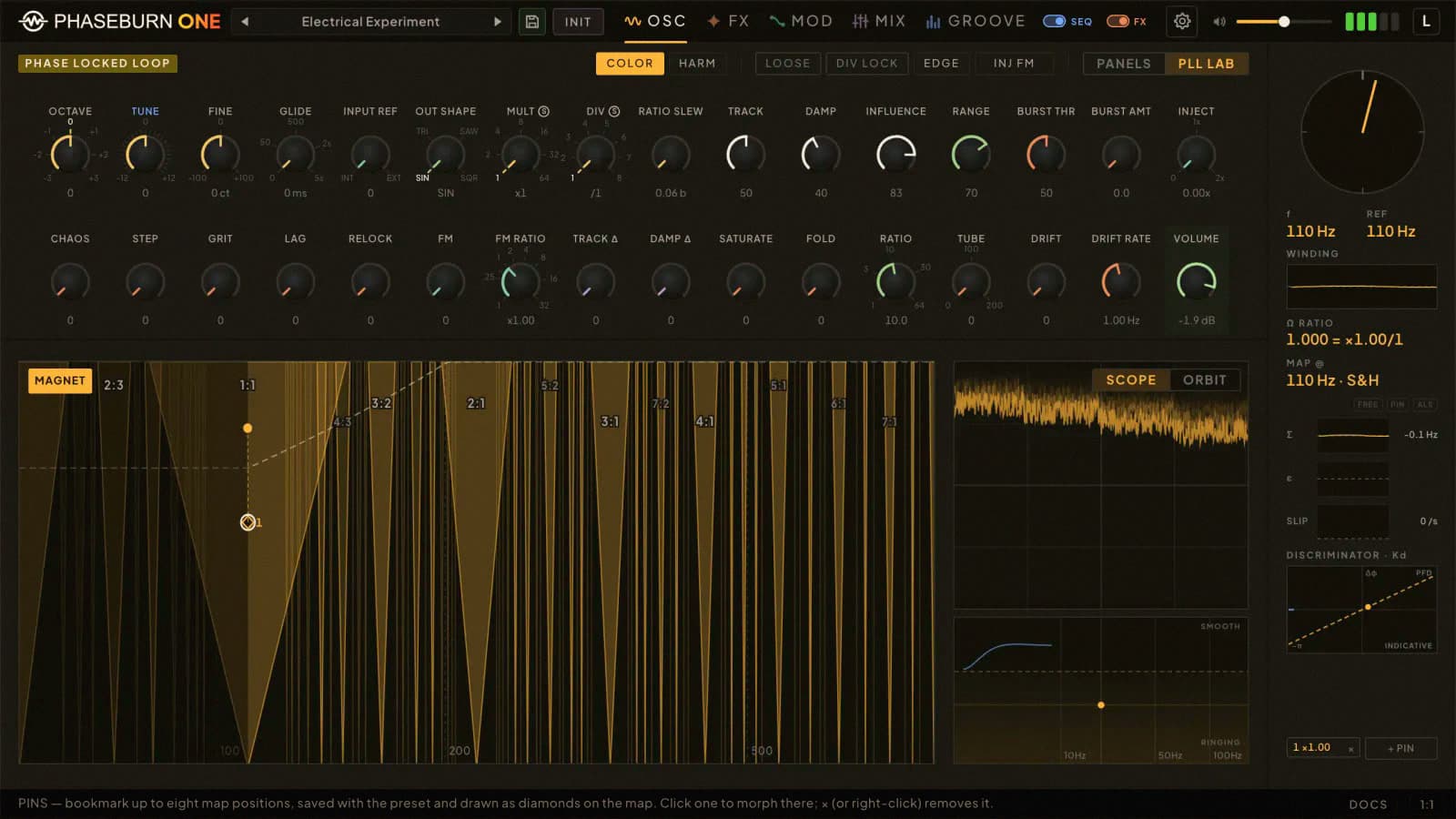
Every synth oscillator most producers have ever touched, analog or digital, free-runs: it generates its own waveform on its own clock and does not care what anything else is doing. A phase-locked loop is the opposite kind of circuit. Borrowed straight from radio tuning, a PLL constantly measures how far its own signal has drifted from a reference and pulls itself back into line. Locked tight, Phaseburn One's PLL oscillator gives a precise, weighty bass tone, the boring-in-the-best-way kind. Push it past what the loop can track and it glides, overshoots and slips into a controlled chaos no free-running oscillator produces, because a free-running oscillator was never chasing anything to begin with.
Four phase-detector modes decide how that chase falls apart. PD tracks cleanly, EDGE walks off pitch, XOR breaks into rhythmic bursts, and S&H holds its last reading and then jumps, each one a different flavor of instability layered on the same core circuit.
Why should a house or techno producer care about a control circuit?
The last decade of software synthesis has chased stability: wavetables, analog modeling, physical modeling, all engineered to never drift by accident. A PLL is engineered to drift on purpose and then correct itself, and that self-correcting motion is exactly the texture a lot of tech house and minimal basslines are missing, a low end that seems to breathe, tighten and loosen against the beat instead of sitting dead still under it. The ratio controls that set how many cycles the loop chases per reference cycle sweep continuously rather than snapping between fixed intervals, so a bassline can glide between ratios the way a modular patch does, without a single step of quantization.
What else is packed around the PLL?
The phase-locked loop is the headline engine, but Phaseburn One is not a one-trick plugin. It carries three additional oscillators plus a dedicated sub, true stereo generated at the oscillator stage rather than widened afterward, and a patchbay that wires its modules in series, parallel or feedback, the kind of routing usually reserved for modular racks. A probability sequencer assigns each step a chance rather than a certainty, so the same pattern rolls a little differently every pass, and the effects section carries a frequency-shifting delay and a freezer alongside filtering, chorus, reverb, distortion and a bitcrusher.
Locked, it's precise, weighty bass. Pushed, it glides, overshoots and slips into controlled chaos no ordinary oscillator can make.
What does it cost, and where does it land among 2026's boutique synths?
Phaseburn One is free to use while it stays in open beta. Developer Phaseburn Music has set 15 October 2026 for the v1.0 launch, when the price becomes €149. The whole 64-bit signal path is written natively in Rust rather than modeled on an existing chip, part of a wider run of small independent studios shipping distinctly non-standard oscillator architectures this year instead of another take on the same analog-modeled subtractive synth. It will not be for every producer. It is squarely for the ones bored of wavetables and hunting for a low end that fights back.