What does a phase-locked loop actually do to a sound?
Phase-locked loops are not new, just new to plugin synthesis. Radio engineers use them to lock a receiver onto a broadcast frequency; pitch-tracking pedals and harmonizers use the same trick; modular heads know the behavior from hardware like the Doepfer A-196 or the WMD Synchrodyne. Phaseburn, per Synth Anatomy's report on the plugin, took that control circuit and turned it into a playable voice for Phaseburn One's free beta.
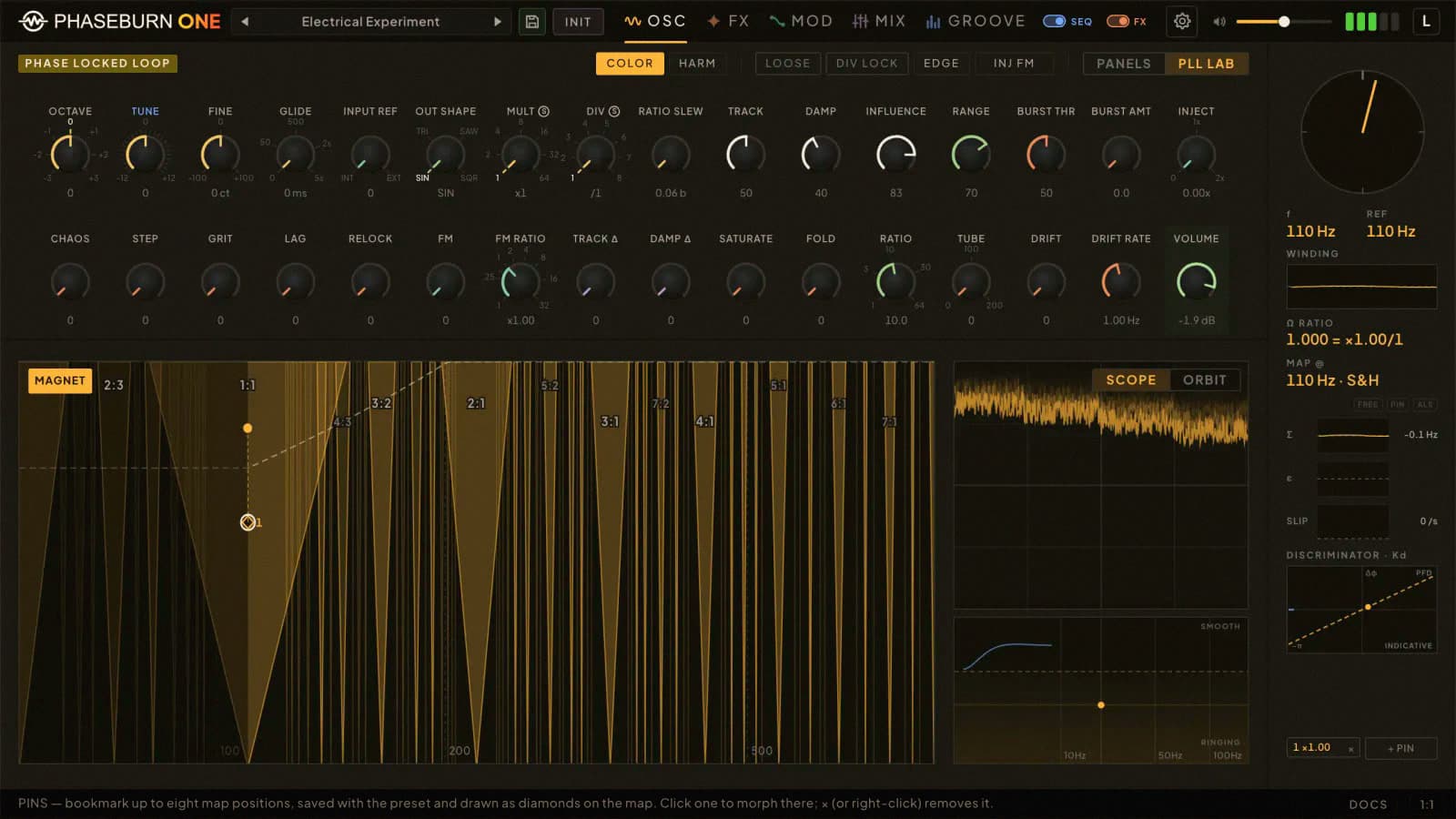
The idea: a PLL oscillator listens to a reference signal and continuously tries to match its frequency and phase. Feed it something stable and it behaves. Push it past its RANGE and CHAOS settings and it starts to fail, catching up, overshooting, breaking the lock, then snapping back. That failure is the sound. Four phase detectors, PD, EDGE, XOR and S&H, each fail in their own way: XOR breaks into bursts, S&H freezes its last reading and jumps, EDGE walks unevenly. MULT and DIV set the ratio the loop chases, so a single note can generate harmonic relationships a wavetable or VA oscillator cannot reach alone, because neither design has a second oscillator actively fighting to catch the first.
Why bundle a PLL with three ordinary oscillators?
Phaseburn One is not a one-trick plugin. The PLL sits alongside a Vector Phase Shaping oscillator (phase-morphing across X/Y coordinates, with a formant mode), a Morph engine running 12 modes from classic waveshapes to detuned unison, additive and spectral wavetable, and a sub oscillator down three octaves. Up to four oscillators per voice route through one shared filter and effects section, plus a patchbay, a probability sequencer and a modulation matrix spread across five UI pages. The whole engine runs in 64-bit Rust with custom DSP the length of the signal path, on macOS and Windows as VST3, AU, CLAP and standalone.
That range matters for who ends up buying it. A PLL alone is a novelty for a small crowd chasing unstable, glitchy harmonics. Wrapping it inside a conventional multi-engine synth gives sound designers a reason to open the plugin on ordinary days too, and a path to stumble onto the PLL once they are already inside.
"A synth whose main oscillator is a phase-locked loop."
That is how Phaseburn itself describes One on the KVR Audio forum, where the beta first surfaced publicly on August 21, 2026.
What is the actual business play here?
The beta is free and fully featured until October 15, 2026, when the license switches to a one-time €149 payment, activated online and usable offline after that, no subscription required. The ten most active beta testers get free licenses outright; others earn discounts for submitting presets or feedback. It is the standard indie-plugin funnel: build a community around the beta, collect presets and bug reports for free, then convert the goodwill into sales the day pricing kicks in.
For sound designers tired of the wavetable-versus-virtual-analog argument, the pitch is simple: a third lane that behaves unpredictably by design, priced like a mid-tier plugin rather than a boutique modular module. Whether €149 holds up against synths with a decade of preset libraries behind them is the real test that starts in October.