What actually makes REVERSIDE different from a normal reverb plugin?
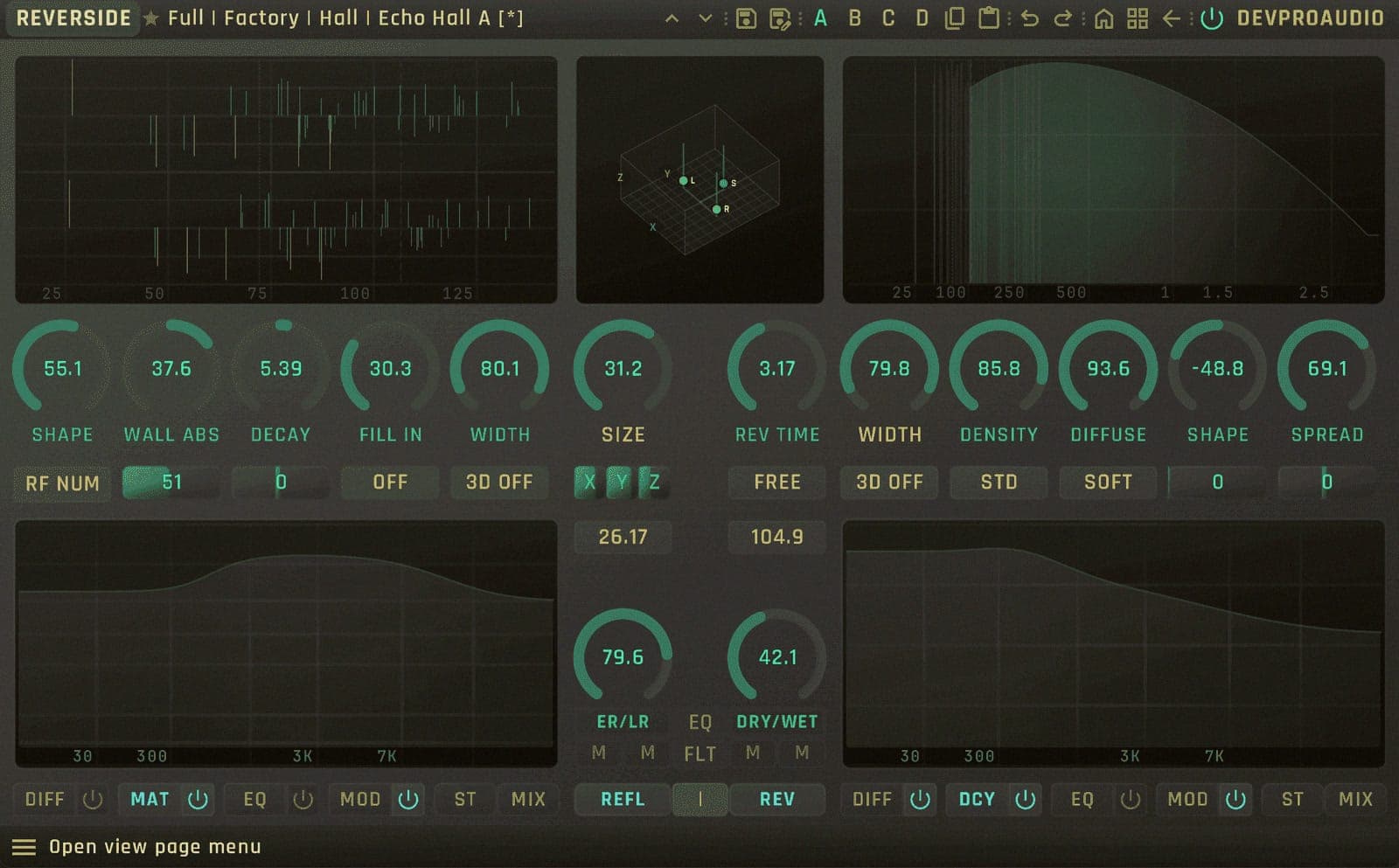
Most reverb plugins blend everything into one algorithm and let you nudge a size knob. REVERSIDE, the new release from DEVPROAUDIO, the studio behind the Aether and B2 reverbs, splits the signal into two fully independent engines instead. The Early Reflections engine models up to 200 discrete reflections off a virtual room's walls, with an AUTO mode that derives the count from the room's geometry, plus adjustable wall absorption and fill. The Late Reflections engine handles the tail separately, running through 14 diffusion models and a non-exponential "EXT" envelope that shapes attack and decay in ways a standard exponential curve can't. Each engine gets its own mini-diffusers, per-channel decay shaping, and a three-band EQ and filter section, so a producer can build a tight, dry slap-back on the early side while running a completely different, smeared, cavernous tail underneath it. Per Synthtopia, the plugin also carries more than 100 built-in LFOs, so nearly any parameter, the room's size, the diffusion, the filter cutoffs, can be set in motion rather than left static.
Why does 3D spatial positioning matter for house and techno producers?
The feature that sets REVERSIDE apart is its interactive 3D positioning system: producers place a virtual sound source and a virtual listener along X, Y and Z axes inside the modeled room, watching the direct path, early reflections and late field update live through angle and position displays. That's a genuinely different way to think about reverb. Dub techno, and a lot of the deeper end of house, built its whole identity on the idea that a track lives inside an implied physical space, the spring-tank wash of a Rhythm & Sound record, the cavernous dub delay running through Basic Channel's catalog. Producers have always chased that feeling with sends, EQ tricks and layered reverbs. A tool that lets you literally draw the room and move the source and the listener inside it turns an intuitive, ears-only craft into something you can see and repeat.
Most reverb plugins ask how much space you want. REVERSIDE asks what shape the room is, and exactly where you're standing in it.
Who gets REVERSIDE free, and what does it cost everyone else?
REVERSIDE ships as VST3, CLAP and Audio Unit v2 for both Windows and macOS, priced $135 / 120 euro. DEVPROAUDIO is offering it free to existing SpinAudio users and to 2CAudio customers who bought before November 1, 2021, a nod to the plugin's lineage from those earlier reverb lines. Everyone else can try a fully functional demo before buying.