What makes Quadra different from a normal effects chain?
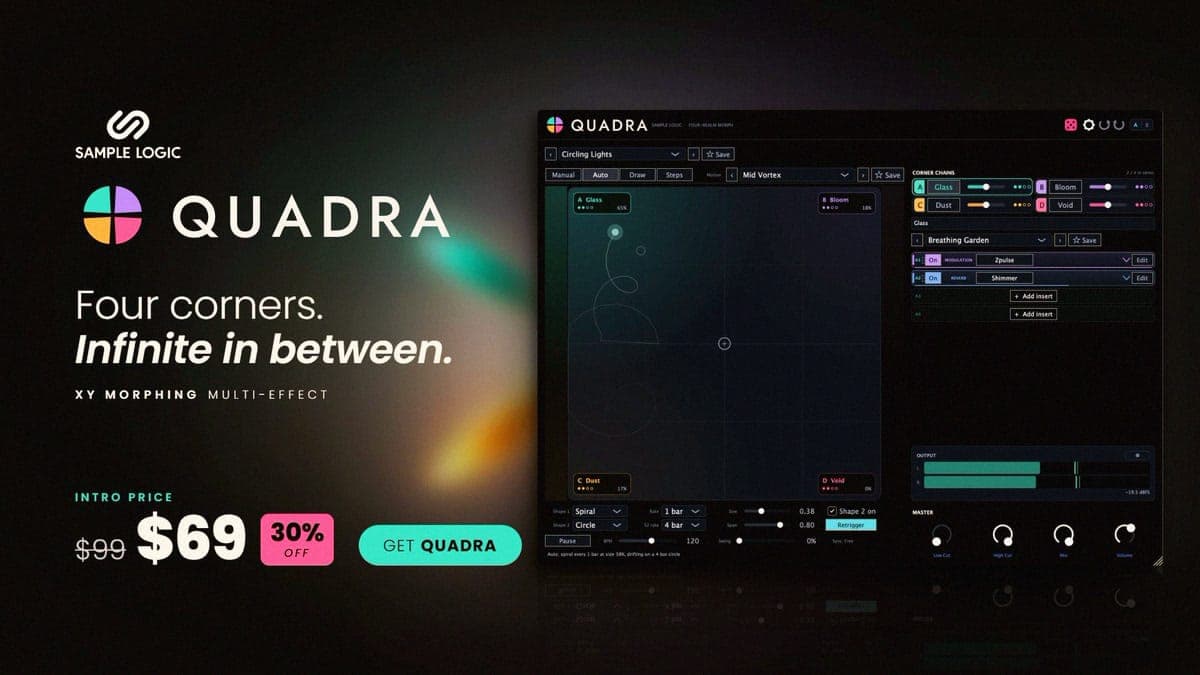
Most multi-effect plugins force a straight line: reverb into delay into distortion, in whatever order you dragged them. Sample Logic's new Quadra throws that model out. It arranges four complete, independent effect chains, each holding up to four of Quadra's 22 studio-grade effects, at the four corners of an XY Morph Pad. Instead of picking one order and sticking with it, a producer sets up four different destinations and blends between them.
How does the morphing actually work?
You can drag a single point across the pad by hand, or hand control to Quadra's Motion Engine, which can run the morph automatically, follow a path you draw, or step it through a 16-stage sequencer. That same morph point also responds to MIDI and modulation sources, so a mod wheel or an LFO can push a sound from dry to drenched mid-performance without touching the mouse. A convolution effect with 81 impulse responses lives inside that same four-chain architecture, alongside A/B comparison and full undo and redo for anyone building out a bank of custom chains.
Why would a house or techno producer care?
A straight effects chain is predictable: the same reverb tail, the same filter sweep, every time. Quadra's four corners are built for the opposite, four completely different textures sitting in one plugin, with a single fader, key or controller deciding which one, or which blend of two or three, you're hearing live. For a tech house producer who wants a hi-hat loop to breathe between a tight, dry pattern and a crushed, cathedral-sized one without stacking separate plugins, that is the kind of real-time move a linear chain simply can't make. Quadra ships with 630+ factory presets, including 150 Master Presets across 12 styles, so there's a running start before anyone builds a morph of their own.