What did Steve Duda actually build?
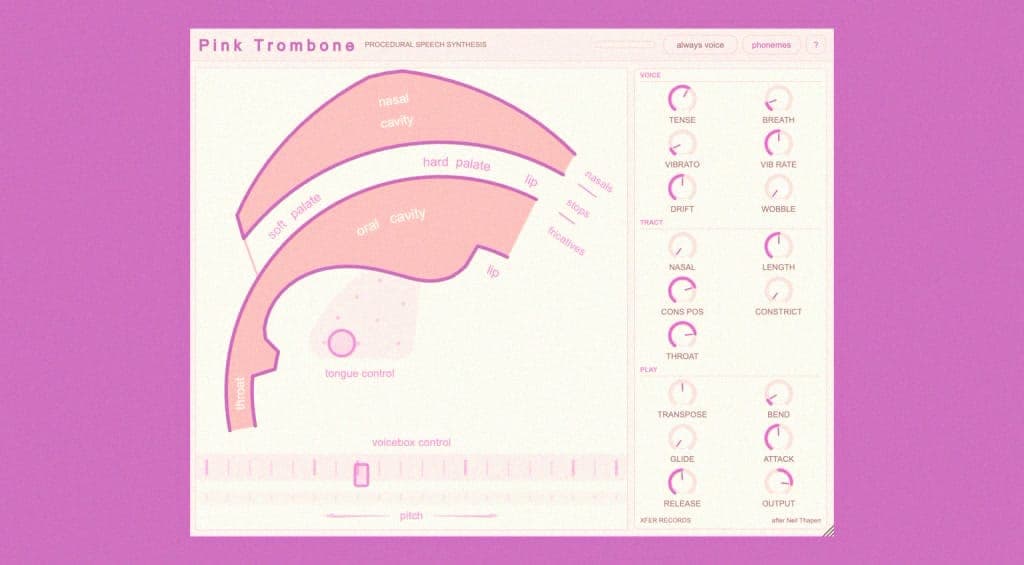
Steve Duda, the Xfer Records founder whose synth Serum sits in half the house, techno and bass templates out there, has ported Pink Trombone, the browser toy the programmer Neil Thapen built in 2017, into a standalone VST3/AU plugin for macOS (Apple Silicon and Intel), Windows and Linux. It's free, and it comes in two forms: an instrument you play like any synth, and an FX processor that runs outside audio through the same vocal-tract model. On top of the original toy's oral and nasal cavity controls, Duda added Voice, Tract and Play sections, four AHDSR envelopes and four multi-wave LFOs, exactly the modulation depth anyone would expect from an Xfer plugin.
Why does a browser toy matter to a Serum user?
For most of the last decade, Pink Trombone was pure internet ephemera: a cartoon cross section of a mouth and throat you dragged with a cursor until it grunted, moaned or approximated a word. But it also, quietly, lived a second life among sound designers and modular heads, who found something in its raw glottal pulse and formant shifts beyond the joke: actual synthesis. Physical modeling of the vocal tract produces textures no subtractive or wavetable engine reaches on its own, and Thapen never packaged it as an instrument. That somebody had to do the plumbing to get it into a DAW, and that the somebody is the guy whose own plugin already lives in half the scene's templates, is the real story here. A niche toy doesn't usually get a serious developer's attention. This one got Xfer's.
A model of a mouth just got treated like real gear, because the guy who builds real gear decided it deserved to be.
What can producers actually do with it?
Run it as an instrument and the vocal tract becomes a genuinely strange melodic and pad source, more human-adjacent than any vowel-morph wavetable preset, but detuned and unstable in a way that reads as alive rather than sampled. Run it as FX and you can push a bassline, a vocal chop or a drum bus through the same model to get formant coloration no EQ or vocoder plugin fakes convincingly. Since it's free and cross-platform, there's no real reason for a curious producer not to load it up this week and see what breaks.