Long before a drum machine ever hummed in a Detroit basement, a tape splicer in a West German radio building was cutting sound into pieces nobody had heard before. That building is where this story starts, and it starts with a broadcaster, not a nightclub.
Why did a radio station build a studio for noise?
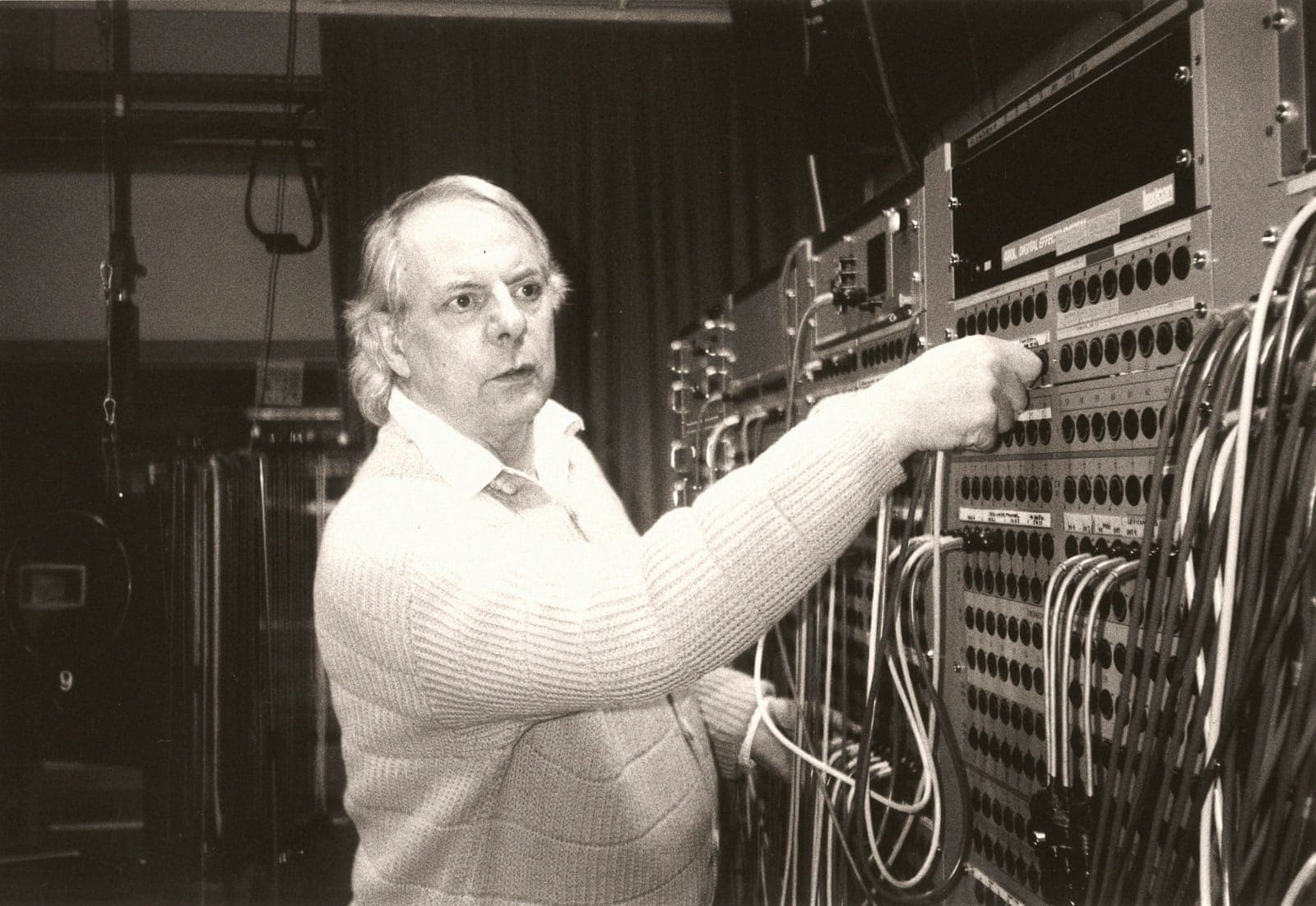
Westdeutscher Rundfunk (WDR) opened its Studio for Electronic Music in Cologne in 1951, the first facility of its kind housed inside a broadcaster anywhere in the world. It existed to generate sound from electronic sources alone (sine-wave generators, filters, tape manipulation) rather than record acoustic instruments. Karlheinz Stockhausen joined in 1953 and spent the next decade turning the studio's oscillators and tape loops into composition. His 1956 piece "Gesang der Jünglinge" spliced a boy's voice with pure electronic tone, built entirely in that Cologne studio, and remains a reference point for anyone who has ever layered a vocal chop against a synthesized pad. This was avant-garde concert music, not dance music, but the method (building a track from generated and processed sound rather than played instruments) is the same method a producer uses today.
How did the studio's methods reach a Cologne rock band?
The connection isn't speculative. Holger Czukay and Irmin Schmidt, who founded Can in Cologne in 1968, had both studied composition under Stockhausen. Czukay in turn introduced engineer Conny Plank, who had worked inside WDR's own studio culture, into that circle. Plank became the connective tissue of the next decade: he engineered Can's early records, then moved on to shape Kraftwerk's first four albums, and later worked with Neu! and Cluster. The through-line from an academic tape studio to a rock and electronic underground ran through specific people who worked together, not a vague “German sound.”
Why does Kraftwerk matter to house and techno specifically?
Kraftwerk built their own Kling Klang studio in Düsseldorf starting in 1970 and, across records from Autobahn (1974) to Trans-Europe Express (1977) and Computer World (1981), turned electronic composition into repeatable, danceable structure: pulse, sequence, groove. That shift, from the studio-as-laboratory to the studio-as-instrument for rhythm, is what Detroit picked up on. Juan Atkins has said he first heard Kraftwerk on Detroit radio via DJ Electrifying Mojo, alongside George Clinton and Parliament-Funkadelic, and has described Detroit's own electronic development as running “basically parallel” to what was happening in Germany rather than as a straight copy. Derrick May put the fusion more bluntly when Kraftwerk played Detroit in 2015, describing the city's techno as sounding like “George Clinton and Kraftwerk caught in an elevator with only a sequencer to keep them company.”
"George Clinton and Kraftwerk caught in an elevator with only a sequencer to keep them company.", Derrick May, on the sound of Detroit techno
That's the lineage: a broadcaster's laboratory in 1951, a composer's decade of tape experiments, a Cologne rock band staffed by his former students, the producer who linked them to Kraftwerk, and a Düsseldorf studio whose sequenced pulse crossed the Atlantic on late-night radio. None of it was inevitable, and none of it happened in a single studio or single city. It happened because specific people kept working with each other.