Did a genre named for its soul just get flagged as soulless?
Yes, and it is the joke nobody at Traxsource wanted to make. On 1 July 2026 the download store switched on its AI-detection program, and every release now wears one of two badges: Human-Made or AI-Assisted, with anything judged fully AI-generated pulled from sale. The detection is run with two partners, SH Labs and SoundPatrol. In the first sweep, eleven tracks sitting in the general Top 100 already carried the AI-Assisted tag, and several of them were soulful house, the one genre whose entire promise is the human hand: the warmth, the gospel roots, a singer who means it. A style named for soul, stamped by an algorithm as something close to soulless. You could not script it better.
How does Traxsource decide what is human?
The line the store draws is between AI as a tool and AI as the author. A producer using a plugin to clean a mix stays Human-Made; a track prompted into existence with no human at the center gets removed. “We don't believe AI is going away,” said cofounder Brian Tappert. “Everything we're doing is about finding a way to live with it, and making sure the value stays where it belongs, with human-created works.” His partner Marc Pomeroy reached for the supermarket: “We envision a future where shopping for music is like shopping for food today, conventional products right next to certified organic, with the choice left to the consumer.” Two things are worth saying out loud. First, the label is a probability, not a verdict: detection errs in both directions, it can brand a human producer a machine, and it can wave through AI good enough to sell. Second, Traxsource knows this, which is why it runs a rebuttal process for anyone who thinks a track was mislabeled.
If the machines are that good, who has already fooled the charts?
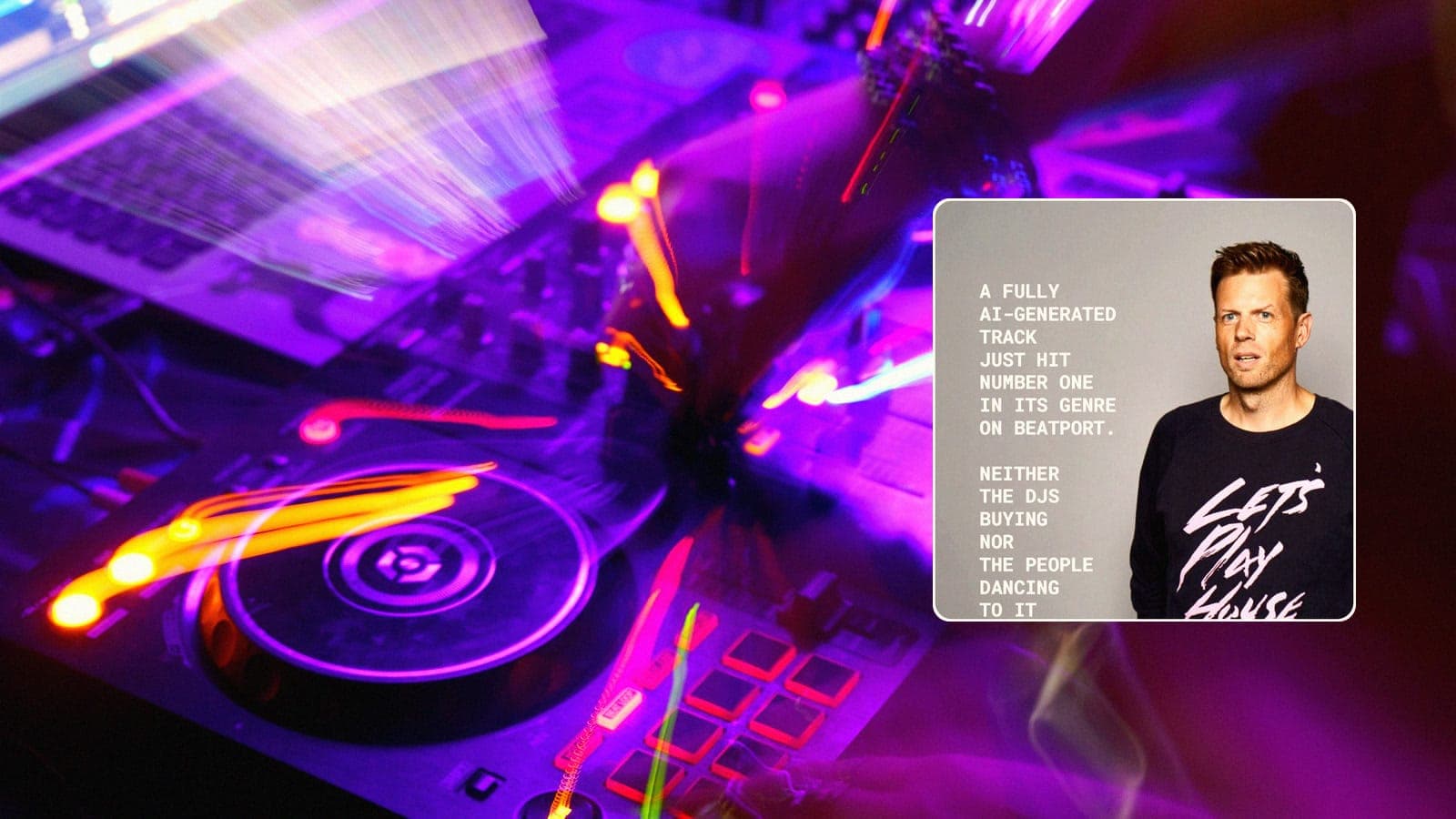
Someone already has. Kevin McKay, the founder of Glasgow Underground, went public in late June with a confession that should unsettle every A&R in the scene: he chased a track he loved, from an artist he rated, and later learned the whole thing had been prompted in Suno, no stems, no session, no human performance. “The same artist had a Beatport number one. Fully AI. Nobody knew,” he wrote. His point was not that the music was bad. It was the opposite. “This isn't AI slop, it's convincing, chart-topping music that sounds exactly like the rest.”
“This was never a callout. It's a warning.” Kevin McKay
What happens to curation when a label cannot trust its own ears?
This is where the badge stops being funny. A chart is a trust machine: it tells DJs what is moving, tells buyers what to trust, tells labels who to sign. If a fully AI track can sit at No.1 with nobody noticing, the co-sign is worth less. If a detector can wrongly brand a human soulful-house record as AI-Assisted, the human takes the reputational hit for a machine's success. Both errors corrode the same thing, the scene's ability to believe its own charts. Traxsource has at least put the question on the table where Beatport, Spotify, Deezer, Apple and YouTube have mostly mumbled. Whether a badge can rebuild trust, or just formalize the doubt, is the argument that will run all summer.