Why does additive synthesis scare producers off?
Additive is the oldest trick in the synthesis book and somehow still the least loved. The premise is simple: any sound can be built by stacking sine waves, one per harmonic, each with its own level and movement over time. The reality is a wall of numbered partials, a spreadsheet you are meant to sculpt into something musical. It can do textures subtractive synths choke on, the glassy, metallic, bell-like, slowly morphing stuff, but most people open an additive synth, see 128 numbered slots, and quietly close it again.
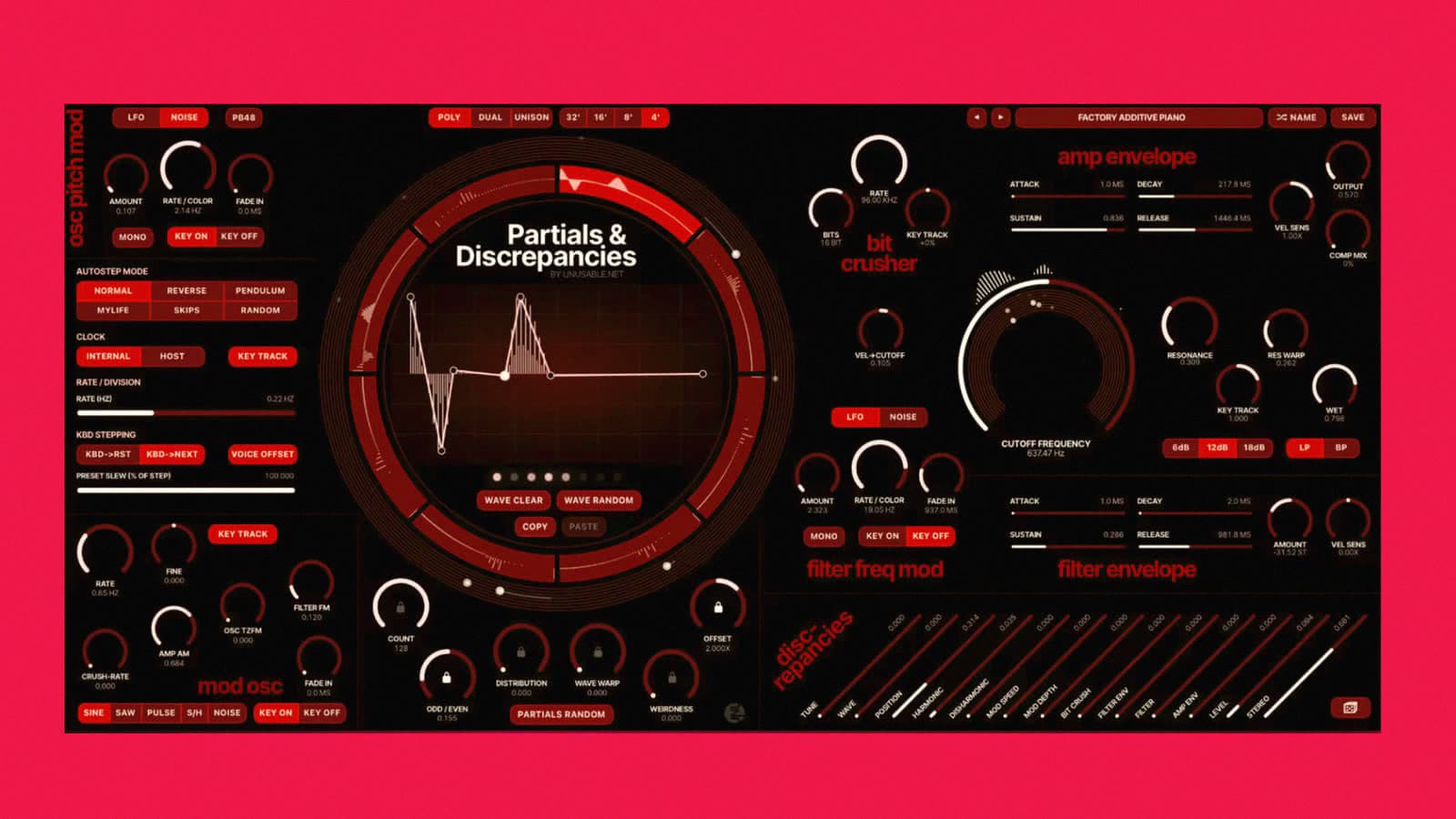
That reputation is exactly what Unusable Engineering, a small developer, just took a swing at. On 27 June 2026 they shipped Partials & Discrepancies, an 8-voice additive synth for macOS and Windows in VST3 and Audio Unit, at 79 EUR including VAT. Each voice runs an oscillator with up to 128 overtones. The pitch is not more partials. It is partials you can stand to touch.
What actually makes it playable?
The centrepiece is a rotating circle with a slot-based animation. Instead of a long numeric list, each slot holds a full partial shape, and that shape is defined by seven node handles you drag, with the option to invert phase in sub-areas. So you are drawing and bending forms rather than typing values into harmonic 47. From there you work in groups: shape them, offset them, warp them, and push them into what the developer calls disagreement, partials that no longer line up neatly. That is where the name comes from, and it is also where additive stops sounding like a tuning fork and starts moving on its own.
The honest innovation here is not the engine, it is the gesture: dragging shapes around a wheel instead of editing a table of numbers.
There is a conventional spine underneath, so you are not stranded in abstraction: a bit-crusher, a resonant filter with cutoff, resonance and a res warp control, amp and filter envelopes, LFO and noise modulation, and poly, dual and unison voice modes. It is the company's second instrument, after Curves & Membranes, a mono synth built on Bezier wave-shaping, and it arrived the same day as three new effect plugins from the same shop.
Is approachable additive a real win or a gimmick?
Here is the genuine take. Approachable additive is a real win, with a catch. The catch is that the things additive does best, evolving spectra, inharmonic motion, sounds that breathe, still demand that you understand what a partial is and what happens when you detune or invert one. No interface removes that. What a good interface removes is the friction between the idea and the sound, and a wheel of draggable shapes is a smarter map of that territory than a column of numbers. For an underground house or techno producer chasing organic, glassy, slightly wrong textures, this is the rare additive tool you might actually keep open. At 79 EUR it does not have to be your main synth to earn the slot.