What does 16-partial spectral synthesis actually let you do?
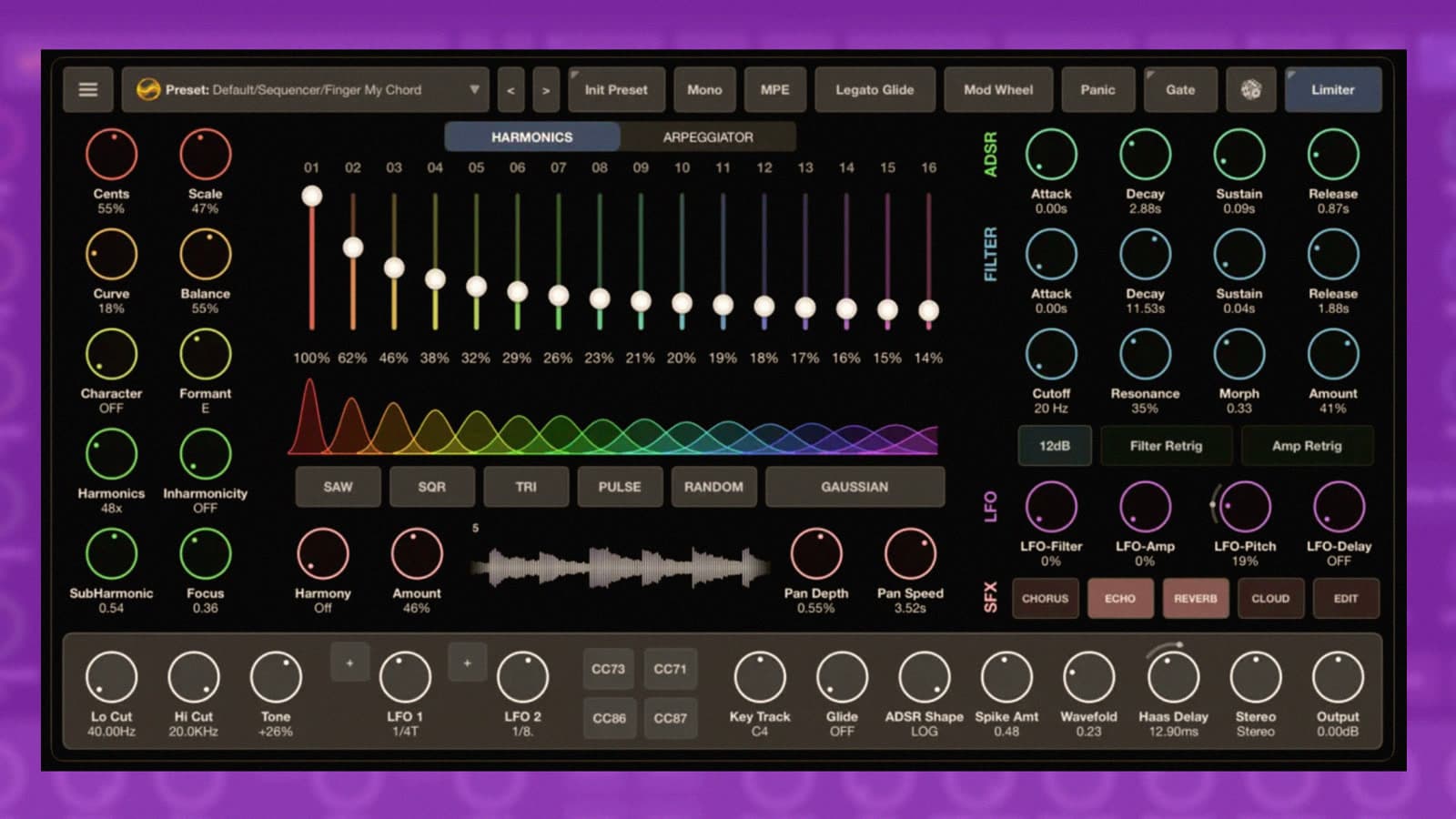
Most synth apps still build sound the old way: pick an oscillator shape, run it through a filter, shape it with an envelope. 4Pockets' new SpectraPad, released this week for iPadOS and macOS, works from the other direction. Its engine breaks a sound into 16 harmonic partials and hands you a slider for each one, so you're shaping the balance and character of individual frequency components rather than picking a waveform and hoping the filter gets you where you want to go. That kind of control used to live in academic spectral processing software or hardware costing multiples of a modest studio budget. SpectraPad puts it on a touchscreen for 9.99 euros, a price that rises to 14.99 euros once the launch window closes.
The app pairs that partial-by-partial control with a formant function that imposes vocal-like A, E, I, O and U tonal qualities onto whatever you're building, plus the rest of a conventional synth's toolkit: a multimode filter, ADSR envelopes, LFOs, a stereo arpeggiator, gate FX, and a multi-effects section running stereo delay, echo and cloud effects. It runs as both a standalone app and an AUv3 plugin, and it supports MPE and MIDI CC, so an expressive controller can actually drive the spectral shaping in real time instead of just triggering notes.
"SpectraPad is designed so you don't need to understand spectral synthesis to enjoy it," 4Pockets developer Paul told Synth Anatomy.
Why does a formant function matter for house producers?
For deep, tech and organic house specifically, this is the part worth paying attention to. Vowel-like formant shaping is exactly what turns a static pad into something that breathes, the texture that makes a chord stack sound like it's saying something rather than just sustaining. Producers have historically reached for vocoder plugins, granular tools or a patched-together Max for Live device to get that effect. SpectraPad folds it into the same interface as the partial sliders, so shaping the spectrum and shaping the vowel character become two dials on one instrument instead of two tools you have to route together by hand.
What does a "lengthy" Apple review say about indie iOS audio right now?
4Pockets says SpectraPad went through a lengthy Apple review process before it reached the App Store, per Synth Anatomy's reporting. That's a small detail with a bigger implication. A studio this size building a serious instrument still has to clear the same opaque, unpredictable review queue as every disposable utility app, with no fast lane for a tool that took real engineering to build. It's one more data point in a pattern small iOS audio developers have been describing for a while: review delays that cost real revenue and launch momentum, for an app that always needed Apple's permission to exist at all.