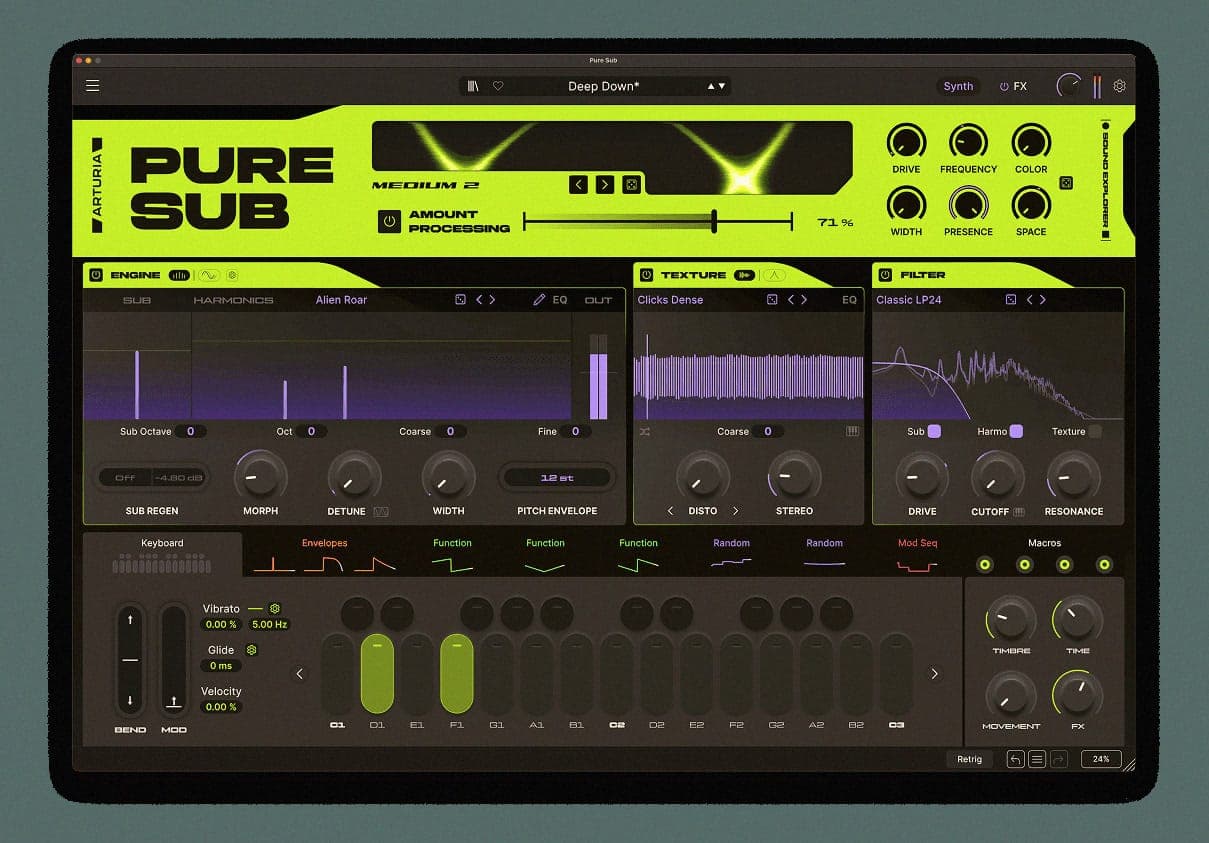
Open the signal-chain diagram of almost any wavetable synth built in the last decade, Serum and its army of imitators included, and you'll find the same order of operations: oscillators first, filter next, then whatever time-based effects come last to add space without touching the core tone. The whole point is control. Keep the source clean, sculpt it precisely, decide exactly how much mess to add and where.
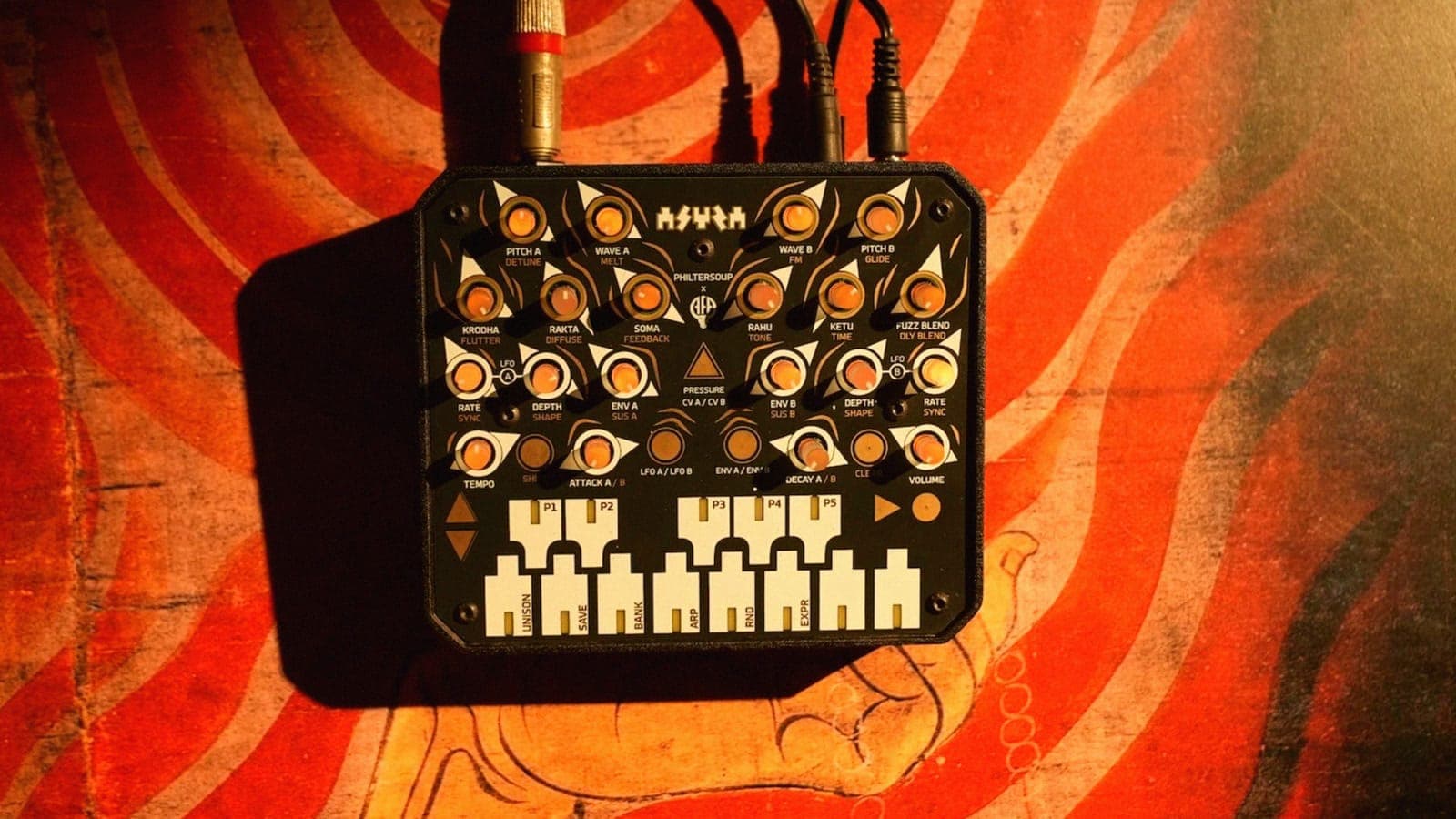
Animal Factory Amplifications just shipped pre-orders for a synth that throws that order out. Asura is a 6-voice polyphonic wavetable instrument built with Sanjay Das, aka Philtersoup, and its defining feature is a dual-headed granular delay, one that plays grains forward and backward, feeding directly into a custom analog fuzz circuit positioned after it in the chain. The fuzz doesn't touch the dry oscillator signal. It mauls the echoes.
Why put distortion after the delay instead of before it?
Run fuzz first and you get a distorted note that then repeats cleanly, predictable and containable. Run the delay first and feed its reversed, granulated trails into an analog fuzz circuit, and the distortion reacts to material that's already unstable: pitch-shifted grains, reversed transients, echoes stacking on echoes. The result isn't a dirtier version of a clean patch, it's a different kind of instrument, one where the effects chain is structurally responsible for the tone rather than a coat of paint over it. That's the whole pitch of Asura: not distortion as an option you can dial in, but distortion baked into the architecture so you can't easily get a pristine sound even if you wanted one.
Underneath that routing sits a fairly conventional wavetable engine on paper: two wavetable oscillators per voice, six-voice polyphony, seven built-in wavetables split across two banks with a user bank for importing your own tables. None of that is unusual. What's unusual is that Animal Factory built the ugly, unstable part of the chain first and designed the rest of the instrument around making that part sing.
Why does a synth built in India matter here?
Asura isn't a Berlin or LA boutique-synth story. Animal Factory Amplifications was founded by Aditya Nandwana, and Asura is the product of a five-year collaboration with Sanjay Das, an Indian producer working as Philtersoup. The synth is designed, built and shipped from India, with pre-orders running until October 15 at Rs. 47,698.94, roughly €433, and units going out from October 31.
That's worth flagging on its own terms. Boutique hardware synthesis has been dominated for decades by a handful of manufacturing hubs in Europe and North America. A six-voice polyphonic instrument with a genuinely unconventional signal architecture, engineered and shipped from India rather than imported as a rebadged product, is exactly the kind of global-south hardware story that deserves more attention than it gets.
Why it matters
Most of the wavetable-synth market is competing on the same axis: cleaner modeling, more precise modulation, glossier presets. Asura stakes out the opposite territory, a synth engineered from the ground up to sound broken in a specific, controllable way, and it does it from a manufacturing base outside the usual synth-industry map.
What we think
The reversed signal chain is the real story, not the spec sheet. A dual-headed granular delay bleeding straight into analog fuzz is the kind of unhinged routing that produces textures you can't get from a preset browser, exactly the grit deep and tech producers have spent years chasing out of broken pedals and circuit-bent gear. Worth watching who picks this up once units actually ship at the end of October.
What is a wavetable synthesizer?
It's a synth that generates sound by cycling through a table of stored single-cycle waveforms rather than a single fixed waveform, letting you morph between timbres smoothly. Serum popularized the format for its clean, modern digital sound; Asura uses the same core wavetable engine but routes it through a deliberately destructive effects chain instead.