What is ShinRonin, and why does its return matter?
Audio Damage has been making oddball effects since 2002, and ShinRonin was one of the first. It arrived in 2003, stayed in the catalogue until 2009, then vanished when the company moved on. Bringing it back now, rebuilt for Apple Silicon and modern hosts, is a small act of preservation, and the price tag makes it a gift: it costs nothing.
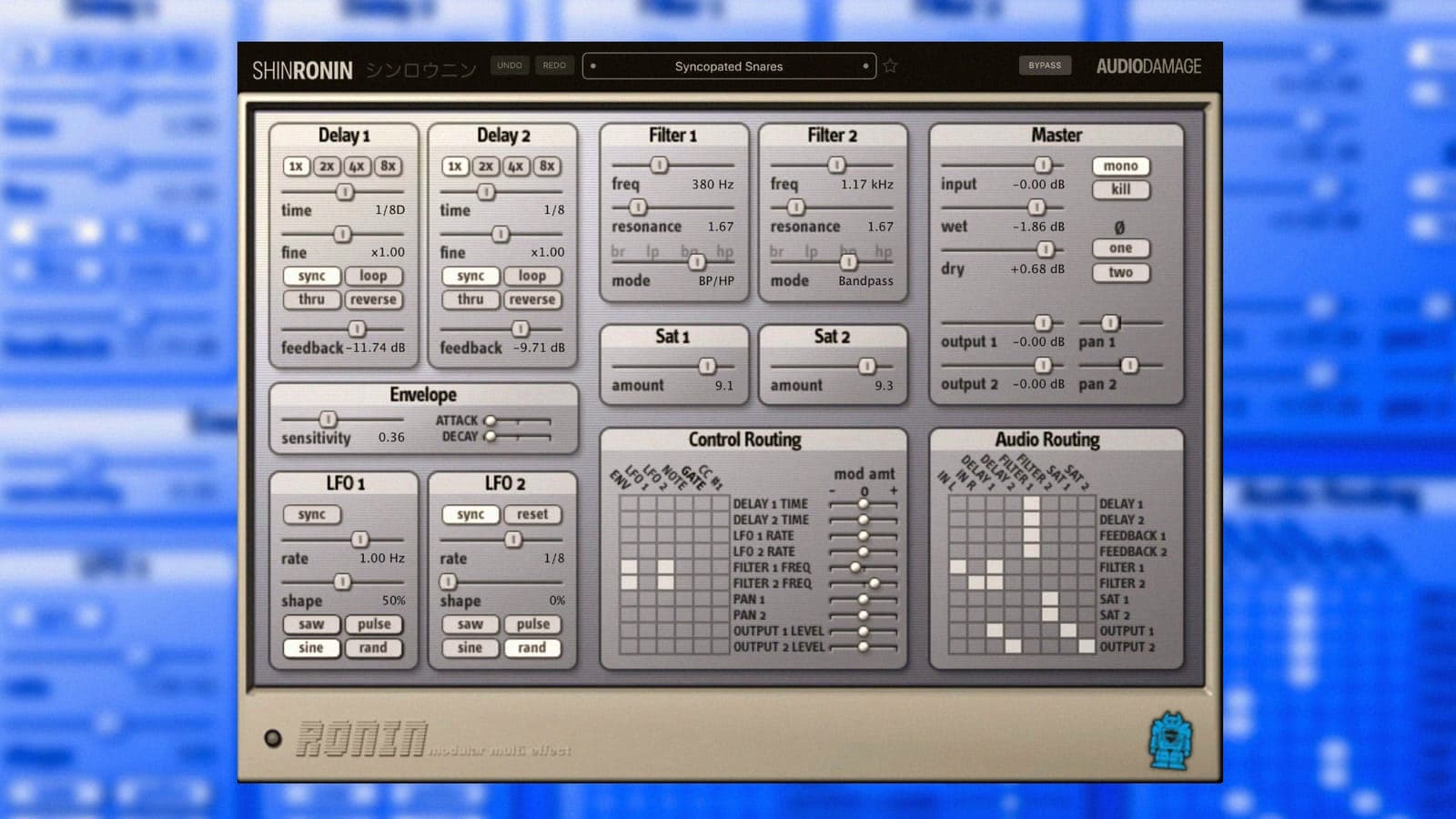
The concept is two of everything. Two delay lines, each able to sync to tempo, loop, run in reverse or pass straight through, with character that moves from clean digital repeats to tape-style wobble. Two morphing filters that glide between lowpass, bandpass and highpass rather than snapping between them. Two saturation stages for grit. On top sit two syncable multi-wave LFOs and an envelope follower, and a semi-modular patch matrix that lets you route audio and modulation between the modules instead of down a fixed chain.
How does it fit a house or techno workflow?
This is a dub and texture machine. Drop a stab or a chord into the twin delays, set one short and one long, then sweep the filters with the LFOs and you get the kind of moving, rain-on-a-window echo that dub techno and deep house live on. Reverse one delay line and the same loop turns into something that breathes backwards. Because the routing is semi-modular, you can feed one delay into the other, or let the envelope follower open a filter only when the kick hits, which is the trick behind a lot of pumping, call-and-response patterns.
Free tools that do one weird thing well tend to end up on more records than the expensive all-rounders.
The practical pull is that it is a single plugin doing a job that usually takes a delay, a filter and a modulation rig wired together. For anyone building dubby spaces or evolving pads, that is a faster route to motion.
What is the catch?
There is no catch worth calling one. No iLok, no online check-in, no demo timeout, no expiry: you download it and it works, on Mac, Windows and Linux, with an iPad build promised. Audio Damage has form here, having open-sourced or freed older products before. The only real limit is that a 2003-era design is focused rather than sprawling, but that focus is the appeal. It does delays and filters, with character, for nothing.