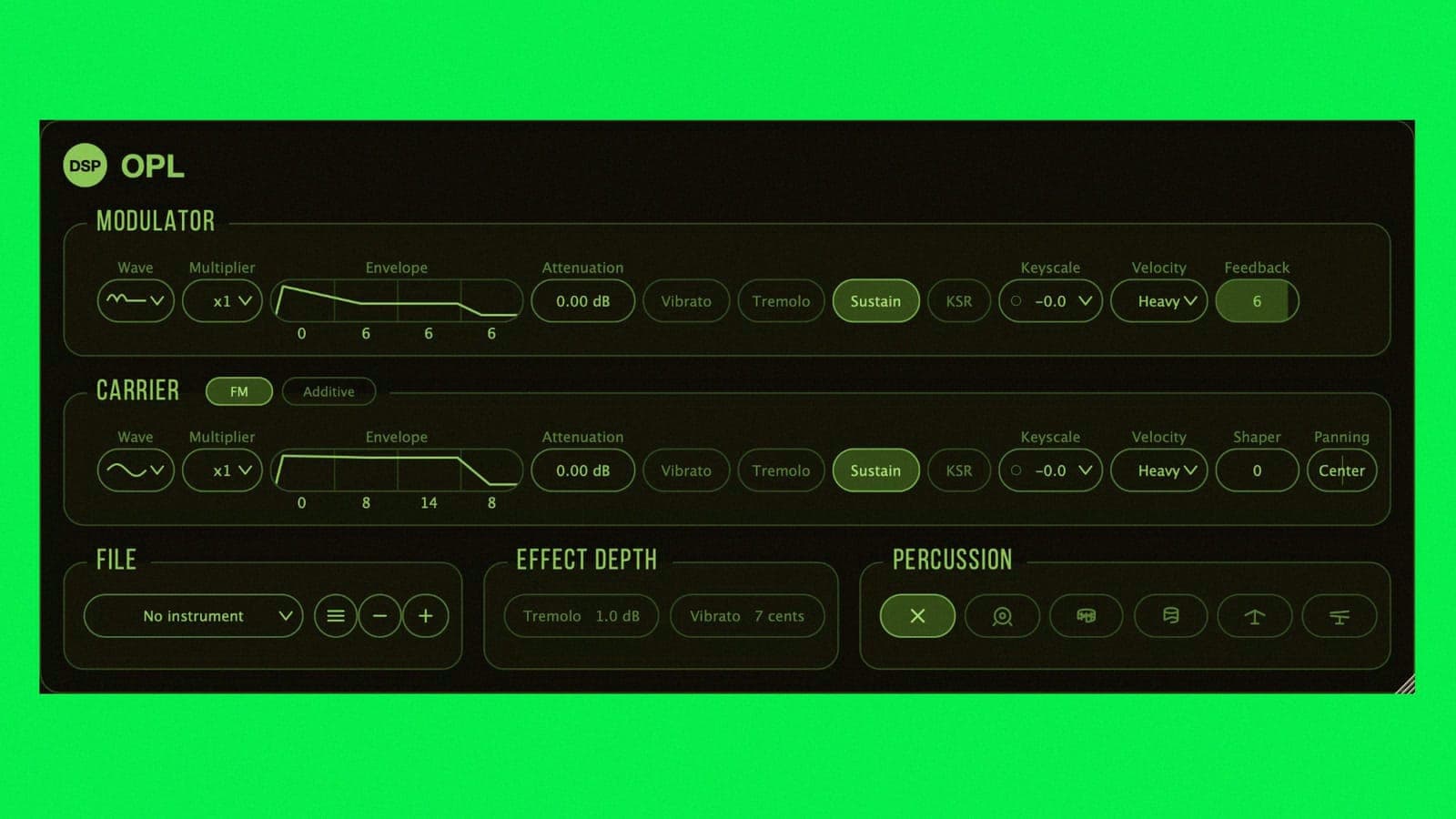
For 40 years, the Yamaha OPL2 chip (the YM3812) has had one job in electronic music culture: making a Sound Blaster card sound like a tiny, buzzing orchestra. discoDSP has emulated it in plugin form since 2016, and on August 10 it pushed OPL to version 3.0, the biggest rework the plugin has had.
What actually changed in OPL 3.0?
discoDSP rewrote the synthesis core, the register layer and the interface. The headline change: every operator now has all eight OPL3 waveforms (sine, half sine, absolute sine, quarter sine, alternating sine, camel sine, square, logarithmic sawtooth) instead of the four it shipped with before. That waveform set is what actually gives OPL-era FM its bite, plain sine operators alone won't get you the AdLib rasp.
Chip oversampling now runs up to 16x, which knocks down the aliasing that shows up in FM synthesis once you push modulation hard, while discoDSP corrected pitch, envelope timing and key scaling to hold steady across every oversampling setting. Offline bounces switch to a linear-phase filter with reported latency, so a render actually matches what you heard while working. The interface, previously fixed-size bitmaps, is now resolution-independent vector graphics in a freely resizable window with a zoom menu and live voice-activity indicators on the envelope displays.
Is this now an OPL3 emulator?
Not quite, and discoDSP is upfront about it. Its own product page calls OPL 3.0 an emulation of 'the OPL2 in full, with the OPL3 waveform set and a subset of its other features.' That distinction matters if you know the chip history: the original OPL2 (Yamaha YM3812, 1985) ran two-operator FM across nine channels with four waveforms per operator, and it's what powered AdLib cards and early Sound Blasters. Its successor, the OPL3 (YMF262, 1990), added a four-operator mode, more channels, stereo panning and the eight-waveform set, and it's what ran Sound Blaster 16 and AWE cards.
discoDSP's plugin is built on ymfm, the open-source Yamaha chip emulation library, and stays on the two-operator OPL2 engine underneath. What version 3.0 imports from the newer chip is its waveform table and a handful of other features, not the full four-operator architecture. Coverage elsewhere has called this a jump to 'full YMF262 emulation', which overstates what's actually in the plugin: more waveforms per operator, not a new chip.
"Emulates the OPL2 in full, with the OPL3 waveform set and a subset of its other features.", discoDSP, OPL product page
Why would a house or techno producer care?
FM synthesis from an actual chip lineage sounds different from a modern FM plugin modeled on ideals of clean sound design: it's grainy, digital, unmistakably retro in a way that's become its own aesthetic in house and techno production, from stabby leads to gritty basslines that cut through a system without eating headroom. Doubling the waveform palette per operator gives producers more of that specific texture to sculpt with, without adding new gear or a steeper learning curve than the plugin already had. At $49 for new buyers, it's a cheap way into a genuinely distinctive sound source most soft synths don't touch.
discoDSP sells OPL as VST, VST3, AU and AAX on Windows, macOS and Linux, plus an AUv3 app on iOS that picked up its own updates in this release: an integrated MIDI keyboard, continuous vibrato depth and the same oversampling options as desktop.