What's Actually Inside Sunset Circuits?
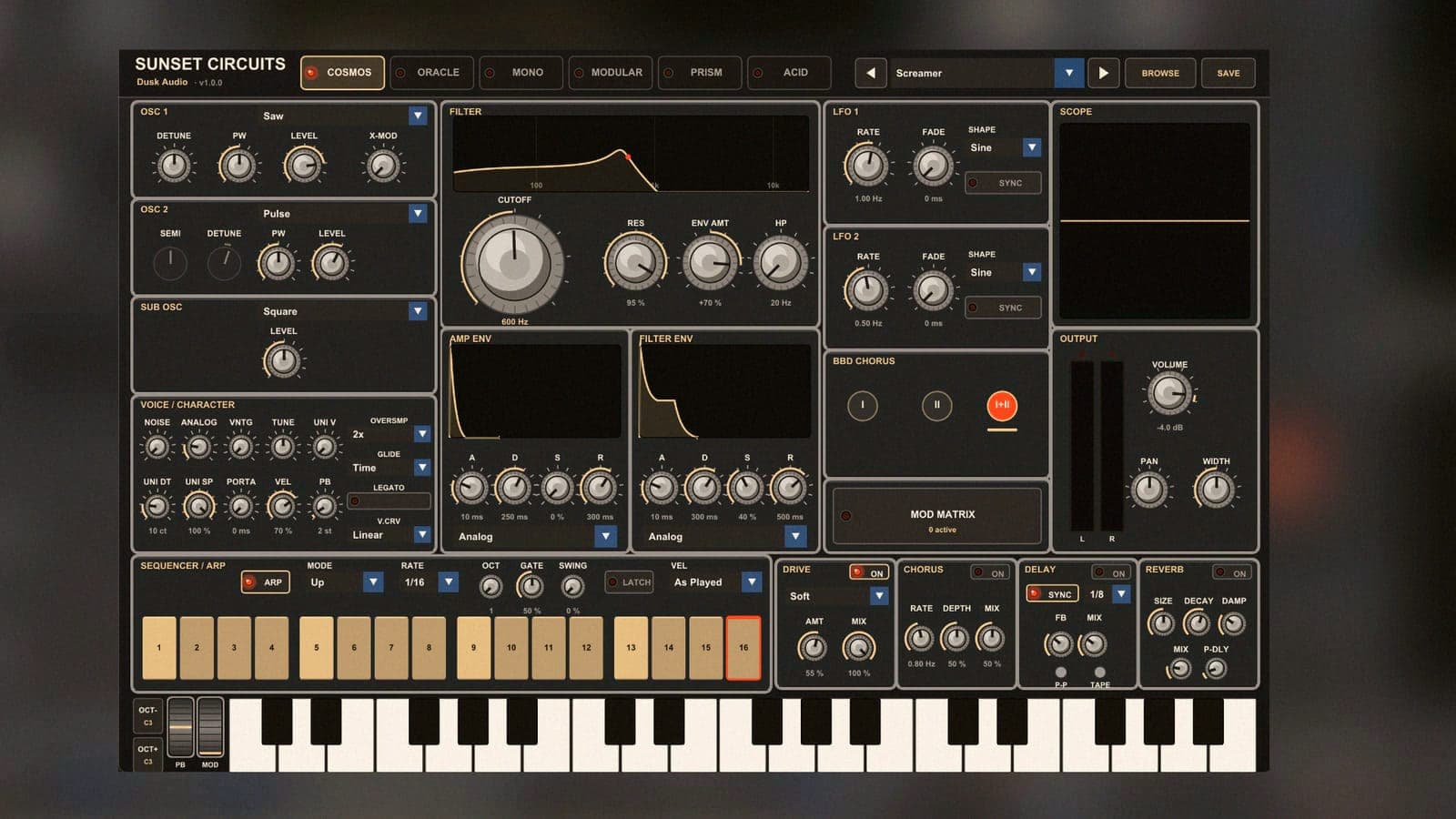
Dusk Audio's new instrument isn't one synth, it's six, stacked behind a shared set of controls. Cosmos covers early-80s six-voice polysynth territory with DCOs and BBD chorus. Oracle chases the late-70s analog polysynth sound with two oscillators and a self-oscillating filter. Mono is a snarling monophonic engine built for bass and leads, with a sub-oscillator, ring mod and hard sync. Modular is a semi-modular patch bay with a built-in spring reverb. Prism is a four-operator FM engine with eight algorithms. And then there's Acid: a TB-303-style bass box with a diode-ladder filter and its own 16-step pattern sequencer, per Dusk Audio's own release notes and Synth Anatomy's coverage of the launch.
That last engine is the one that matters most to anyone making house or techno. The 303's rolling, resonant bassline built an entire subgenre, and hardware clones or premium plugin recreations of that circuit routinely cost real money. Dusk Audio ships one, folded into a bigger instrument, for nothing.
Why Does Free and Open Source Actually Matter Here?
Free plugins aren't rare. Free AND open source is: Sunset Circuits is released under the GPLv3 license, with the full source code sitting in Dusk Audio's public GitHub repository. That's a different promise than a company giving away a stripped build to collect emails. A GPLv3 project can be forked, audited and kept alive by anyone, even if Dusk Audio stops maintaining it.
For a producer without a studio budget, that combination, zero cost, permanent availability, an actual acid engine, closes a gap usually filled by cracked software or a secondhand TB-303 nobody can afford. It runs on Windows, macOS and Linux, in VST3, AU, CLAP and LV2, which covers a laptop running Bitwig on Linux as easily as a Mac running Logic.
What Do You Get Beyond the Acid Engine?
Sunset Circuits is built to cover a full session, not just one sound. Cosmos and Oracle handle pads and stabs in two distinct vintage-poly flavors. Mono and Prism cover bass and lead duties outside the acid lane. Modular is the deep-end option for anyone who wants to build a patch from scratch instead of starting from a preset. All six sit behind one shared layout and an eight-slot mod matrix, with 54 factory presets and a searchable user library to start from, and the entire plugin loads in at roughly 300KB.