Why Is Fabric Skipping a Traditional Club for a Bridge in Brooklyn?
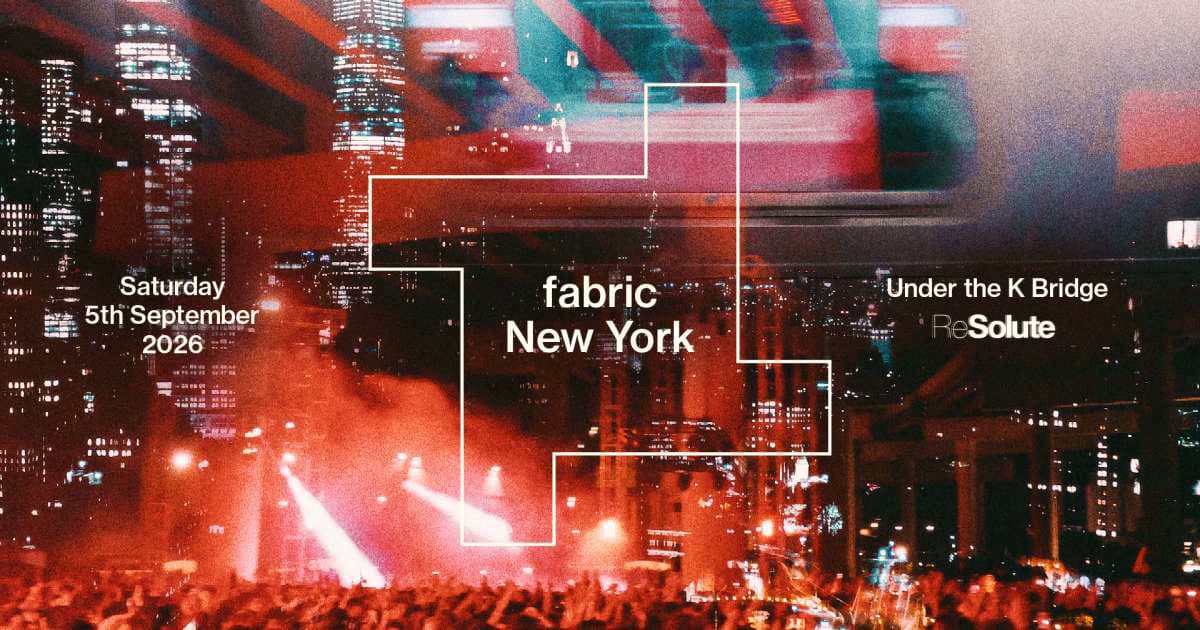
fabric isn't opening a New York outpost or booking a residency inside an existing room. It's building a one-off audiovisual production at Under the K Bridge Park, the industrial waterfront site tucked beneath the Kosciuszko Bridge on the Brooklyn-Queens border, running from 2pm to 2am on September 5. That choice says something. fabric's identity was built inside a specific room, sound system and crowd, in a converted Victorian cold store on Charterhouse Street. Rather than try to recreate that inside a rented Manhattan basement, the brand is leaning into what an outdoor industrial space can do that a conventional club can't: scale, daylight-to-dark programming and a visual production by studio dreamrec built around the site itself rather than bolted onto someone else's room.
It's also a low-risk way to test the US market. A one-day event run under New York promoter ReSolute's banner carries none of the licensing exposure of opening a permanent venue, exposure fabric knows too well.
Why Does Fabric Even Need to Prove Itself Here?
Because for 27 years it never had to. fabric opened in October 1999 in a former meat cold store near Smithfield Market and became one of the clubs that defined UK dance music's post-warehouse era, twice voted the world's best club in DJ Mag's Top 100. In September 2016, Islington Council pulled its licence outright after two drug-related deaths, citing a "culture of drug use" staff couldn't control, and briefly shut down London's most influential room for good. It took a #SaveFabric campaign that raised more than £200,000 and a negotiated settlement with the council and the Metropolitan Police to get the doors back open in January 2017, under a tightened ID and surveillance regime. A club that fought that hard to keep its own address doesn't cross an ocean for a minor booking.
Who's Actually Playing, and What Does the Bill Say About US Techno?
Jeff Mills headlines. He co-founded Underground Resistance in Detroit and has spent three decades as one of techno's most rigorous, uncompromising DJs, the opposite of the festival-EDM booking that usually gets handed a US "debut" headline. Around him: Ben UFO and Craig Richards, two of British club culture's most respected selectors, both built on unclassifiable, crate-dug sets rather than genre formula, and Helena Hauff, the Hamburg DJ and producer who has become one of Europe's most in-demand names for exactly the kind of raw, unpolished techno fabric was built to host. It's a bill assembled for people who already know these names, not a lineup engineered to trend.
A promoter doesn't fly Jeff Mills and Craig Richards across the Atlantic to chase a viral moment. This bill is aimed at people who already know why fabric matters.
What Does This Signal for the US Underground Scene?
fabric choosing Brooklyn, and specifically an outdoor industrial site over a Manhattan club, is a bet that American audiences want the same thing fabric's UK crowd always wanted: a serious sound system, a lineup built on reputation rather than algorithm, and a room, or in this case a bridge, that doesn't need bottle service to sell tickets. If it works, expect fabric back in the US, and expect other European institutions watching closely how a one-off event lands before deciding whether to follow.