Most Eurorack manufacturers guard their firmware like a trade secret. Hermetic Modular, a new Seattle-based outfit, is doing the opposite: its debut Alchemy Lab platform ships every module with an MIT-licensed firmware layer and a public SDK, an invitation for owners to rewrite what the hardware does rather than just what it sounds like.
What is the Alchemy Lab actually selling?
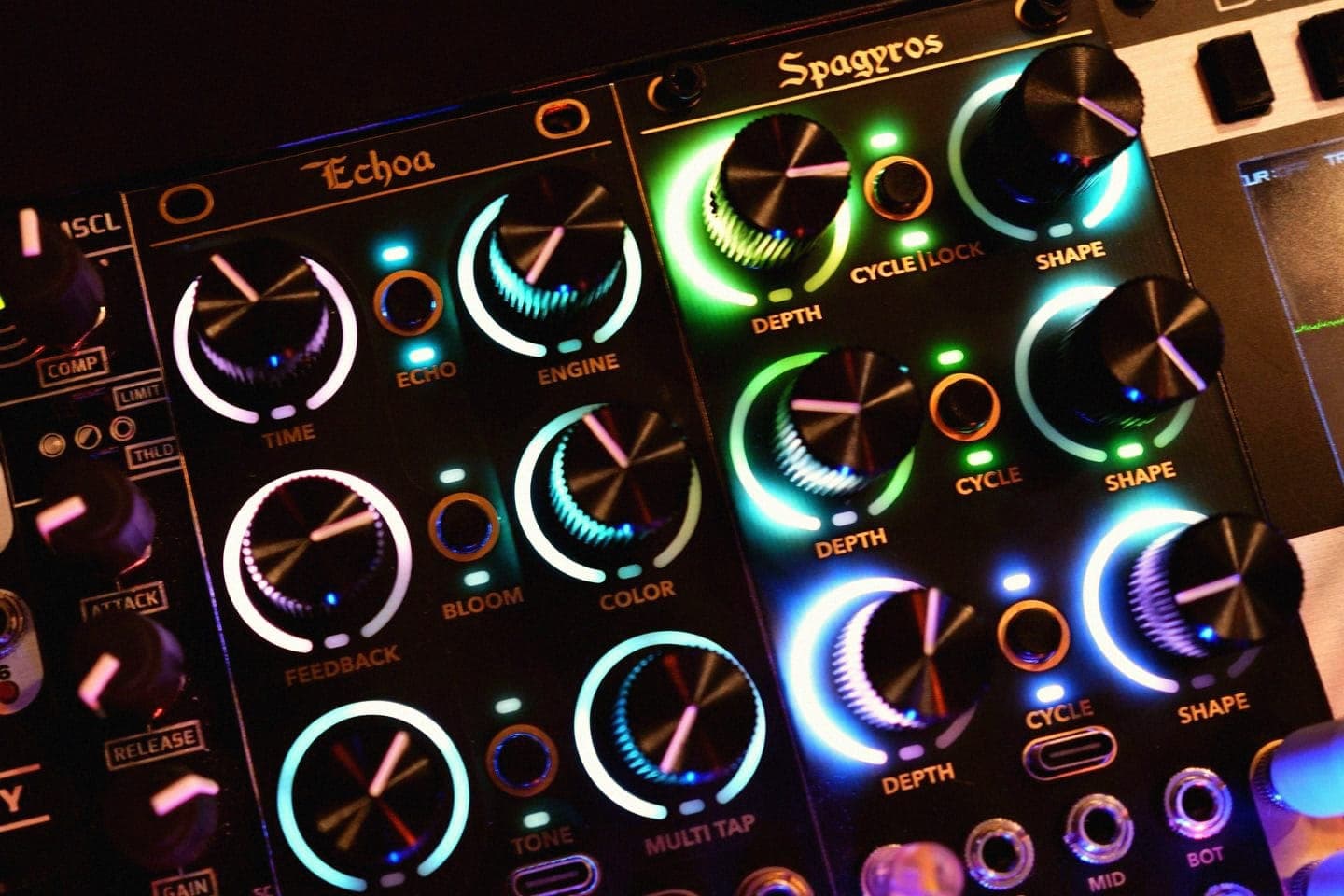
Alchemy Lab is the underlying hardware and firmware architecture, not a single module. The first release, Echoa, is a 12 HP stereo dual delay and reverb built on a 480 MHz STM32H750 processor with 64 MB of SDRAM and 16 MB of QSPI flash, enough headroom for up to 96 kHz/24-bit stereo processing. Echoa runs four delay lines, two per stereo channel, with delay times from 1 millisecond up to 16 seconds and up to four taps per line. Its reverb mode morphs from a straight digital delay into a four-stage Schroeder all-pass network, and users can route the two channels in series, parallel, isolation or spectral configurations. Four character engines, digital, BBD, tape and vinyl, layer in saturation, wow and flutter, glitches or crackle, and the module stores 16 full-parameter presets with per-destination CV mapping and parameter lock on every pot.
The second module, Spagyros, is built for the end of a performance chain: three effect slots in series, two pots per slot for depth and a main parameter, a 24 PPQN clock input and an internal clock defaulting to 120 BPM, aimed squarely at beat repeat, vinyl break and chopper-style live mangling.
Why does the open-source part matter?
Because it is not a marketing footnote. Per Hermetic Modular's own site, the firmware is genuinely field-programmable: owners can load alternate firmware onto the same hardware, including running Spagyros's effects on an Echoa unit or vice versa, or write entirely custom voices against the published SDK. That is a meaningfully different proposition from most Eurorack DSP modules, where the chip is locked to whatever the factory firmware does and modding means physically hacking the board.
Every hardware release includes an open firmware layer with a permissive MIT license and a powerful SDK that lowers the barrier from DSP to embedded programming.
For a modular scene that already prizes patchability and DIY culture, a manufacturer opening the firmware layer itself is the logical next step: the module becomes a platform other people can build on, not a fixed black box.
How serious is the build quality?
Hermetic Modular says its quality assurance process included burn-in testing of 36,700 LEDs across its modules, with a minimum five-hour test per board, a detail that signals a small team taking panel reliability seriously before shipping into a market that has seen its share of flaky RGB Eurorack gear. Both modules are listed as available now through dealers, per Matrix Synth's July 26 launch post.