Who started composing with tape instead of instruments?
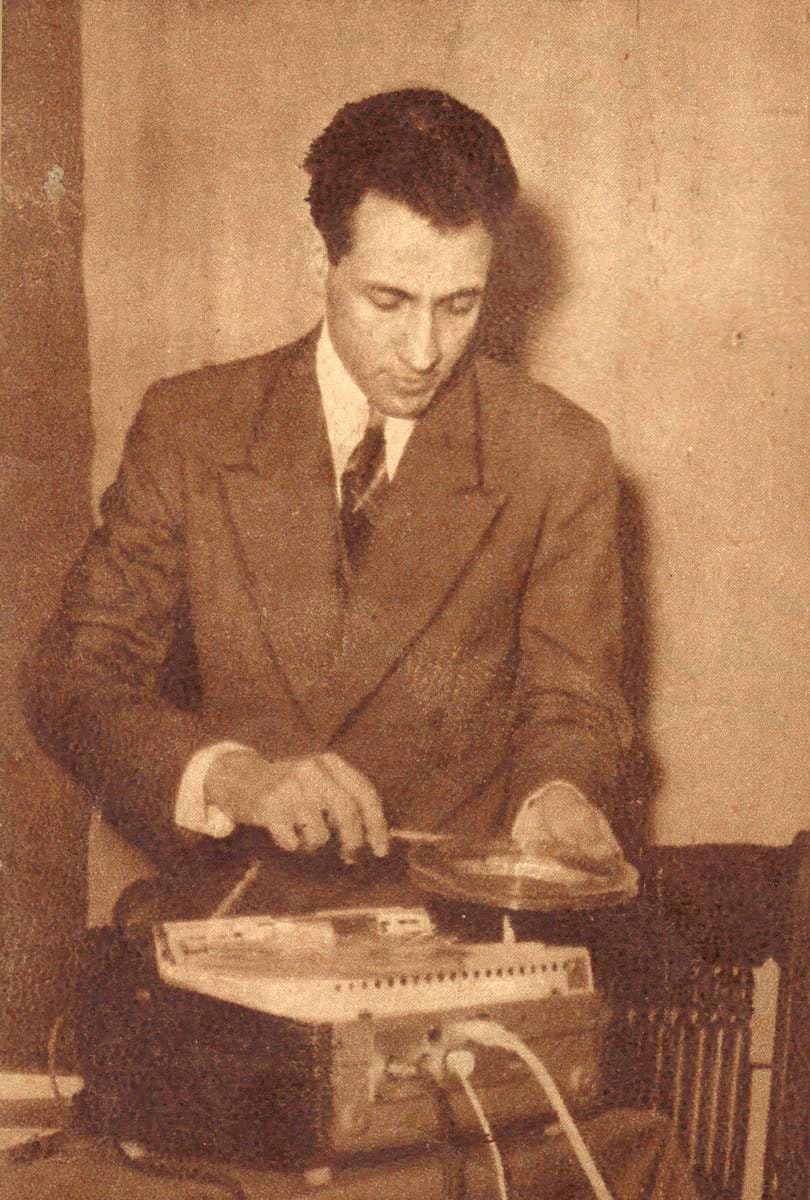
Pierre Schaeffer was an engineer, not a musician, on staff at French state radio, Radiodiffusion Française (RTF), when he decided a recording itself could be the raw material for a composition. In 1948 he took a microphone and a disc-cutting lathe to the Gare des Batignolles in Paris and recorded the trains. That recording became “Étude aux chemins de fer,” the first of his Cinq études de bruits (Five Noise Studies), assembled from trains, pianos, saucepans and boats. No instrument was played live: the sound was recorded first, then cut, looped and layered afterward. RTF broadcast the studies on 5 October 1948 as Concert de bruits, and Schaeffer named the method musique concrète, because he was starting from an already-recorded, concrete sound object rather than a blank score.
How did one radio studio raise a generation of French electronic musicians?
Schaeffer needed a composer's ear, and found one in Pierre Henry in 1949; together they built “Symphonie pour un homme seul” out of turntables, filters and a mixer, premiering it in Paris on 18 March 1950. In 1951, with engineer Jacques Poullin, Pierre Schaeffer and Henry founded the Groupe de Recherche de Musique Concrète (GRMC) inside RTF, the first studio of its kind anywhere; after disagreements pushed Henry to resign in 1958, it was rebuilt as the Groupe de Recherches Musicales (GRM), recruiting composers including Luc Ferrari, Iannis Xenakis and Bernard Parmegiani. That studio became a training ground: Jean-Michel Jarre studied under Schaeffer at the GRM between 1969 and 1971, then applied the same instinct, record it, cut it, loop it, at home, building his 1976 album Oxygène in a home studio and selling an estimated 18 million copies, the first time the studio-as-instrument idea reached a mass audience.
The Vinyl Factory called Schaeffer “the godfather of sampling” in 2016, noting he was cutting up recordings nearly fifty years before DJ Shadow's Endtroducing was celebrated as the first album built entirely from samples.
How did France go from avant-garde radio labs to a global dance export?
By the 1990s the lineage had split into two French scenes with real chart weight. In Manchester, a young Laurent Garnier discovered the Haçienda in 1987 and DJed there as house arrived from Chicago and techno from Detroit; back in Paris in the early 1990s he ran the Wake Up parties at the Rex Club and, with Eric Morand, founded the label F Communications, work that got him credited as a founding figure of French techno. At the same time, a Paris house scene was building filtered disco loops into a signature sound: Étienne de Crécy's Motorbass released the influential album Pansoul in 1996, and Daft Punk, formed in Paris in 1993 by Thomas Bangalter and Guy-Manuel de Homem-Christo, carried the same instinct onto their 1997 debut Homework. The scene already had a name: “French Touch,” coined in 1987 by photographer Jean-Claude Lagrèze for parties he threw at Le Palace, then popularized in 1996 when journalist Martin James reviewed de Crécy's album in Melody Maker, and widely used in the UK press by 1998. Stardust's 1998 single “Music Sounds Better With You” carried it onto charts worldwide.
Why does this 70-year arc matter for house and techno now?
Because it is one continuous chain, not three unrelated anecdotes: state radio funds a tape experiment in 1948, that experiment trains the composer who builds a home-studio pop album in 1976, and by the 1990s the same country is exporting both a techno-scene blueprint and a house-adjacent chart sound built on the identical instinct, record it, chop it, loop it, call it music. France's electronic music history is not a footnote to Chicago and Detroit; it runs in parallel, fully documented, from a train station platform to a duo selling out arenas in robot helmets.