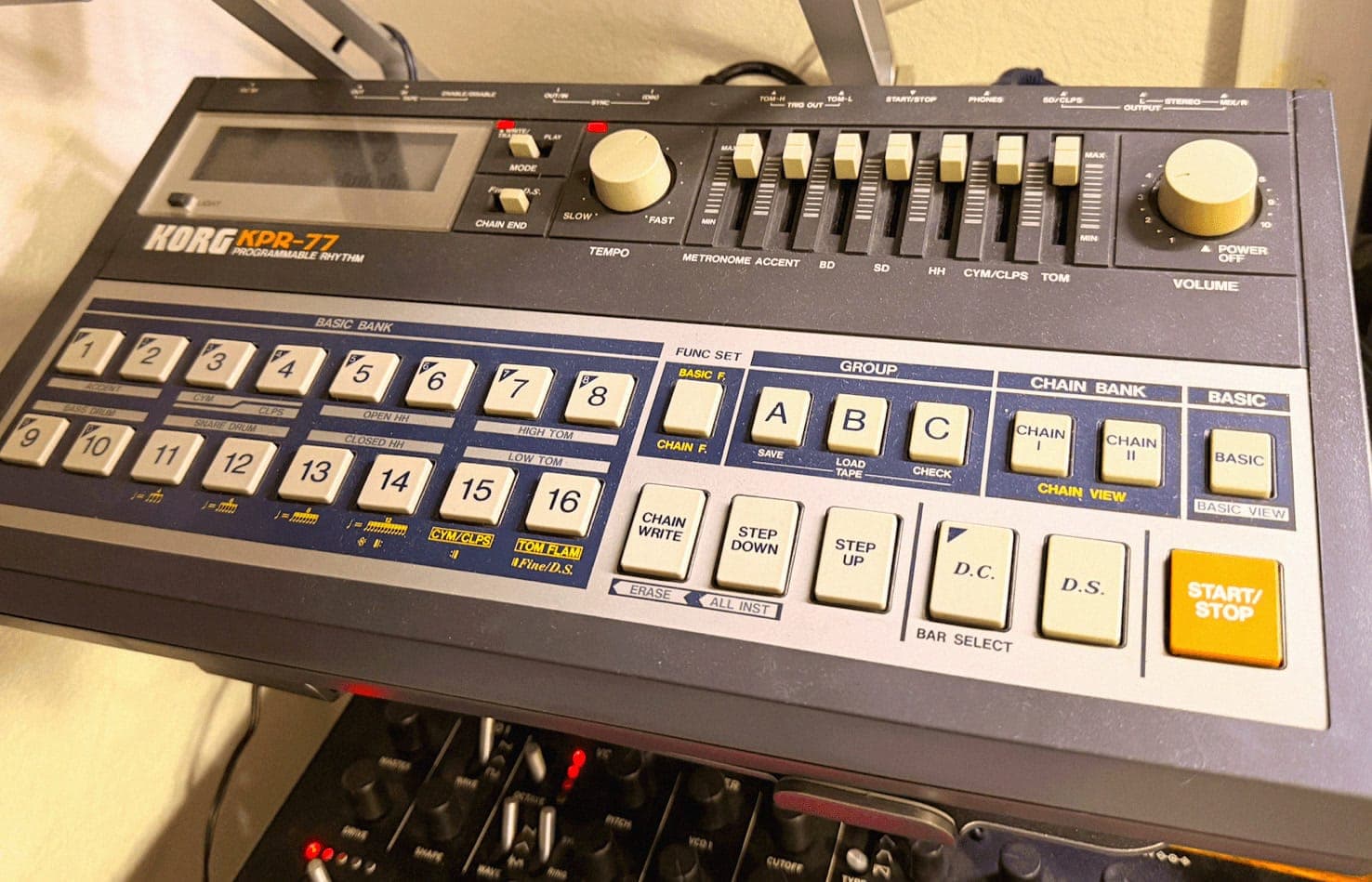
The Korg KPR-77 never got its due. Released in the early 1980s as Korg's answer to Roland's TR-606, it lost that fight decisively: the 606 became a budget-rhythm-box footnote that still gets sampled today, while the KPR-77 mostly vanished into secondhand bins. Forty-plus years later, a solo developer has gone back into that circuit board and rebuilt it from scratch.
Hügelton Instruments' new plugin, Kepra, isn't a sample pack dressed up as an emulation. According to Synth Anatomy, the team got there through circuit analysis, waveform measurement, timing analysis and spectral comparison against the original hardware, the same forensic process serious analog-modeling developers use when there's no schematic shortcut available. It's the kind of reverse-engineering effort usually reserved for gear with actual commercial legacy, spent instead on a machine most producers have never touched.
What's actually in the box?
Kepra ships with 12 drum voices: the KPR-77's original eight, plus mid toms, metronome and click that rounded out the hardware, and one new addition, a Shaker that never existed on the 1980s original. Per the product's itch.io page, six of the twelve instruments carry adjustable parameters, bass drum gets pitch, decay and slope, snare gets snap and decay, claps get tone and decay, toms get pitch, decay and slope, hihat gets ring and decay, cymbal gets ring and decay. Sequencing runs on a 16-step grid with NOTE, FLAM and ACC layers and eight pattern banks, alongside a stereo mixer and a drive and character section for pushing the signal past clean. It syncs to internal, host or external MIDI clock, so it drops into an existing studio setup rather than demanding to run standalone.
Why release a forgotten machine at all?
That's the interesting part. Kepra isn't chasing the TR-808 or TR-909 gold rush that's kept every plugin house busy for a decade. It's picking up a machine that lost, on the theory that losing commercially in 1982 says nothing about whether the circuit is worth hearing in 2026. For producers digging for analog character that hasn't already been sampled to death, that's precisely the appeal.
The KPR-77 lost the commercial race to the TR-606 more than forty years ago. Hügelton just gave it a second chance.
What does the dollar price signal?
Hügelton is launching Kepra at $1, a figure explicitly framed as introductory rather than a permanent price point. It's sold directly through the developer's own itch.io storefront rather than through a plugin marketplace, keeping the whole transaction between the developer and the buyer.