Instagram Is Turning DJs Into Content Creators. What Is It Doing to the Music?
There was a time when being a DJ meant spending an unhealthy amount of time finding music.
Being a producer meant disappearing into the studio for days trying to make something nobody had heard before.
Now there's another job attached to both:
Proving online that you're doing it.
Post consistently. Film the process. Document the studio session. Capture the crowd. Turn the tour into Stories. Turn the new track into ten pieces of content. Reply to comments. Feed the algorithm. Repeat.
And somewhere in the middle of all that, make the music.
A recent Reel making the rounds points to a strange trap social media has created for artists: instead of simply being an artist, you increasingly have to show yourself being one.
For DJs and producers, that distinction matters.
The Artist Has Become the Content
Social media didn't invent self-promotion.
DJs have always needed flyers, press photos, interviews, mixes, radio appearances and some kind of mythology around them.
What changed is the frequency.
Promotion used to happen around the work.
Now promotion can become part of the work itself.
A producer can spend eight hours trying to get a bassline exactly right and have absolutely nothing to post.
Another can spend twenty minutes filming themselves dramatically turning a knob in the studio and suddenly have a Reel.
Guess which one the algorithm can see?
That creates a subtle incentive: make creativity visible.
The problem is that some of the most important parts of creativity are painfully unphotogenic.
Listening isn't content.
Digging for records isn't always content.
Sitting with an unfinished idea for three weeks isn't content.
Changing one hi-hat 47 times definitely isn't content.
But jumping around the studio when the drop hits?
Perfect.
DJ Sets Are Becoming Film Sets
The same pressure exists inside the booth.
The moments that travel fastest online tend to be obvious ones.
The huge drop.
The recognizable edit.
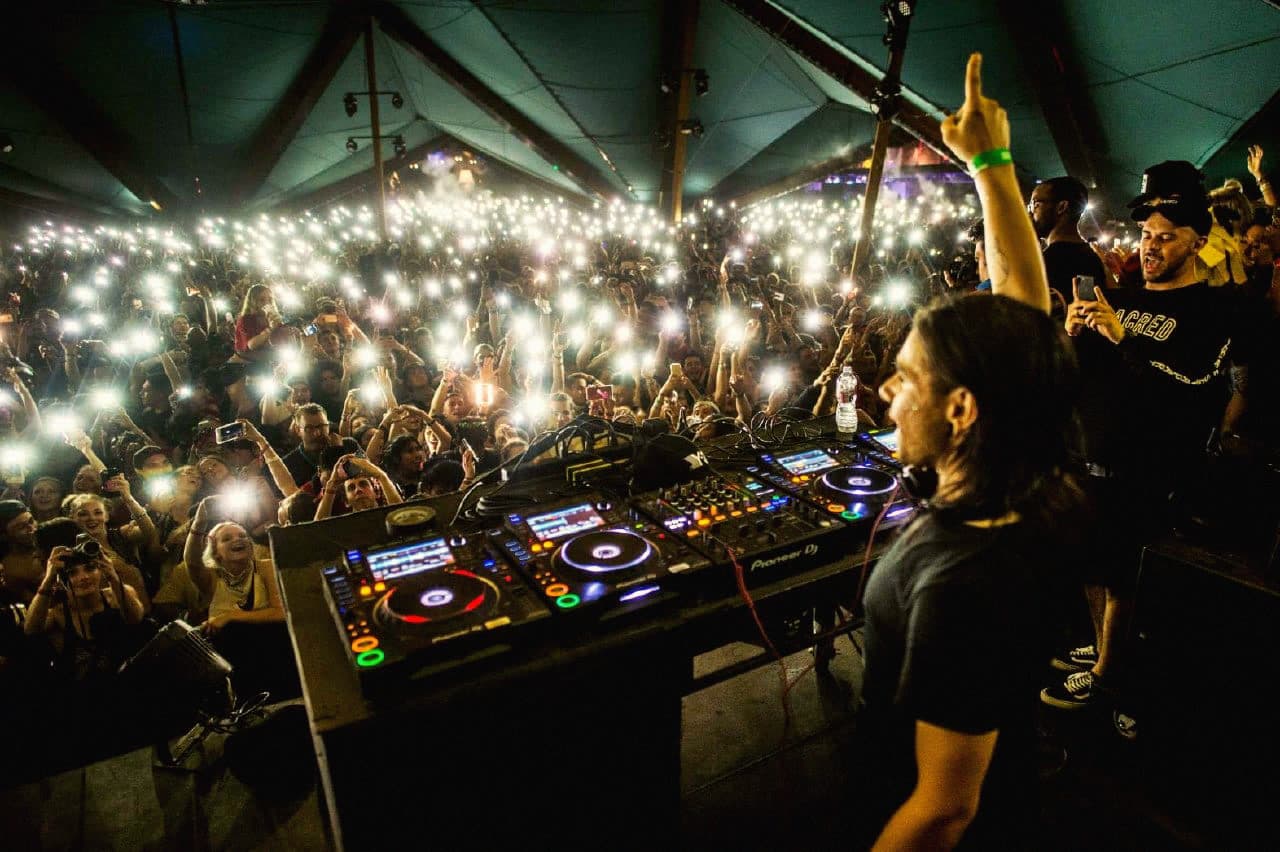
The screaming crowd.
The DJ standing on the mixer.
The confetti cannon.
The famous person dancing behind the decks.
A two-minute transition that slowly changes the temperature of a room is harder to communicate in a seven-second Reel.
That doesn't mean DJs are consciously choosing every record for Instagram.
But when short clips become one of the main ways an artist's career is marketed, it would be naive to pretend the camera has no influence at all.
The booth is no longer facing only the dancefloor.
It's also facing thousands, sometimes millions, of people who were never in the room.
And increasingly, the performance has to work for both.
Producers Now Have Two Outputs: Music and Content
The same thing is happening in studios.
Labels, managers, agents and marketing teams need content around releases because attention matters.
That part makes sense.
There is more music being released than any listener could possibly process, and without visibility even brilliant records can disappear almost instantly.
But somewhere along the way, musicians started being expected to become full-time media companies too.
Make the track.
Finish the mix.
Create the artwork.
Shoot a teaser.
Explain how you made it.
Film yourself reacting to it.
Post a studio breakdown.
Tell the story behind the song.
Make three versions of the hook.
Ask followers which drop they prefer.
Reply to comments.
Then do it again tomorrow because apparently the algorithm has already forgotten who you are.
At some point, the obvious question is:
How much creative energy is left for the actual music?
The Irony Is That Social Media Also Saved Independent Artists
This isn't an argument for DJs disappearing from Instagram.
That would be equally unrealistic.
Social media has broken down enormous barriers.
A producer can make something in a bedroom, upload it, send it directly to DJs and potentially have people playing it across the world without needing a magazine editor, major label or powerful gatekeeper to decide whether the public is allowed to hear it.
Artists can build audiences directly.
They can sell tickets directly.
They can release music independently.
They can create communities without asking permission.
That is genuinely powerful.
The problem begins when the tool used to distribute the art starts shaping the art itself.
When producers start asking:
"Will this work on TikTok?"
before asking:
"Is this actually good?"
When DJs start thinking about which moment will make the best Reel rather than where the dancefloor needs to go next.
When being visible starts feeling more important than becoming better.
The Algorithm Rewards Different Things Than Art Does
Social media rewards immediacy.
Art often requires patience.
Social media rewards frequency.
Creativity sometimes requires disappearing.
Social media rewards recognition.
Great music sometimes works because it initially feels unfamiliar.
Social media asks:
What can you show us today?
Art occasionally needs the freedom to answer:
Nothing yet. I'm still working on it.
That tension probably isn't going away.
So perhaps the answer isn't rejecting social media.
Maybe the answer is learning where the artist's job ends.
Maybe Artists Need to Stop Doing Everything Themselves
Visibility is crucial now.
Pretending otherwise won't help artists either.
A brilliant record can disappear if nobody knows it exists.
A great DJ can play incredible sets every weekend and still struggle to grow beyond the people physically standing in front of them.
But visibility doesn't mean the artist has to personally manage every part of it.
Filming a DJ set can be incredibly simple.
An iPhone.
A camera stick safely attached to the booth.
Press record.
You don't necessarily need a production crew following you around documenting every second of your life.
The real work starts afterwards.
Finding the moments.
Cutting the clips.
Adding subtitles.
Creating designs.
Writing captions.
Posting consistently.
Understanding what works on each platform.
Answering comments.
Replying to messages.
Maintaining a presence between releases and shows.
That takes time.
And once an artist reaches the point where they can actually live from their art, hiring someone to handle social media might eventually become as normal, and as important to the career, as hiring someone to do the taxes.
Not because every DJ needs a giant marketing team.
But because doing everything yourself has a cost.
Every hour spent cutting a Reel is an hour not spent producing.
Every afternoon designing Instagram slides is an afternoon not spent digging for music.
Every night answering comments could be time spent sleeping, living, meeting people, having experiences or simply giving your brain enough space to come up with something new.
And that cost becomes even higher when social media is something you don't enjoy or simply aren't very good at.
The Best Social Media Person Should Protect the Artist
The role shouldn't be to manufacture a personality.
It shouldn't be to turn every producer into an influencer.
And it definitely shouldn't be to force artists into trends that have nothing to do with who they are.
A good social media person should almost do the opposite.
Capture what is already there.
Recognize the moments worth sharing.
Translate the artist's world into formats people can discover online.
Create short clips.
Build simple graphics.
Post consistently.
Answer comments.
Understand the platforms.
And most importantly, protect the artist's time.
The DJ plays.
The producer produces.
Someone else can help turn those moments into content.
Because there is an important difference between documenting creativity and interrupting it.
Social media should amplify the work.
It shouldn't become the work.
Visibility is part of an artist's career now.
There is no point pretending otherwise.
But there also comes a point where doing absolutely everything yourself stops being resourceful and starts becoming expensive.
Not financially.
Creatively.
And if the whole point of building an audience is to give an artist more freedom to make music, then the smartest move might eventually be learning to give some of that work away.
Because the answer probably isn't escaping the algorithm.
It's making sure the algorithm never becomes more important than the reason people followed you in the first place.
The music.