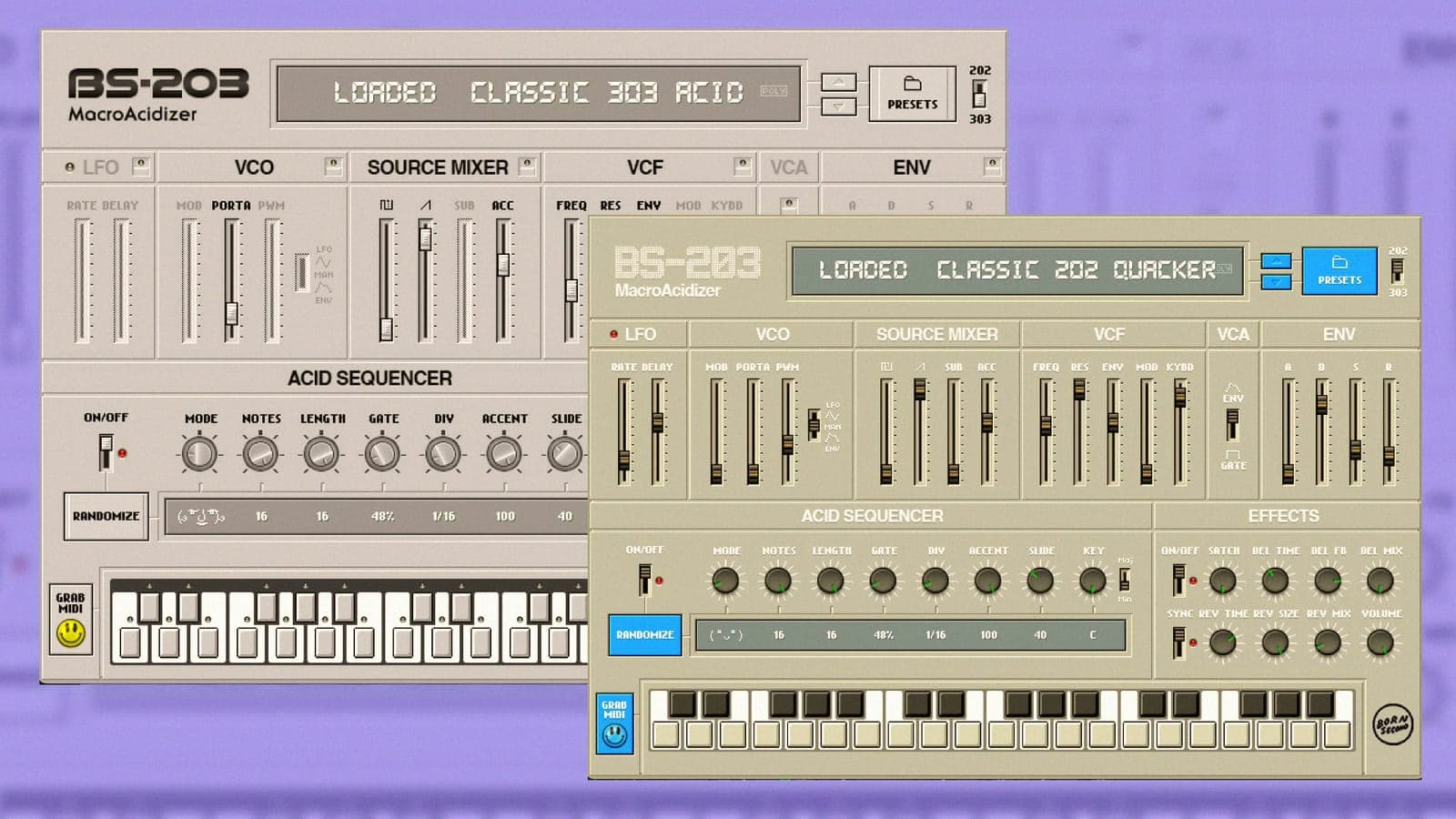
Acid never left house and techno, but the gear that made it has mostly stayed vintage, cloned or emulated in software. Michigan Synth Works just put a fresh analog take on the format on the convention floor at Knobcon 2026, and it goes straight after the one thing every 303 clone still argues about: the sequencer.
What's actually new here?
The MSW-820S is a two-oscillator analog monosynth built on the same architecture as the company's existing MSW-820, which itself traces back through the MSW-830's analog section to the 1983 Roland CMU-10. Both VCOs offer switchable saw and pulse waveforms, a 4' to 16' range, tune and two-mode sync, plus pulse-width modulation you can drive manually, from the LFO or from the mod envelope.
The filter is the part synth nerds will recognize instantly: 16 selectable modes running through the 3109 OTA chip, the same chip at the heart of the Roland SH-101, MC-202 and Jupiter-8. That gives the MSW-820S access to low-pass, high-pass, band-pass, notch and even phase (allpass) responses at multiple slopes, not just the single 24dB ladder most acid boxes are built around.
Why does the sequencer matter more than the filter?
Because it is the part that actually makes something a "303-style" instrument. Per Synth Anatomy's reporting, the MSW-820S runs Michigan Synth Works' own open-source SuperOS-303 firmware, the same 303-pattern engine underneath the company's dedicated sequencer line. That means the classic ingredients (step-based pitch and gate programming, two-level accent, adjustable portamento, slide behavior) come bundled with things the original 1982 TB-303 never had: pattern randomization, scale-locking so a jammed-out pattern stays in key, nudge functions, playback direction and triplet options, and modern undo, redo and state-reset controls edited live from a hands-on interface or a web editor.
The filter borrows a 40-year-old Roland chip. The sequencer borrows a 44-year-old Roland idea and adds the undo button acid house never had.
The existing MSW-820 (no onboard sequencer) already ships at $549 for the desktop version or $499 in Eurorack format through Michigan Synth Works' own site. Pricing and a ship date for the MSW-820S itself are still to be announced.
Why it matters
303-derived acid lines are still load-bearing in house and techno right now, from deep-tech rollers to full-on acid-techno sets, and most of that sound still comes from either a genuine vintage 303, a boutique clone, or software. A new hardware sequencer built around that exact workflow, but with scale-locking and undo, lowers the barrier to programming acid lines live without losing the analog voltage-controlled sound underneath them.
What we think
The smart move here isn't the filter, it's shipping the 303 sequencer as open-source firmware across a whole product line instead of one flagship box. Undo and scale-locking sound like small conveniences until you've lost a great pattern to a fat-fingered step edit at 3am; building those into an acid sequencer, rather than treating faithfulness to 1982 as the whole point, is the right call for producers who actually perform this stuff.