What is flock synthesis, exactly?
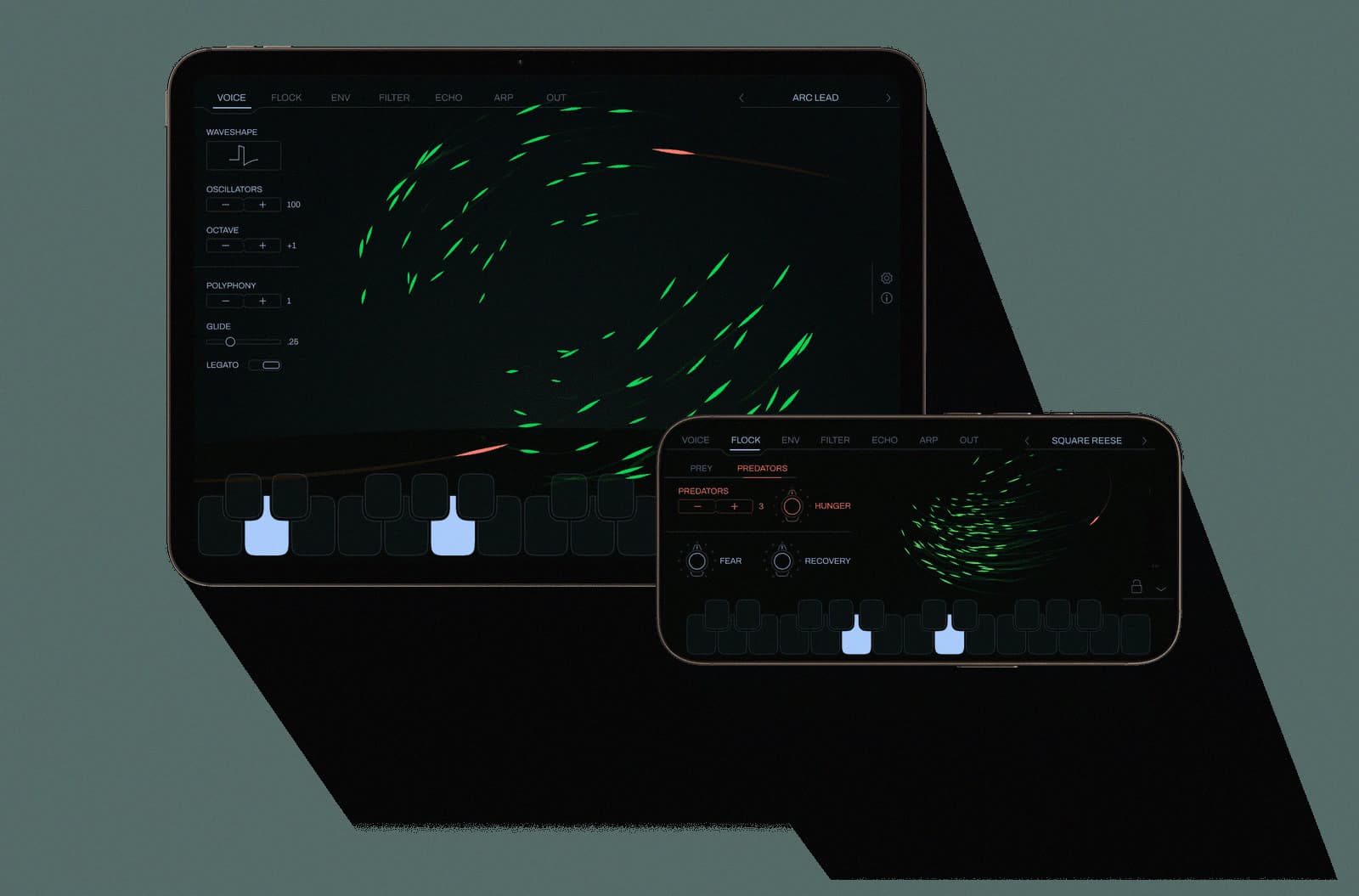
Most synths build a sound by running oscillators through filters and envelopes. Taika Systems' Photophore 2 does something stranger: it simulates a flock of 100 individual oscillators drifting through a virtual 3D habitat, the way a swarm of insects or a school of fish moves through open space. Instead of a filter cutoff or an LFO rate, the main controls are cohesion, avoidance, speed and turbulence, the same variables that govern whether a real flock holds together or scatters.
“As they drift, they naturally detune and spread across the stereo field, creating rich timbres that are perfect for massive basses, complex pads and swarming leads.”
That is how Taika Systems itself describes the engine. The drift is the whole instrument. Pull the flock tight and it reads as a thick unison pad; loosen cohesion and push turbulence up, and it splits into the kind of chaotic, swarming texture that gave the original app its name.
Why did it take 12 years for a sequel?
The original Photophore launched standalone on iPad in December 2014 at $4.99, and the reaction was split. Some reviewers called the concept and the touch interface genuinely novel for the tablet format; others argued the actual output amounted to little more than unison detuning, with a few comparing the demo sounds to generic EDM voices rather than anything new. Taika Systems never pulled the app, but it sat without a major update for over a decade, a stretch in which AUv3 became the standard way iOS producers load third-party instruments straight into Logic Pro, GarageBand and AUM instead of juggling standalone apps.
What's actually new in Photophore 2?
Photophore 2 ships as a full AUv3 Audio Unit, so it now loads inside Logic Pro for iPad, GarageBand, AUM, Loopy Pro and Cubasis, and it finally runs on iPhone as well as iPad. The headline addition is a predator system: set a predator loose on the flock, tune its hunger and the flock's fear response, and let that hunt destabilize tuning and stereo spread in real time instead of programming an LFO by hand. Taika Systems also widened the stereo field, added a tape-style stereo delay, synced the arpeggiator to host tempo, and rebuilt the interface. Sound designer Bop, known as Alexander Dmitriev, built 30 new factory presets, and presets from the original Photophore import directly. Photophore 2 costs $7.99 through November 30, 2026, rising to $14.99 after, and needs iOS 15 and an A12 chip or newer.