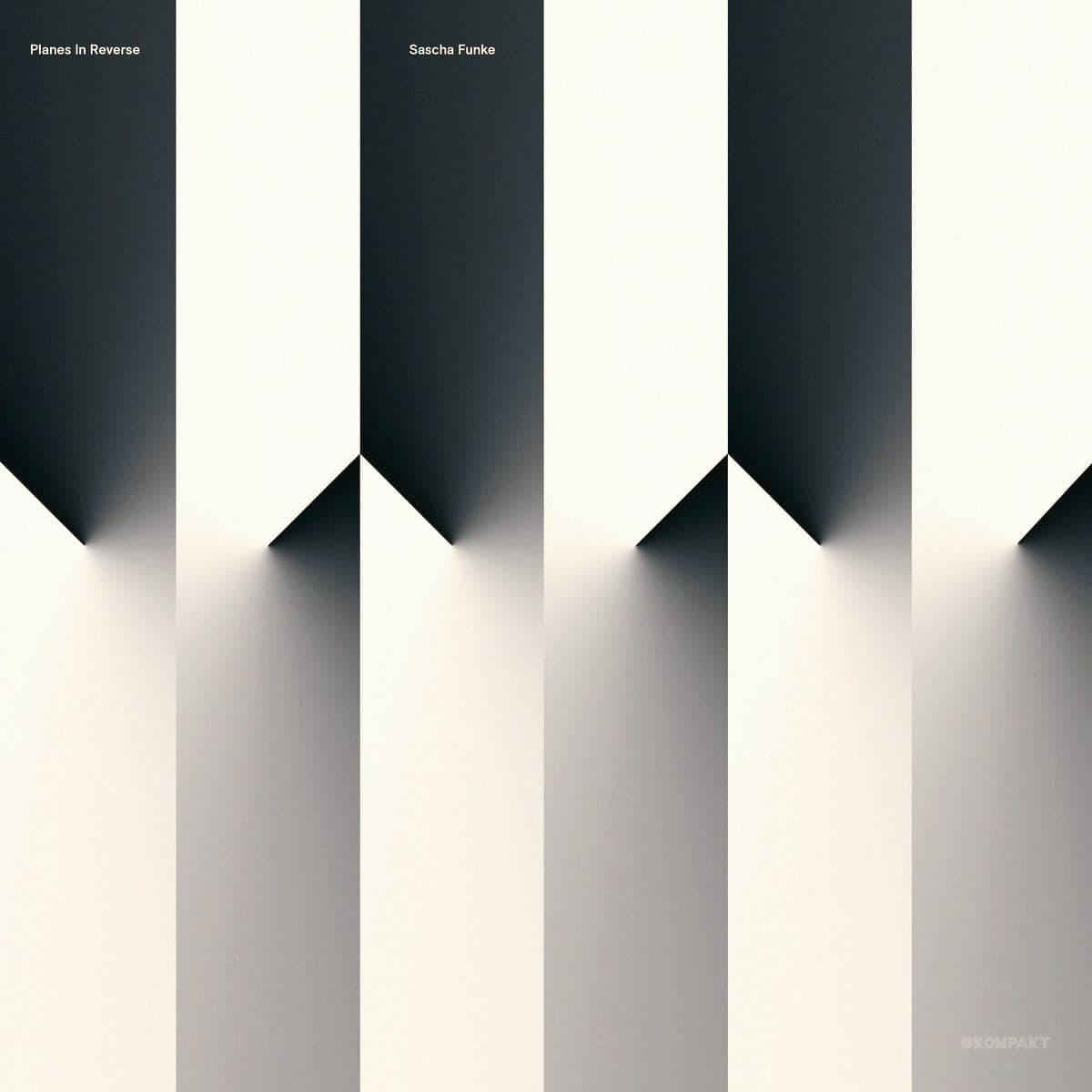
Sascha Funke doesn't need an introduction to anyone who was in a Berlin club between 1999 and 2005, but his album output has gone quiet. "Planes in Reverse" landed on Kompakt on November 6, his first full-length since 2017's "Lotos Land" on Endless Flight, and his first solo album back on the Cologne label that shaped his sound in the first place.
Why did it take Sascha Funke nine years to make another album?
By his own account it didn't take nine years, it took two months. "Last winter, I had two or three new tracks," Funke said of the sessions. "It was very fast and direct." Those first sketches snowballed into a ten-track record built around field recordings and structured synth arrangements, recorded over the following winter weeks rather than stretched across a slow-burn studio process. The gap on the calendar is real, but the record itself reads like a sprint, not a decade of tinkering.
"Last winter, I had two or three new tracks. It was very fast and direct."
Julienne Dessagne of Fantastic Twins appears across multiple tracks, which isn't a cold feature credit. She and Funke recorded together as Saschienne, whose 2012 Kompakt album "Unknown" folded pop songwriting into techno's repetition. "Planes in Reverse" picks that creative thread back up rather than starting cold.
What does an album that stays under 130 BPM actually sound like in 2026?
"Planes in Reverse" moves between techno, house, minimalism and disco house across its ten tracks, "What You See," "Flags" and "Karat" among them, without a single cut crossing 130 BPM. That's a deliberate choice in a year when club tempos keep drifting up: peak-time techno sets routinely sit at 140-plus now, a shift that's reshaped everything from CDJ pitch ranges to how promoters bill their headline slots. Funke's record doesn't argue the point, it just ignores it, leaning on groove and melodic detail instead of velocity to hold a dancefloor.
Why does Kompakt still matter to this record?
Kompakt is the Cologne label that effectively invented the melodic, microhouse-adjacent strain of minimal techno Funke came up playing in the late 1990s Berlin scene, run by Michael Mayer and Wolfgang Voigt among others. Funke built his early catalog in that orbit; his return there isn't a label signing a hot new name, it's an institution reabsorbing one of the people who helped define what it stands for. For a genre whose current center of gravity keeps sliding toward faster, harder club tracks, Kompakt putting out a sub-130 BPM record from one of its own old guard is a quiet statement about what the label still thinks minimal techno is for.
Why it matters
Kompakt backing a deliberately slow, melodic record right now is a signal to the rest of the minimal and deep-tech scene that the tempo race isn't the only lane worth funding, and that the label which built this sound still has the authority to say so.
What we think
The interesting thing here isn't that Funke made a good record, it's that Kompakt chose this moment to put it out. Minimal techno's commercial center has been drifting toward 138-142 BPM peak-time tools for a couple of years now, and Kompakt itself has leaned into some of that on its 12-inch output. Putting Funke's sub-130 BPM, field-recording-laced album on the main imprint reads like a deliberate counterweight from the label that can actually afford to make that statement without looking out of touch.
FAQ
Content handled via structured faq field below, not here.