What pushed the Musicians' Union over the edge?
January 1982: Barry Manilow arrives in the UK not with a full orchestra, but with synthesizers programmed to replicate orchestral sounds. For the Musicians' Union, this is the breaking point. Session players are being replaced not by cheaper musicians, but by machines.
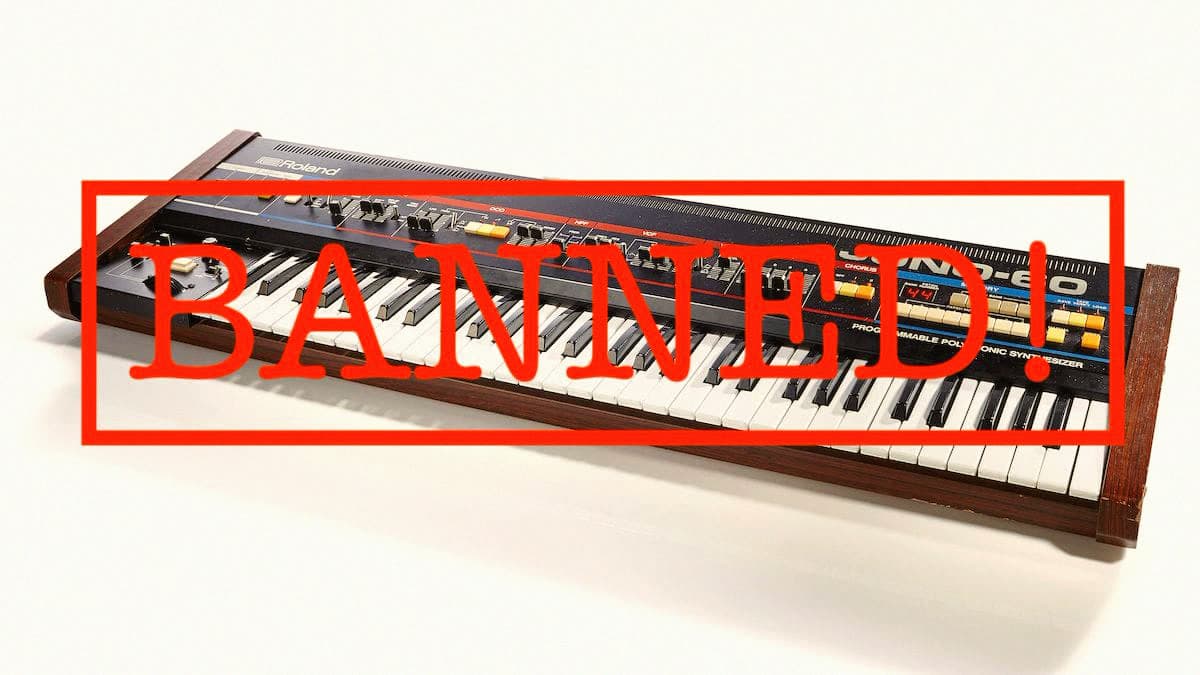
On 23 May 1982, the Central London Branch passes a formal motion to ban synthesizers, drum machines, and "any electronic devices capable of recreating the sounds of conventional musical instruments." The union's concern is immediate and practical: West End pit orchestras, session work, live touring, all of it threatened by a generation of programmable instruments. Synth players are effectively barred from MU membership. A rival organisation, the Union of Sound Synthesists, forms in response.
The union is not entirely wrong about the disruption. These machines will reshape the labour market for musicians. But it is spectacularly wrong about what they will create.
What were those machines actually doing?
While the MU is passing its ban, across the Atlantic a different kind of music is being made. In Chicago, a generation of young Black producers has found something in these same machines that the union could not have anticipated: liberation.
Frankie Knuckles, resident at The Warehouse since 1977, opens The Power Plant in 1983 and starts weaving drum machines into his sets. Derrick May, then a young Detroit producer who would go on to define techno, sells Knuckles a Roland TR-909. "This is going to take us to the future," May tells him. "It'll be the foundation of music for the next ten years." Knuckles plays it under every record that night.
In January 1984, Jesse Saunders releases "On and On" built on a Roland TR-808, co-produced with Vince Lawrence. It is widely regarded as the first house track committed to record.
Larry Heard is even more precise about his tools. "I used a Roland JUNO-60 and a TR-909 drum machine," he later recalled. "That's all the gear used on 'Can You Feel It'." He recorded it with two cassette decks, one pass, one take. The result is one of the most enduring pieces of music ever made.
Did the ban do anything?
In practical terms: almost nothing. The machines kept selling. The music kept spreading. The MU's motion applied to a single local branch and was never adopted as national union policy. But the hostility to synth technology persisted in the union's structures for years; synth players remained outside MU membership until 1997.
By that point, house music was a global industry. The Roland TR-808 and TR-909, which Roland had discontinued by 1984 after poor commercial reception, had been picked up secondhand for almost nothing by the producers who mattered. The MU was trying to ban instruments that were not even selling. Chicago turned those supposed failures into a genre.
Why does this keep happening?
The 1982 vote is a useful mirror for today. The AI music debate, the question of whether a model can replace a session player, a composer, a vocalist, is structurally identical to the drum machine panic of four decades ago. Institutions reach for bans when they cannot control the technology. Sometimes the concern is legitimate; the labour displacement is real. But the music itself tends to land somewhere no one predicted.
In 1982, the machines the union wanted to ban were already building something extraordinary in Chicago. The MU was not looking at Chicago. The question now is what the current argument is missing.