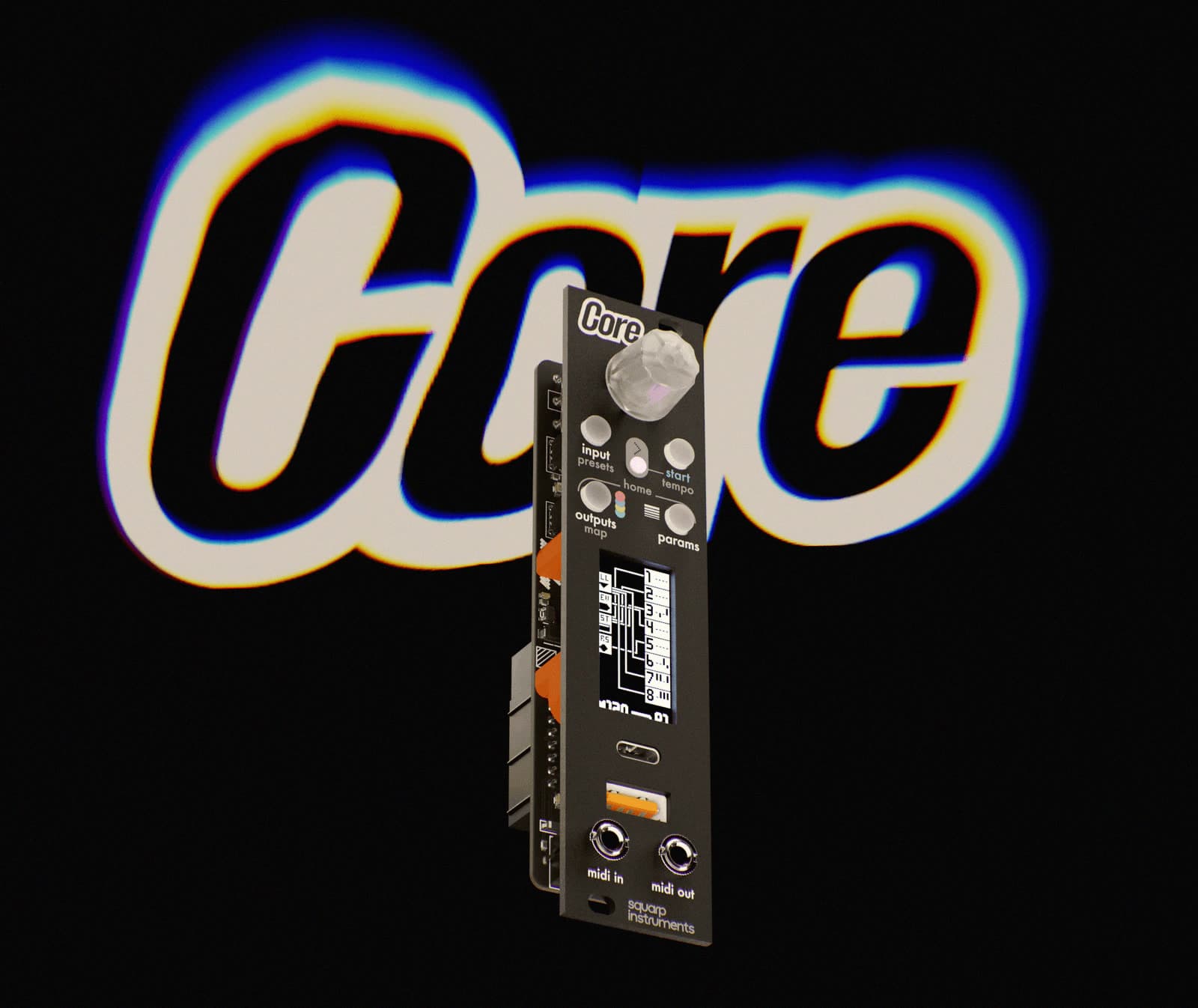
Squarp Instruments has spent years building sequencers that modular heads actually trust: the Squarp Instruments Pyramid, Hapax and Hermod all made their name as pattern-based brains for a rack. Core, released in early October 2026, is a different kind of product. It is not a sequencer. It is the plumbing that lets everything else in a rig talk to each other, and Squarp built it deliberately short on its own outputs.
Why would you buy a module with no CV jacks?
Core is a 6HP MIDI-to-CV/gate interface that, on its own, has nowhere to send a converted signal. It needs an XP32 expander to actually output anything: one XP32 unlocks 32 CV outputs (8 tracks times 4 outputs each), and a second XP32 pushes that to 64. Squarp prices the pieces separately on purpose: Core alone is 190 euros, the Core-plus-one-XP32 bundle is 590 euros against a regular combined price of 680 euros. You buy exactly as much output as your rack needs, and Core's job is entirely upstream of that decision: it is the brain deciding what gets converted and how, not the hardware doing the converting.
That split solves a real bottleneck for anyone running a mixed MIDI and CV rig. Most interfaces assume one source talks to one destination. Core merges USB Host, USB Device and TRS mini MIDI in/out at the same time, so a laptop running a DAW, a standalone hardware sequencer and a MIDI keyboard can all be plugged in and playing into the same rack simultaneously, no switching cables, no choosing a master. For a touring or studio setup where the DAW handles automation while a hardware sequencer and a keyboard both want control over the same voices, that merge is the actual feature, not the conversion itself.
"We set out to build a small utility in two months. Two years later we have a machine that plays on its own. It still isn't a sequencer."
That quote from Squarp co-founder Benoit Desaissement, reported by Sonicstate, gets at what Core actually became. Beyond the basic MIDI-to-CV/gate/velocity/aftertouch/CC duties, it carries generative engines: LFOs, Euclidean gate generators, an arpeggiator, AHDSR envelopes, DC offset and logic operations, plus melodic loops that mutate over time on their own. None of that needs a connected computer. Eight global presets store entire routing configurations, so a performer can recall a full patch of engines and mappings mid-set.
Does the size actually matter here?
At 25mm deep and 6HP wide, Core is built to disappear into a compact skiff case, the kind of travel rig a working modular musician actually carries to a gig rather than the kind built to look impressive in a studio photo. Packing an OLED display and 14 engines into that footprint is the harder engineering problem than the CV conversion itself, and it is the detail that separates a module meant for a desk from one meant for a bag.
Why it matters
Sqaurp is the first company this generation of modular hardware watched build its reputation entirely on sequencing, and Core is its admission that the real friction in a modular rig is often connectivity, not pattern generation. A dedicated, expandable MIDI brain that merges every input source at once addresses a problem every hybrid studio has quietly worked around with MIDI splitters and manual re-patching.
What we think
The decision to strip CV outputs out of the base unit and sell them as a separate expander is the smartest part of this release: it stops Squarp from forcing a fixed I/O count on every buyer, and it means the 190-euro entry price is honest rather than a loss-leader for a bundle nobody can avoid. Two years in development for something this focused also tells you Squarp is playing a longer game than shipping incremental sequencer updates.