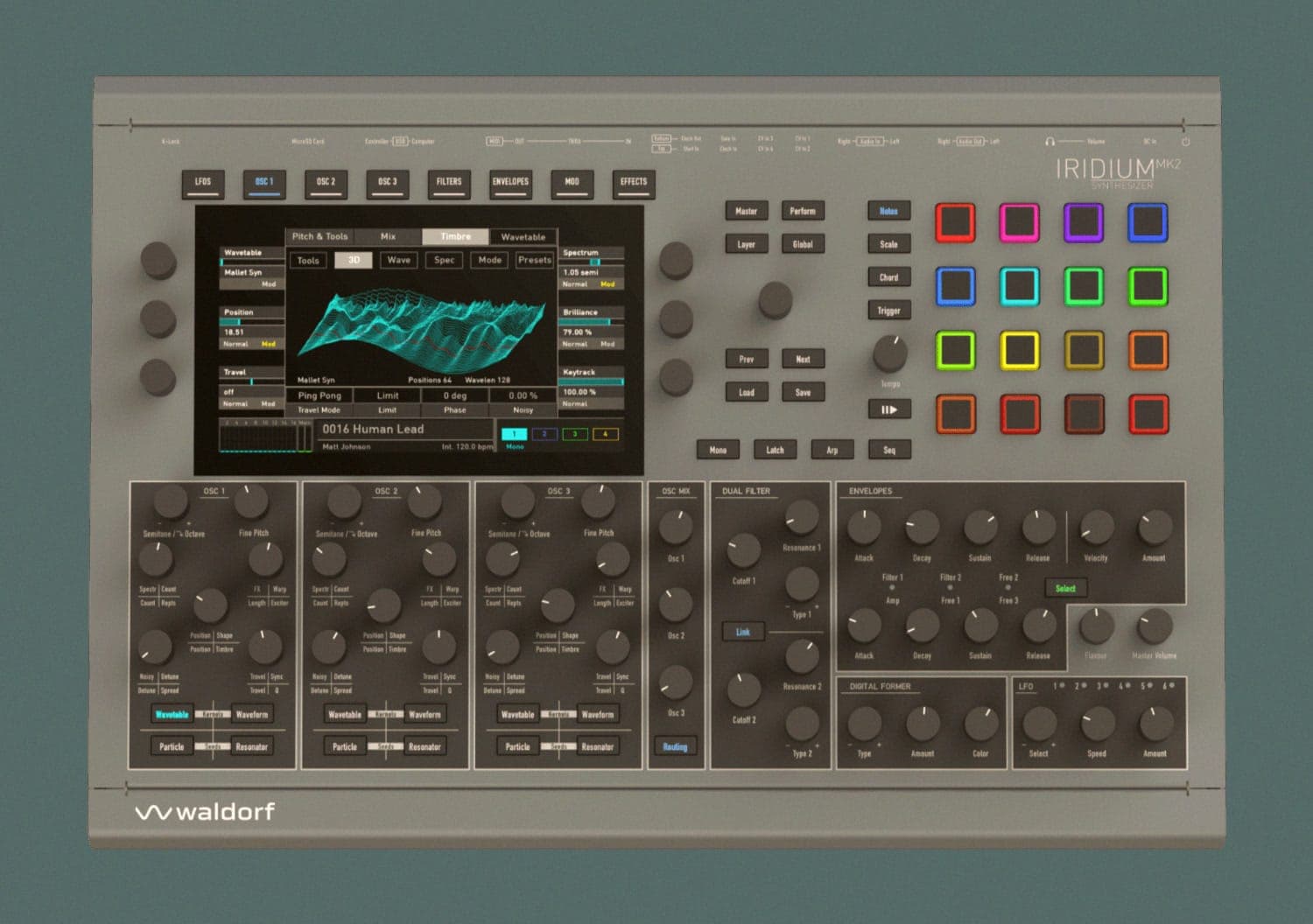
Most synths still work on one basic promise: hit the same key twice, get the same sound twice. Aphex Twin apparently found that boring enough to help fix it. Waldorf's new Iridium MK II desktop synth ships with a feature called Per-Note-Parameter-Locks, built as a direct result of working with the producer, who has used the original Iridium desktop for years.
The mechanic is simple to describe and deep to use: each of the synth's 128 playable notes can hold up to 16 individually locked parameter variations. Hold a note, turn a knob, and that specific value gets saved to that specific key, at that specific slot. Play the same note again and you can land on a totally different combination of filter cutoff, effect send or even oscillator synthesis mode, all tied to a single key on the keyboard.
Why does a parameter lock per note actually matter?
Because it attacks a convention almost every synth shares: pitch and timbre are locked together. A real player's touch varies a performance without changing the notes, through velocity, timing, phrasing. Most synthesizers can fake velocity-sensitive timbre, but they can't give a single key a genuinely different identity from one hit to the next. Per-Note-Parameter-Locks does that on purpose. A four-bar loop hitting the same note repeatedly can cycle through 16 distinct textures without a single extra MIDI event or automation lane, which is exactly the kind of controlled unpredictability that has defined Aphex Twin's own production style for three decades.
Per-Note-Parameter-Locks lets a single key sound different every time it's struck, without touching the note itself.
The rest of the MK II upgrade is built around the same idea of breaking static repetition. Seeds, a new sixth synthesis engine, generates live waveforms on the fly instead of scanning a fixed wavetable, so the raw material itself shifts rather than just the processing on top of it. A new Flavour knob adds controlled micro-variation in timing, timbre and pitch across notes, tuning how far the instrument strays from a perfectly identical repeat. Under the hood, the MK II doubles the original's multitimbral capacity to four synthesis layers running at once, on top of the existing FM, additive, granular and SoundFont-import engines.
What does it cost, and can existing owners get it?
The Iridium MK II desktop unit is priced at 2,369 euros. Waldorf isn't leaving MK I owners behind: a CPU board upgrade, priced at 598 euros, brings the new engine and the Per-Note-Parameter-Locks system to existing Iridium hardware, including the desktop, keyboard and Core versions.