Most quantizers in a Eurorack case do one job: snap a wandering voltage to the nearest note of a 12-tone scale. Xaoc Devices built Skopje to do something a lot of modular musicians have wanted for years and rarely gotten in a 6HP footprint: quantize to ANY scale, including scales that don't exist in 12-tone equal temperament at all.
What does Skopje actually let you do?
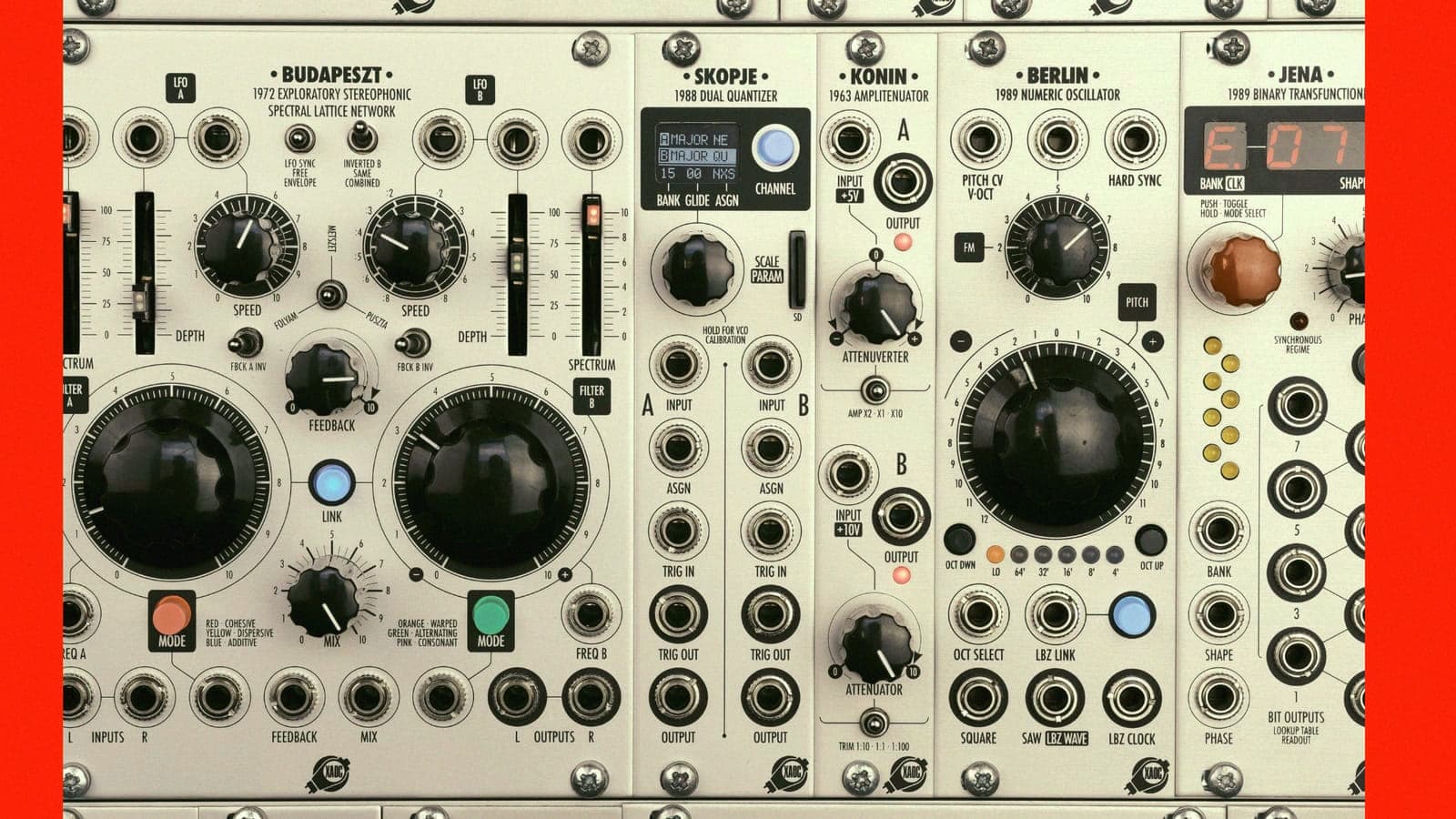
Skopje reads SCALA files, the open scale-description format microtonal composers have used for decades to define just intonation, historical temperaments, and made-up tuning systems of their own. Load a .scl file (or a plain text scale) off a microSD card and Skopje will quantize incoming CV to it, two independent channels at a time, each with its own input and output. With room for 100 banks of 100 scales, a single card can hold a working library covering everything from Indonesian gamelan tunings to 31-tone equal temperament, switchable live via trigger or CV.
The module leans on high-precision A/D and D/A conversion and an OLED display so scale selection happens without menu diving, plus glide, CV-triggered scale switching, unquantized transposition for vibrato, and a calibration mode for VCOs that don't track cleanly. None of that is new in isolated form. What's new is having all of it, including full SCALA support, in a compact dual-channel module at 319 euros.
Skopje treats microtonality as a preset, not a project. That's the actual shift.
What is Budapeszt built to do?
Budapeszt is a different kind of tool: a stereo dual spectral processor built around two independently tunable comb-type filters, run across six operating modes, with cross-coupled feedback paths between the two channels and a feedback-phase-inversion switch on each filter. A comb filter works by summing a signal with a delayed copy of itself, which reinforces some frequencies and cancels others in a comb-shaped pattern, and stacking two of them with switchable feedback is how you get anything from metallic ringing and physical-modeling-style resonance to flanging and chorus, depending on the mode and the delay times you dial in.
A stereo LFO (free-running or synced) and an envelope follower let that filtering move on its own or react to whatever's being fed into it, so the effect can breathe with a sequence rather than sit static. It's less an effects pedal than a resonant instrument in its own right, the kind of module generative and drone patches get built around rather than dropped on at the end of a chain.
Why should deep-tech and minimal producers care?
Neither module is aimed at a four-on-the-floor session, and Xaoc isn't pretending otherwise. But the deep-tech, minimal and organic-house corners of the scene lean hard on modular gear for texture, and both of these solve a real friction point in that workflow. Skopje removes the usual excuse for staying in 12-tone (loading a microtonal scale used to mean patching workarounds or hunting for a rare quantizer); Budapeszt gives a spectral, resonant character to a patch without reaching for a laptop plugin. For producers building generative or semi-improvised sets around a modular rig, that's two fewer reasons to leave the case.
Where do they fit in Xaoc's catalogue?
Both releases extend a line Xaoc has built specifically around experimental, generative and microtonal composition rather than conventional subtractive synthesis, the niche the Warsaw manufacturer has quietly owned in Eurorack for years. Skopje is shipping now through Thomann and Perfect Circuit; Budapeszt rounds out the pair as the spectral-processing half of the same release.