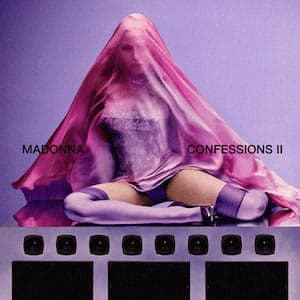
What does Confessions II actually sound like?
Twenty-one years after Confessions on a Dance Floor ran on disco-house and an ABBA sample, Madonna switched genres for the sequel. Confessions II swaps that palette for Detroit techno and Chicago house structures: four-to-the-floor patterns, stripped drum programming, minimal breakdowns. NME's Nick Levine called it a record "structured like a DJ set with no breaks between tracks," 63 minutes sequenced as one continuous mix rather than 16 separate singles. Crack Magazine went track by track and heard acid-techno on "Everything," tekfunk on "Danceteria," subterranean techno on "School." None of that vocabulary showed up in reviews of the 2005 original.
The album was built almost entirely in Stuart Price's London studio. Price has been making house and electroclash records under the alias Jacques Lu Cont since 1996, was Madonna's musical director on the 2001 Drowned World Tour, and co-produced Confessions on a Dance Floor. He is not a pop producer borrowing a sound for one album cycle. He has been inside this music for three decades.
Did Madonna earn this palette, or is she borrowing prestige?
That is the argument the reviews are actually having, underneath the star ratings. Writing in Martin Cid Magazine on July 3, critic Molly Se-kyung argued the album's "structural debt to Black electronic music, Detroit techno, Chicago house, is foundational, not merely stylistic," and framed the wave of five-star reviews as critics "not only having a change of heart about Madonna" but "having a change of heart about itself," settling an old debt alongside the new album.
"The music press is not only having a change of heart about Madonna. It is having a change of heart about itself." (Molly Se-kyung, Martin Cid Magazine)
The counter-argument comes from inside the industry, not from a critic. Producer Linda Perry dismissed the album, telling interviewers Madonna is "following the trends" and trying to "compete with Charli XCX and this and that" instead of setting her own direction. Se-kyung's rebuttal is that this misreads what Madonna actually does: less an originator than "a genre synthesizer with an unmatched ability to make synthesis feel necessary." Both readings can be true at once, and that is precisely why the album works as a story, not just as a stream count.
Why does the chart math matter here?
Confessions II opened at number one on the UK Official Albums Chart's midweek update on July 6, with 37,106 chart-equivalent units, most of it physical sales, making it Madonna's 13th UK number-one album. In the US, tracking services had it "with the edge" for a Billboard 200 number-one debut off roughly 101,000 first-week units, which would be her tenth chart-topper there. None of that commercial performance depends on whether critics settle the credit question. It depends on Price's production holding up as house and techno records, not pop records wearing a house coat, in rooms that have nothing to do with Madonna's fan base.